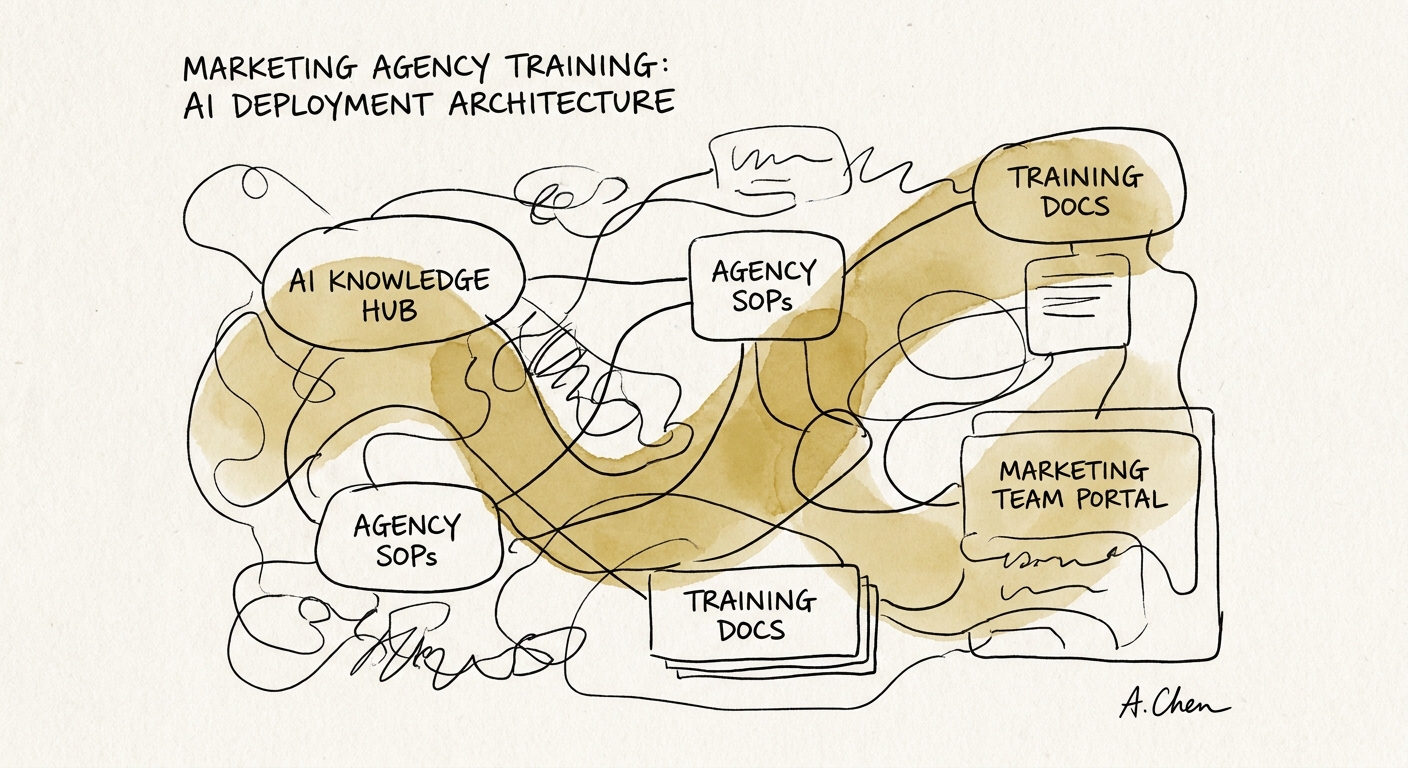
The problem isn't missing documents. It's the fourth Slack ping this week.
Picture a 60-person agency on a Tuesday. A new account coordinator needs to run her first SaaS client kickoff. The playbook exists — somewhere. There's a Google Doc from 2024, a Notion page a senior strategist started and abandoned, and a slide deck that was "the final version" until the agency reworked its discovery process last fall. So she does what everyone does: she pings the one senior AE who knows, and that AE — who should be on a renewal call — becomes the firm's human help desk again.
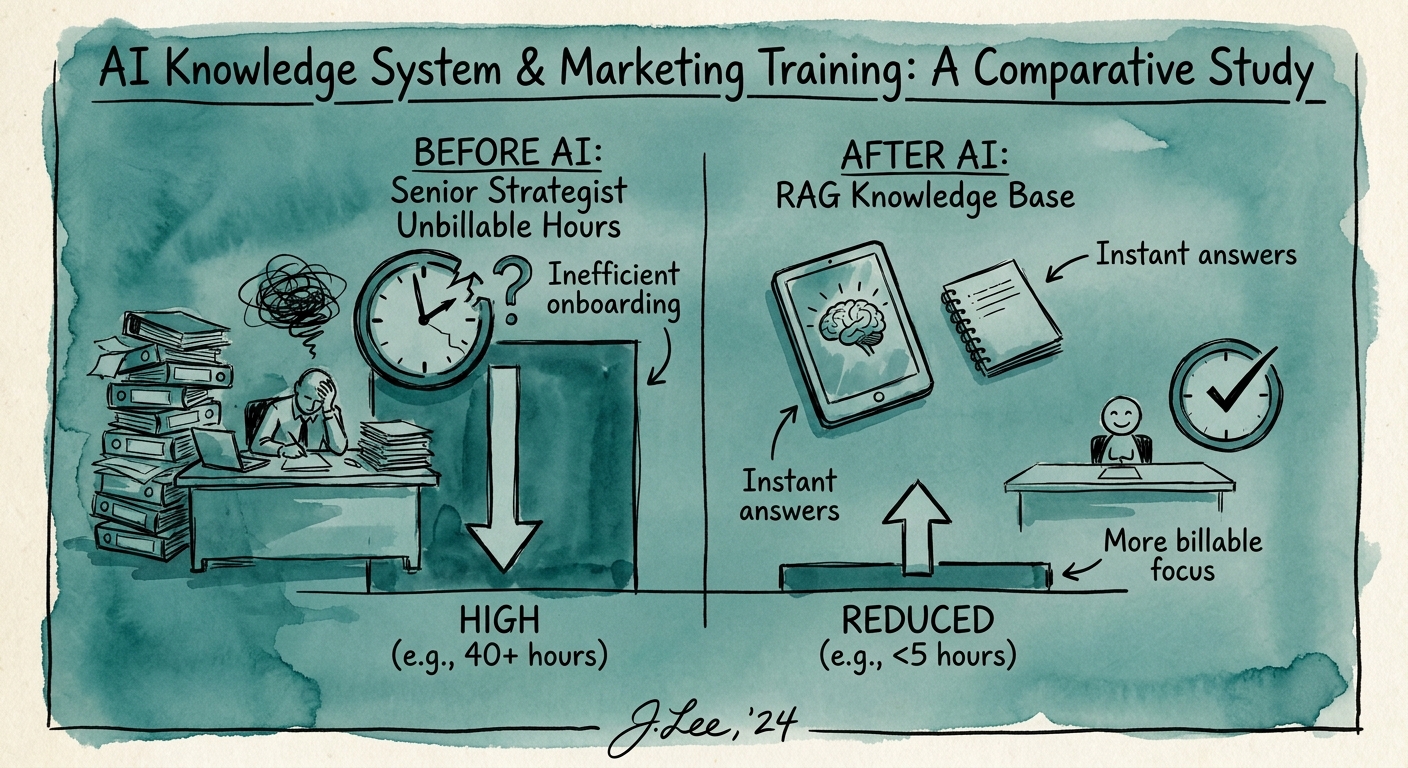
Agencies almost never have a document shortage. They have a retrieval and trust problem. The approved answer exists, but nobody can find the current, sanctioned version fast enough to use it before a kickoff, a scope conversation, or a creative review. And the cost is specific to your business model: agencies live and die on utilization. Every minute a senior person spends re-explaining the onboarding sequence, the brand-voice rules for a regulated client, or how the agency handles out-of-scope requests is a minute not billed and not sold.
This is why agency size matters here. The U.S. Census Bureau reported in May 2026 that AI adoption climbs sharply with headcount — 32% of firms with 100 to 249 employees and 37% of firms with at least 250 employees. A 12-person shop keeps its playbook in two people's heads and that mostly works. By the time an agency crosses 40 or 50 people, that knowledge has scattered across drives, channels, and departed employees — big enough to have real operating knowledge, not yet disciplined enough to make it findable.
Why a chatbot pointed at your shared drive makes it worse, not better
The tempting move is to bolt an AI assistant onto your existing file store and call it done. For an agency, that's the fast path to a confident, wrong answer — the assistant cheerfully surfaces the 2024 kickoff template, or worse, pulls a confidential client's pricing structure into an answer meant for a junior coordinator. A useful AI knowledge system is not a search box over a messy drive. It's a governed retrieval layer over one valuable, bounded knowledge domain. Start with training and delivery documentation — your onboarding sequences, client-type playbooks, brand and voice standards, scope and escalation rules.
The unglamorous work comes first: source cleanup. Kill the obsolete versions outright, because in an agency a stale "final" doc is more dangerous than no doc. Separate the genuinely reusable operating knowledge from material that's client-confidential or restricted to a specific team — your training library should not be a side door into a regulated client's account. And name an owner for the answer library before launch, not after. CISA's AI data security guidance stresses protecting the data used to train and operate AI systems; in a 50-to-300-person agency that translates to concrete tasks — access control by team, source approval, query logging, and a named person who owns exceptions.
Tag each document the way an agency actually thinks: by client type, function area, owner, last-approved date, permission group, and confidence level. Then run the system on the discipline of the NIST AI Risk Management Framework — map the workflow, measure answer reliability and data risk, govern ownership, manage change over time. The assistant answers only from approved material, cites the source it pulled, says "I don't have an approved answer for that" when it doesn't, and routes the gap to a named human. This belongs in your stack as a real AI knowledge and RAG system, not an unowned experiment someone spun up in a free trial.
What to do Monday: write the twenty questions first
Before you evaluate a single tool, write down the twenty questions your team actually asks about training and delivery — the ones that hit the senior AE's DMs every week. "How do we run a first kickoff for a healthcare client?" "What's the approved voice for this retainer client?" "When does a request become out-of-scope and who flags it?" For each one, identify the single approved source. Then test whether a candidate system retrieves the right source — and, just as important, whether it keeps restricted client material out of an answer it shouldn't appear in. That test set is your acceptance criteria; it's also the clearest demo you can put in front of skeptical partners.
The reason to insist on a production owner from day one: most pilots never make the leap. Deloitte's 2026 enterprise research found only 25% of leaders had moved 40% or more of their AI pilots into production. A knowledge system with a demo sponsor and no production owner becomes another abandoned Notion page — the exact problem you set out to solve.
Once retrieval is stable, measure the things that matter to an agency P&L: adoption, senior-staff interruptions avoided, answer quality, and how fast a new hire can run a kickoff without a lifeline. Push vendors on privacy, retention, and data-use terms — verify your client-data boundaries, don't assume them. The mechanics of standing up that first assistant are in our internal knowledge assistant guide, and when you're ready to turn one working system into a broader plan, the AI Transformation Blueprint maps where it goes next.