
The practical answer
- Short answer
- Your highest-paid ML hire has a PhD and can't deploy a model past a Jupyter notebook. Here's how to screen B2B SaaS engineering talent for production, not theory.
- Best fit
- Industry: B2B SaaS & Technology. Function: Talent Acquisition & Engineering
- Operating path
- Team & Hiring → Operational Excellence → Transaction Execution Services
- Key metric
- 105 Days average time-to-fill for senior ML roles, stalling product roadmaps.
Nine months, $285,000, and not one model in production
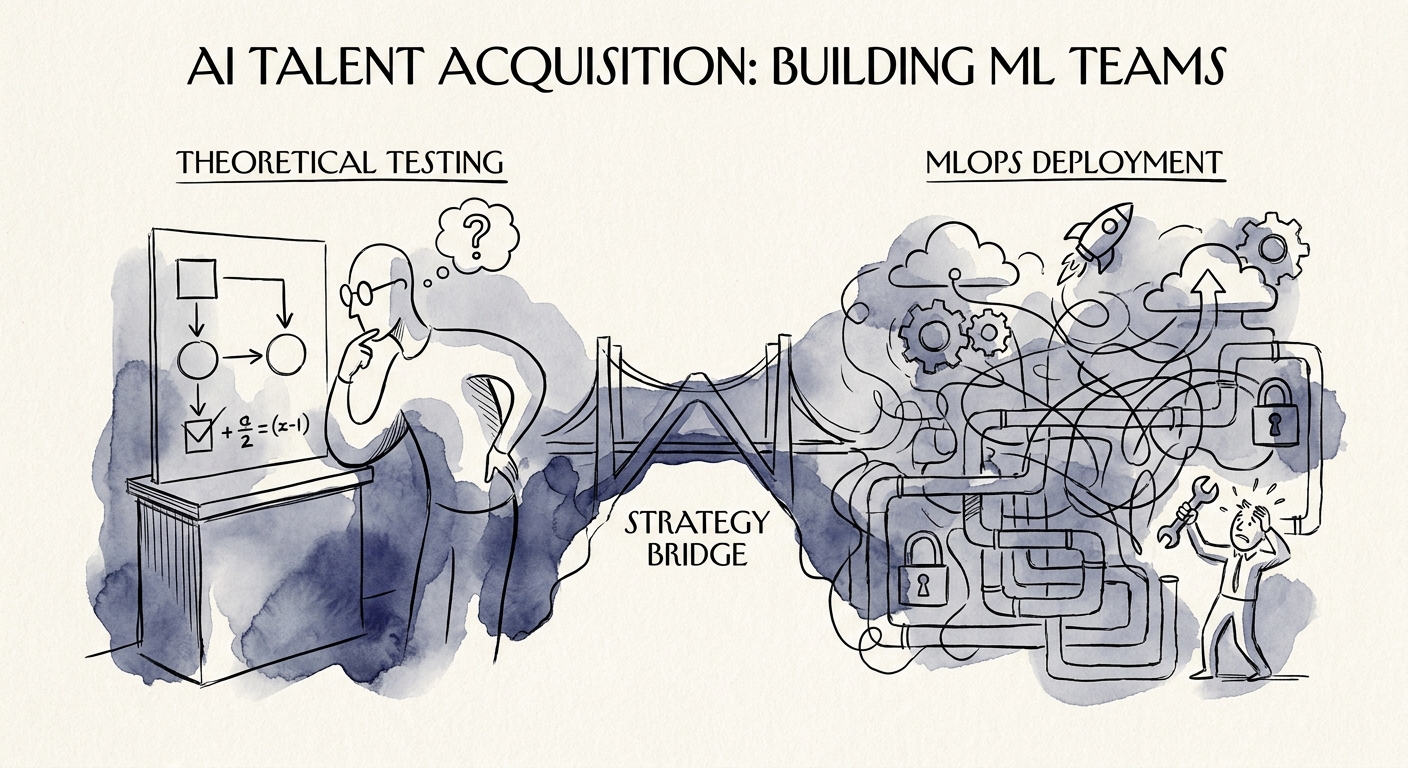
Here is where it usually breaks. A founder-CEO at a Series C B2B SaaS company pulls up the model the team has been building for two quarters, wants to demo it to a customer, and the answer comes back: "It runs great in the notebook." Not in staging. Not behind an API. Not anywhere a paying customer can touch it. The engineer who built it has a strong academic pedigree, a top Kaggle finish, and a compensation package that assumed all of that would translate into shipped product. It didn't.
I call this the notebook engineer trap, and it is the most expensive hiring mistake I see in the mid-market right now. On one engagement auditing the ML org of a generative-AI scale-up, I found a multi-million-dollar engineering payroll concentrated in people who had genuinely never pushed a model outside a local environment. They could explain the math behind a transformer in exquisite detail. None of them could keep one alive under real traffic. The roadmap had quietly stalled for months while everyone assumed the smart people were close.
The data says this is structural, not bad luck. Stanford HAI's 2024 AI Index Report documents how the field has matured from research into deployment-heavy engineering, and McKinsey's 2024 State of AI Report finds that the teams actually capturing value from AI attribute it overwhelmingly to operational discipline — data pipelines, MLOps, and infrastructure — rather than novel algorithm work. Building the model stopped being the hard part. Keeping it running, fed with clean data, and cheap enough to serve is the hard part. If your job descriptions still read like a graduate admissions checklist, you are not screening for the problem you actually have. We unpack the same failure mode in our piece on the $250k "notebook engineer" trap inside partner ecosystems.
Stop asking candidates to derive backpropagation on a whiteboard. Ask them what happens when a malformed payload hits their endpoint at 3 a.m. and nobody's awake. The second question tells you whether they've ever actually run a model in production.
A 90-minute interview that tells you everything a whiteboard won't
The standard ML interview — whiteboard the architecture, derive the gradient, name the activation functions — reliably surfaces people who are excellent at the part of the job that no longer matters most. It tells you almost nothing about whether someone can operate. So replace it with a session that mirrors a bad Tuesday on the team.
Hand the candidate a pre-trained model, a deliberately dirty dataset, a latency budget, and a deployment pipeline that's already broken in one specific way. Ask them to get a prediction out the door behind a working endpoint inside the time box. Watch what they reach for. The tell isn't whether they finish — it's the instinct. Does the candidate start spinning up the newest, heaviest LLM framework for a problem a gradient-boosted model would have solved at a tenth of the compute? Or do they ask what the business actually needs the output to do before they touch any code? Then break it on purpose: a corrupted JSON payload starts hitting the inference endpoint at 10,000 requests a minute. An engineer who's lived in production has a reflex here — input validation, a fallback, a circuit breaker, an alert. An engineer who's lived in a notebook stares at a stack trace. That single moment separates the two populations more cleanly than any take-home assignment.
This matters because the clock is your enemy. Gartner's 2025 Tech Talent Compensation Benchmark puts time-to-fill for senior ML roles at roughly 105 days — a full fiscal quarter of an empty seat while a roadmap waits. You cannot afford to burn that quarter hunting for the rare unicorn who clears forty theoretical boxes. Bain & Company's 2025 Technology Report reinforces where the leverage actually sits: the organizations scaling AI successfully are leaning on cloud-native deployment competence, not bespoke architecture invention. Hire for engineering rigor and operational pragmatism first; the candidate who can ship a boring model that makes money beats the one who can invent an elegant one that never leaves staging. Our diagnostic on the technical interview that predicts 90-day performance walks through how to score this without devolving into gut feel.
You can't out-cash Google. Stop trying.
The second mistake compounds the first: a mid-market SaaS company tries to win the hire on base salary and ends up matching a compensation band it can't sustain. The Bureau of Labor Statistics' Data Scientist Occupational Outlook tracks just how fast wages in this category have climbed. Chase that number with cash and you can quietly torch your gross margin and your runway before your first AI feature reaches general availability — all to land an engineer who, per the section above, you haven't even verified can ship. You will not win a base-pay bidding war against the hyperscalers. So don't enter one.
Compete on the two things you can actually offer that they often can't: speed and ownership. Architect equity that refreshes against deployment milestones and gross-margin gains the engineer's own models generate, so their upside tracks the company's enterprise value instead of a flat number on an offer letter. Then protect the thing that actually retains this profile — velocity. The fastest way to lose a strong ML hire is to land them and then bury them in six months of governance committees and review cycles before they ship a single thing. Top operators stay where their code reaches production quickly and they can see it move a real metric. Take that away and your retention problem becomes a recruiting problem all over again.
So here's the Monday version. First, rewrite one open ML req this week to lead with deployment, data engineering, and MLOps — and cut the line that demands a graduate degree. Second, build the 90-minute production simulation above and make it the screen that actually gates the offer. Third, set an honest early checkpoint: by roughly day 60, a new hire should have shipped something real — a model update, a pipeline, a latency win in staging — and if they haven't, find out why before month nine instead of after. The cost of getting this wrong isn't just the salary; it's the recruiting fees, the idle compute, and the roadmap quarter you never get back, as we lay out in our breakdown of the true cost of a bad tech hire. You're building an engineering organization, not a research lab. Measure people by what reaches customers.