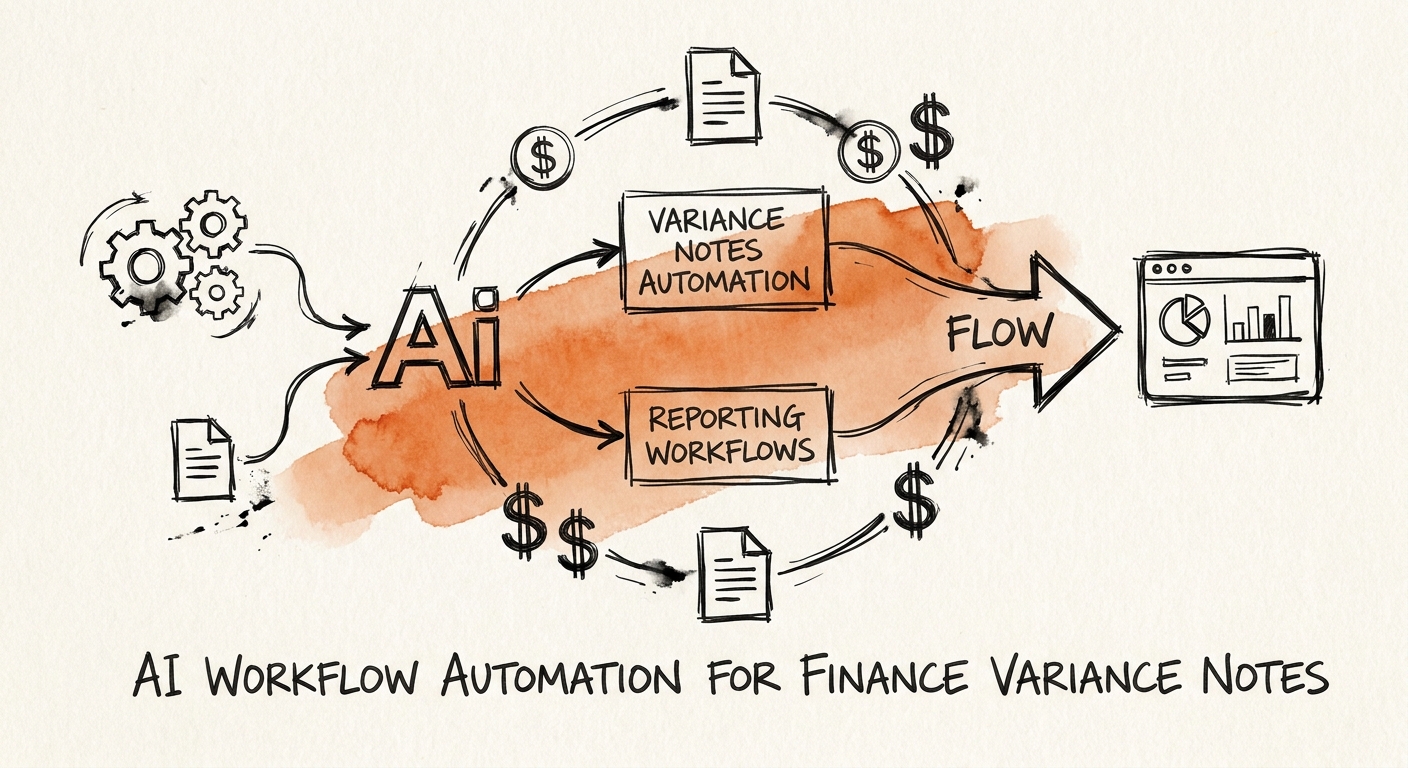
Day six of close, and the controller is still typing "due to timing"
Picture a 90-person B2B services firm closing the month. The numbers tied out on day four. But the board deck doesn't ship until someone explains why services margin came in 380 basis points under plan, why a hosting line jumped 22%, and why bookings landed soft in two regions. So the controller spends the back half of close doing the same archaeology every month: pulling the GL detail, chasing the regional GM for context, re-reading last month's commentary, and writing two paragraphs per material line that mostly say "timing" and "phasing" because there wasn't time to dig further.
That last part is the real cost. Not the hours, the hand-waving. Variance notes are a near-perfect candidate for AI drafting precisely because the inputs are bounded and repeatable: actuals, budget, prior-period commentary, the driver detail behind each line, and the business owner's emailed explanation. A model can assemble those into a clean first draft of "revenue was $214K under plan, driven by two enterprise renewals slipping from March into Q2" faster than a human can open the variance report. Both IBM's Institute for Business Value AI capabilities research and McKinsey's State of AI research land on the same point from different angles: the value shows up when you wire AI into a real operating workflow, not when you bolt a chatbot onto the side of one. Variance commentary is that workflow.
The line that matters: the model drafts the explanation, finance owns it. The first release should produce review-ready notes — never push commentary into the board deck or touch a financial record without a human signing off.
The trap: a confident sentence with no traceable source
Here's where variance automation goes wrong, and it's specific to finance. The model will happily write "the margin compression reflects elevated subcontractor spend on the Henderson account." That sentence reads beautifully. It might also be invented — a plausible synthesis the model stitched together because the GL showed subcontractor costs up and Henderson was the biggest active project. In month-end commentary that the audit committee reads, a confident-but-unsourced sentence is worse than a blank one.
So the workflow has to make traceability non-negotiable, and that's why finance variance notes need tighter controls than, say, a marketing summary. Four things have to be visible on every drafted note before a controller will trust it: the source data each claim pulls from, the assumption boundary (is this a confirmed driver or a model guess?), the reviewer who signed off, and the edit history showing what the human changed. If a claim can't be traced to a GL line, a planning-system figure, or a named business owner's explanation, it doesn't make the final note — it gets flagged for a human to confirm or kill. The PwC Responsible AI survey and the NIST AI Risk Management Framework are the right reference points here because they treat accountability and traceability as design requirements, not afterthoughts — which is exactly the posture a controller already brings to close.
Permissions are the other quiet landmine. Variance commentary pulls from FP&A spreadsheets, the planning system, project-accounting detail, and sometimes a CRM for bookings context — each with different access rules. The model must respect those boundaries, not flatten them. Microsoft's 365 Copilot architecture and data-protection documentation is a useful blueprint for that permission design: the AI should see exactly what the requesting analyst is already cleared to see, and no more, so an automated note never surfaces a salary line or an unannounced deal to someone who shouldn't have it.
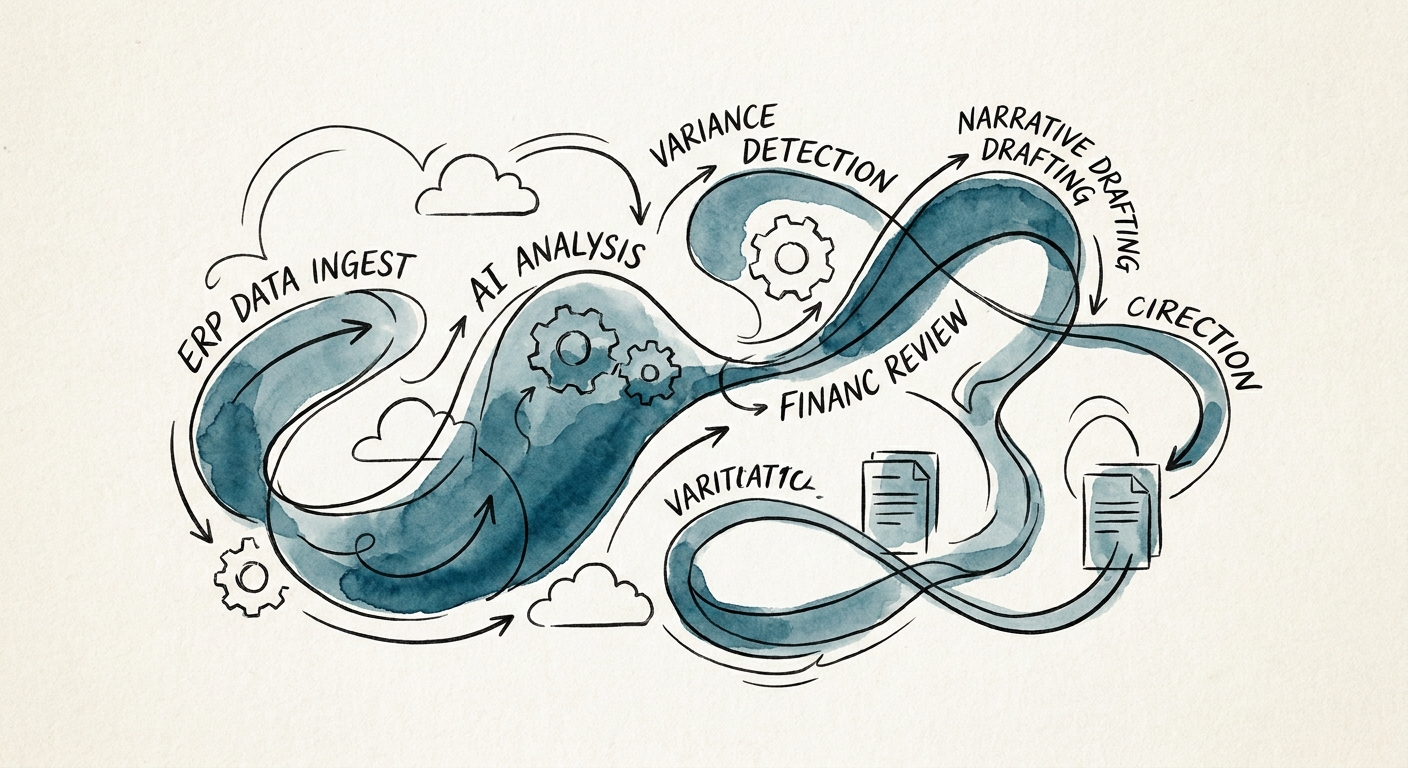
What to measure: fewer "timing" notes, not just fewer hours
The tempting metric is time saved, and you'll get some — the controller stops spending the back half of close on commentary archaeology. But measure the thing that actually improves the board's understanding. Track five signals through the pilot: close-cycle time, reviewer edits per note (high edits early is fine; it should fall as the prompts learn your drivers), rejected drafts, missing-source flags raised, and leadership's read on whether the commentary explains the business better than it did before. If notes get faster but vaguer — more "timing," fewer named deals and months — you've automated the wrong thing.
Run it on one statement first. Pick the P&L lines that generate the most board questions (usually services margin and a couple of opex categories), draft those for a single close, and have the controller mark up the drafts as if grading a junior analyst. You'll know inside one cycle whether the model is surfacing real drivers or padding with phrasing. The AI ROI Calculator will help you weigh analyst hours recovered against the review load this adds — because it does add one, at least at first. And if the honest answer is that your source data is still scattered across spreadsheets nobody fully trusts, start with a QuickStart AI Audit instead; no model writes a clean variance note on top of a messy GL.