The renewal you missed cost more than the review you skipped
Say a 120-person SaaS company signs a vendor agreement with a 60-day non-renewal notice window buried in section 9. Eleven months later, nobody flagged it, the clock runs out, and the contract silently rolls for another year at a 7% uplift. The legal team didn't make a bad call — they never saw the date. It was sitting in a PDF in someone's inbox, in a stack of forty others.
This is the specific failure contract-review automation is built to kill, and it's why this work is a strong fit for AI: the expensive part of first-pass review isn't judgment, it's finding. Pulling the renewal date, the liability cap, the data-processing terms, the payment schedule, the termination rights — then comparing them against what your company actually agreed to accept. That's classification, extraction, and comparison at volume. Machines are good at exactly that. World Commerce & Contracting research has long put the cost of poor contract management in the high single-digit percentages of contract value — most of it leaking through exactly these unseen terms.
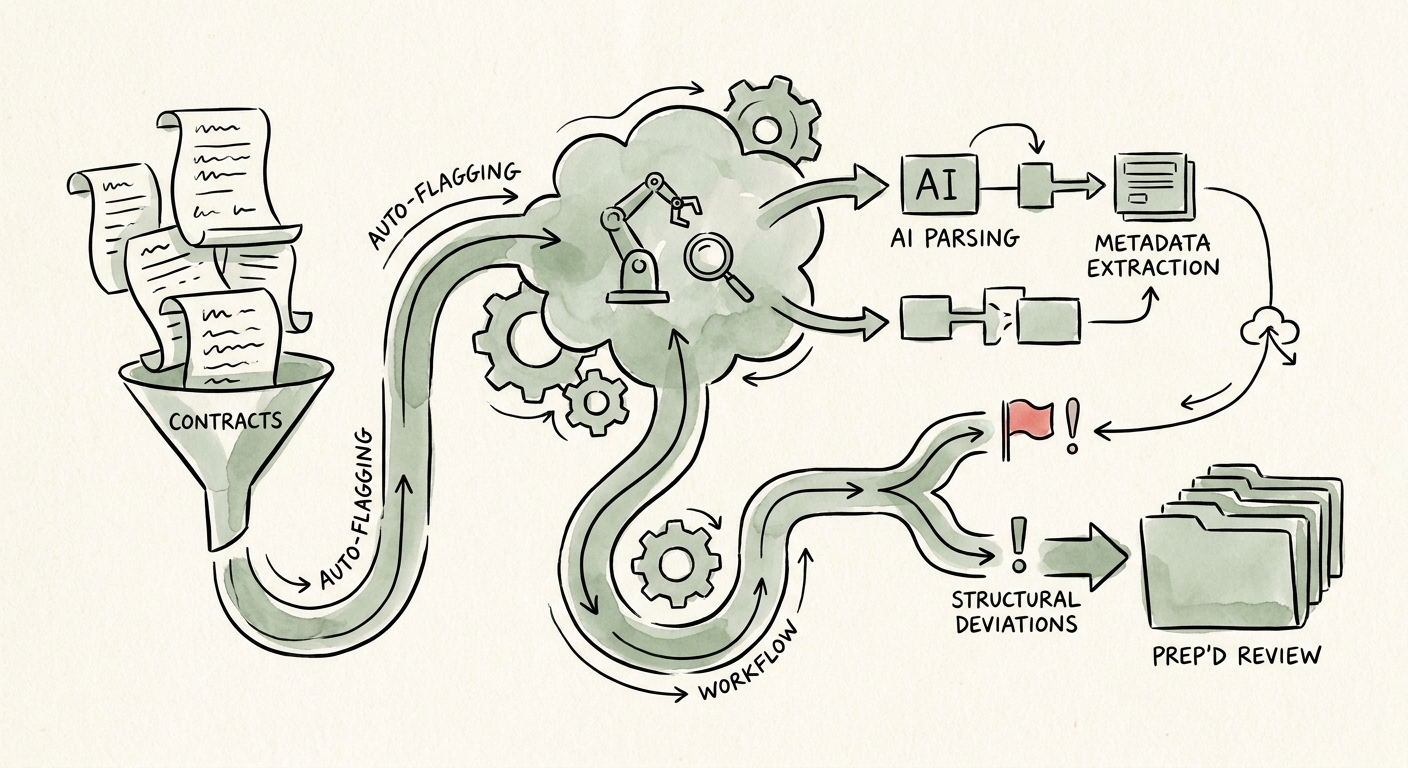
The line that matters: AI prepares the review, it does not approve the agreement. It reads the incoming draft, extracts the terms, compares them to your standards, summarizes where the counterparty's paper deviates, and hands it to the right human. Negotiation strategy, legal judgment, and the signature stay with people. The day you blur that line, you've automated liability, not review.
Before you go shopping for a contract-lifecycle platform — and Gartner's coverage of that category will show you no shortage of options — start with how to find manual work worth fixing. Your first workflow should attack one bottleneck a VP can measure, not boil the whole contract ocean.
No playbook, no workflow — there's nothing for the AI to compare against
Here's what teams get wrong: they buy the AI before they've written down what "standard" means. The AI has no opinion about your liability cap unless you've told it your cap is 12 months of fees and anything above 24 is an escalation. So the real first step isn't technology — it's a one-page playbook per agreement type. For a vendor MSA: required clauses, your fallback positions, the dollar threshold that triggers approval, restricted terms you won't accept, who owns it commercially, who owns it in legal, and where it escalates.
With that in hand, the workflow's job is to produce a review packet, not an answer. For an inbound NDA or order form, the packet should carry: document metadata, the extracted commercial terms, every non-standard clause with the standard quoted beside it, missing provisions, the renewal and notice dates, risk flags, and a routing recommendation. Critically, every flag links back to the exact source language. A reviewer should be one click from reading the counterparty's actual words before they decide anything — PwC's responsible-AI work calls this traceability, and it's the difference between a tool people trust and one they quietly stop using.
Then set hard human gates on the terms where the downside is real: data processing, liability, indemnity, exclusivity, termination, payment penalties, regulated obligations, and anything touching revenue recognition. The AI's contribution is making those issues visible on day one of the cycle instead of day forty. It does not sign, does not approve, and — this one bites people — does not silently overwrite a record in your CLM. Lower-risk, high-volume paper like routine NDAs and renewals can flow through a controlled queue; the sensitive ones land in a human's lap with the homework already done.
Run a 90-day pilot on one agreement type, and watch the overrides
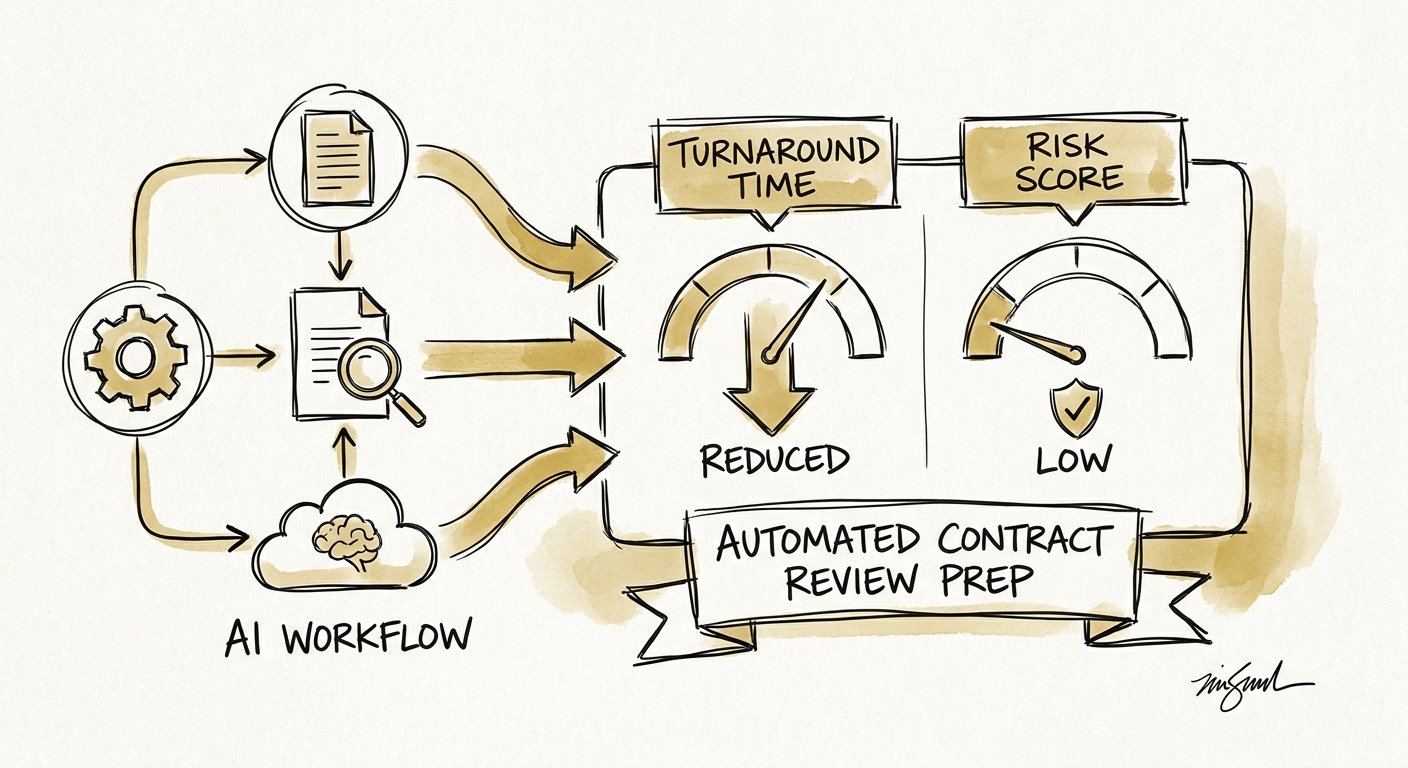
Don't measure this on accuracy alone — measure it on cycle time and exception quality. Track contracts reviewed, terms extracted, exceptions routed, review cycle time, outside-counsel handoffs avoided, and — the metric most teams forget — missed renewal dates the system surfaced before they expired. Then watch reviewer overrides like a hawk. Every time a lawyer corrects the AI's read of a clause, that's a signal your playbook or your extraction rules are wrong, and it's the cheapest improvement data you'll ever get. Thomson Reuters' legal-market research and Deloitte's contract-management work both point the same direction: the value shows up as throughput and control, not as a flashier signature.
Keep the pilot narrow. Pick one agreement type — say, vendor MSAs under $250K — in one business unit. Month one: write the playbook and connect the source systems. Month two: run AI-generated packets alongside your existing process and compare them clause by clause. Month three: route the low-risk subset through the controlled queue while every high-risk exception stays human-led. Four packet elements are non-negotiable before anything reaches production — source language, owner approval, risk flags, and audit history. Miss any one and you're not in production, you're in a demo.
Pressure-test the numbers with the AI ROI Calculator and sequence the rollout with the 90-day implementation plan. The goal was never a faster signature at any cost. It's a review path where fewer terms slip through, accountability is obvious, and your most expensive judgment gets spent on the contracts that actually warrant it.