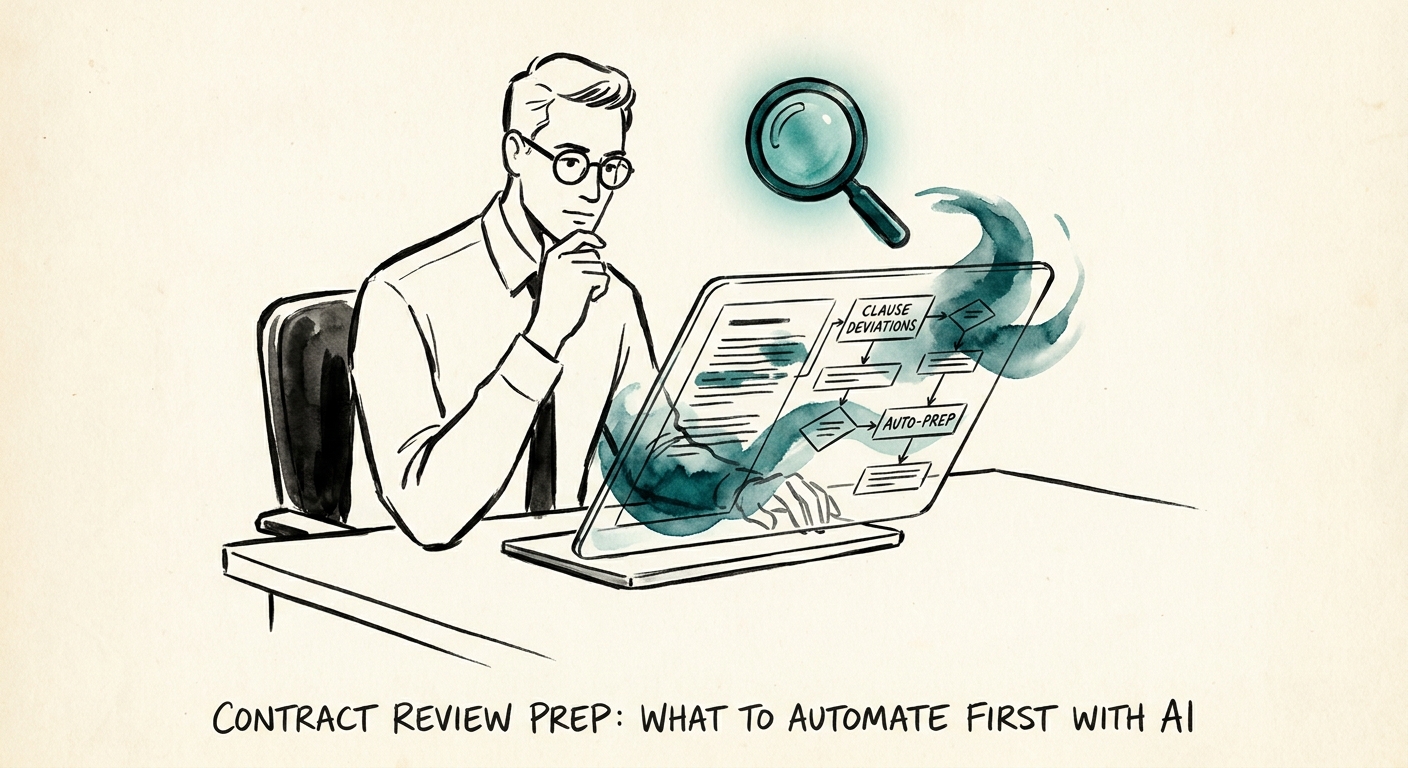
A renewal sits for nine days before anyone reads it
Picture a 60-person managed-services firm renewing a master agreement with a mid-market customer. The customer's procurement team sends back a marked-up MSA on a Thursday. By the time it actually lands in front of someone who can evaluate the indemnity changes, nine days have passed. None of those nine days were spent reviewing anything. They were spent finding the executed prior version, confirming which of three order forms is current, locating the security exhibit that was negotiated separately last year, and figuring out whether the redline matches the email summary procurement attached.
That is the work to automate first — and it is not legal work. It is intake, retrieval, and triage. The fastest win for an operations or legal-operations team is a workflow that, the moment a contract arrives, pulls the related documents, lists what's missing, flags every clause that differs from your approved template, and routes the package to the right reviewer with the non-standard terms already surfaced. The lawyer or commercial owner opens a complete packet instead of starting a scavenger hunt.
Draw the line hard: the workflow assembles and compares. It does not approve, interpret an obligation, or rewrite language. Enterprise AI controls like OpenAI's enterprise privacy commitments and Microsoft 365 Copilot privacy and data controls tell you the tooling can handle confidential contract material safely. They do not tell you where the AI should stop — that boundary is yours to draw, and for contract prep it stops at the moment a judgment call begins. The adjacent build, organizing the contract knowledge the workflow pulls from, is covered in the knowledge-management contract review guide.
The five clauses that always bounce to a human
Here's the failure mode that kills trust in week two: the AI confidently summarizes a limitation-of-liability cap as "standard" when the customer quietly raised it from 12 months of fees to a hard dollar number buried in an amended exhibit. Now a reviewer is trusting a summary that's wrong, and one bad call resets the whole program to manual.
So the workflow needs an explicit escalation list — terms it is forbidden to characterize and must instead flag verbatim for specialist eyes. For a service business, that list is short and consistent: indemnification scope, the data processing addendum and any subprocessor language, security and uptime commitments, pricing exceptions or most-favored-customer clauses, and termination-for-convenience rights. These are exactly the clauses where a customer's redline costs or protects you real money, and exactly where a plausible-sounding paraphrase is most dangerous. The AI's job on these is to locate them and quote them, not to judge them.
Underneath that sits one non-negotiable rule, because contract packets carry customer data, pricing, and security terms that fall squarely within CISA's AI Data Security Best Practices: every summary line must point back to a specific document, version, and clause location. If the workflow can't cite where a claim comes from — file name, version, section number — it doesn't get to make the claim. Preserve the document names, the version history, the clause anchors, and the reviewer's notes as a permanent trail. A summary you can't trace is a summary you can't defend, and in contract work you will eventually have to defend it.
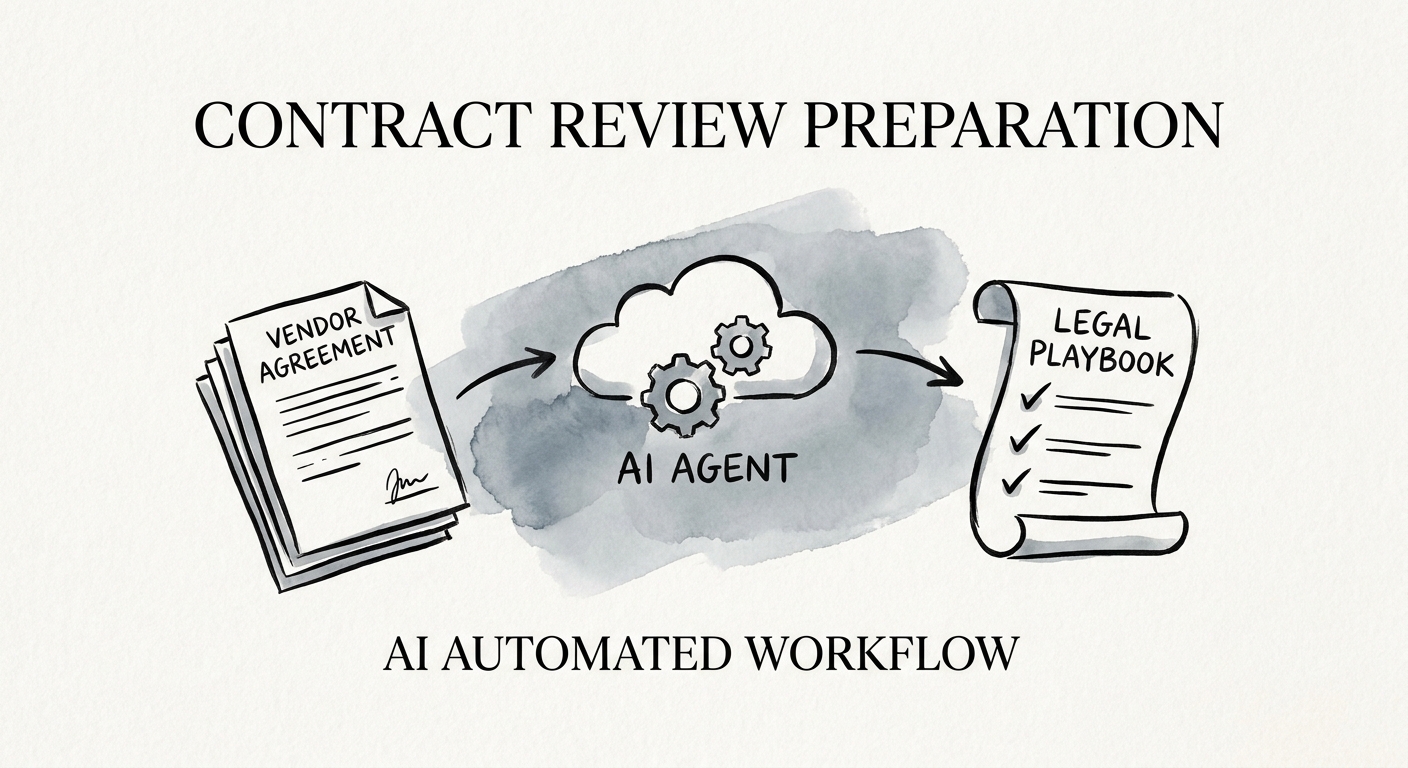
Measure prep speed and reviewer corrections, not contracts "handled"
The wrong metric is "contracts processed by AI," because it quietly rewards the system for doing more interpreting than it should. The right metrics measure the prep, and they map cleanly onto the NIST AI Risk Management Framework's loop of mapping context, measuring risk, and managing controls. Track four numbers from day one: intake completeness (did the packet arrive with every required attachment, or did a human still have to chase the missing order form), time from contract arrival to a review-ready packet, the reviewer-correction rate (how often the human had to fix a clause comparison the AI got wrong), and the count of escalated terms that surfaced versus ones a reviewer caught later that the workflow missed.
Watch the correction rate above all. If reviewers are quietly re-doing the comparison the AI produced, you haven't saved nine days — you've added a step. A healthy workflow shows that correction rate falling week over week as your approved-template library tightens, while time-to-packet drops and nothing important slips past the escalation list. The business case was never "AI reviews contracts." It's that the renewal lands on the right desk in hours instead of nine days, fully assembled, with the risky clauses already flagged — and legal and commercial owners still make every actual decision.
Give it a 90-day window so the numbers mean something: a few weeks to instrument intake, a few to tune the escalation list against your real redline history, and a clean final stretch to read the trend. The sequencing fits the structure in a 90-day AI implementation plan — start with one contract type, prove the prep loop, then widen.