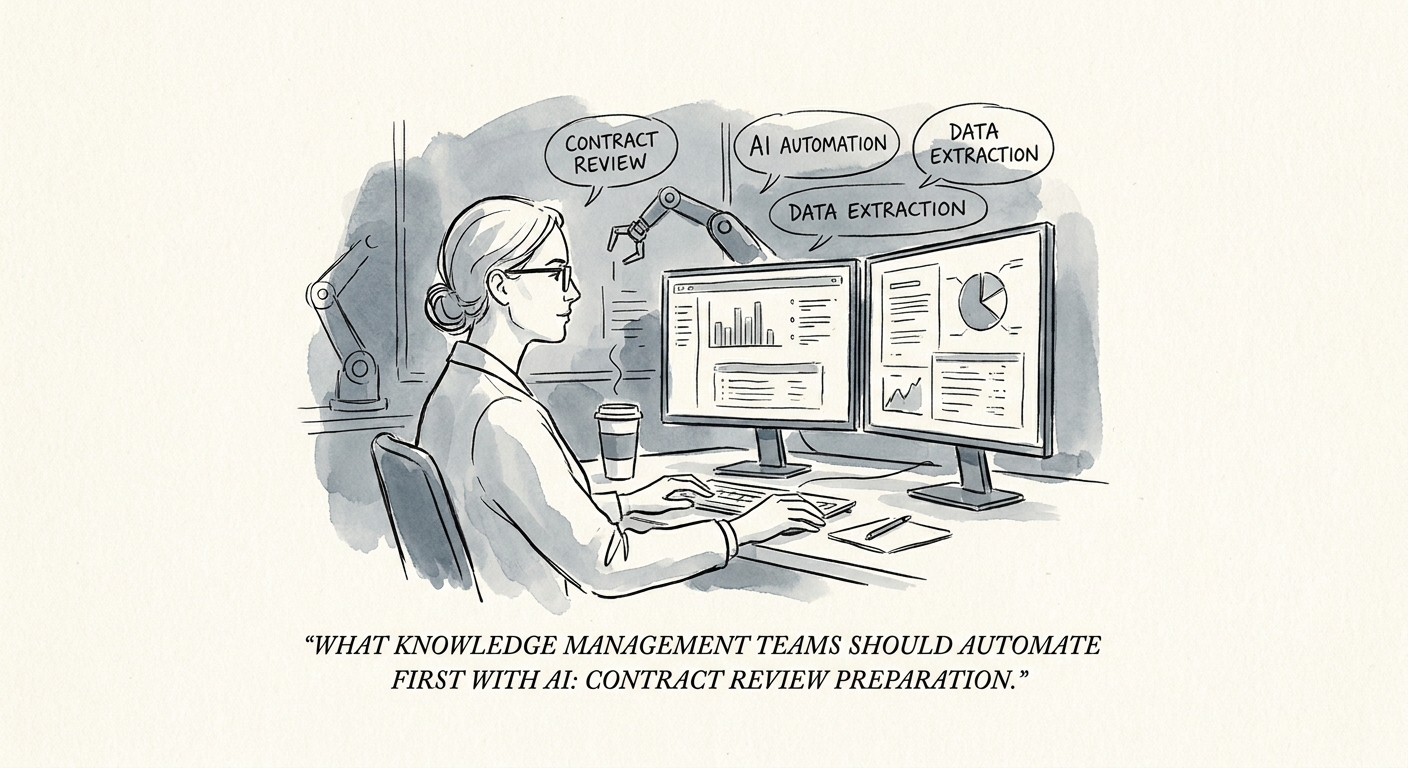
The half-hour nobody bills for
Picture a 60-person professional services firm. A new MSA comes back from a prospect with markups, and before anyone can read a single redline, someone has to assemble the file: find the original agreement, dig out the matching order form, hunt down the last two negotiated versions of the same clause set, check whether the security exhibit was ever signed, and remember which partner owns the relationship. That assembly is the part no one bills for, and it is where reviews quietly lose a day or two while a deal cools.
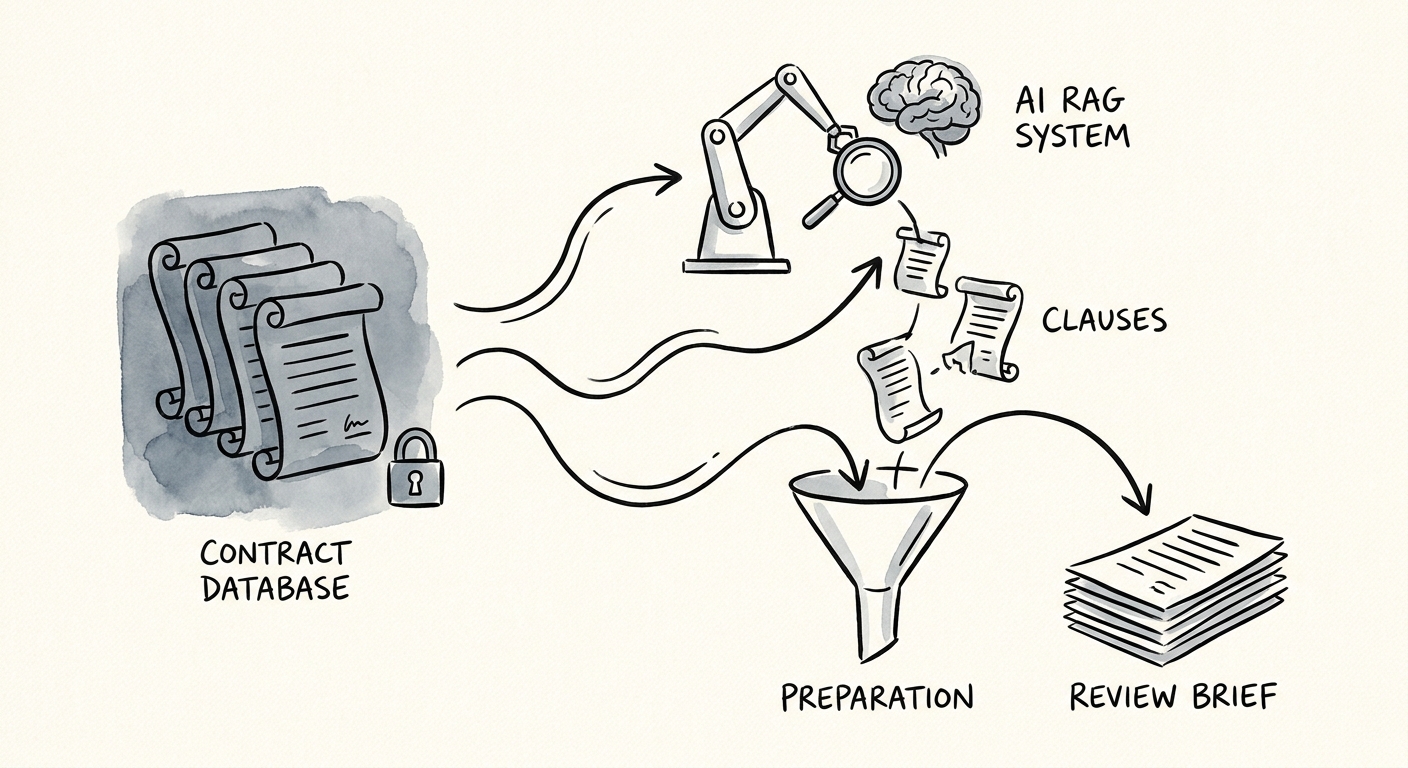
This is the work to hand AI first, and it is worth being precise about the boundary. The job is to gather and arrange: pull the agreement, the related order form, prior redlines, the approved clause library, the risk notes, the ownership history, and the open questions into one packet. The job is explicitly not to say whether an indemnity cap is acceptable, whether a payment term is too aggressive, or anything that resembles legal advice. The moment the tool starts grading clauses, you have built a liability, not a workflow.
What makes a packet useful in a services firm specifically is provenance. Your contract context lives in too many places at once: the executed PDF in a shared drive, the negotiation thread in email, the commercial terms in the CRM, and the "we agreed to X last time" knowledge in one account lead's head. A good first release produces a single packet where every line traces back to its source document, flags what is missing before the reviewer wastes time, separates standard language from the exceptions worth reading closely, and routes anything privileged or high-risk to the named human who owns it.
Why "who can see this" comes before "how fast is it"
A contract packet is one of the most sensitive objects a services firm assembles. It can carry confidential pricing, a customer's data-handling obligations, security commitments your firm has to live up to, and privileged commentary your counsel never wants surfacing in a summary. So the first design question is not speed, it is retrieval scope: who is allowed to pull the source material, and where the generated packet is permitted to live. If a project coordinator can ask the assistant for the partner-only pricing exhibit, you do not have a contract workflow, you have a leak.
The CISA AI data-security guidance is the right reference for setting those access rules, and the platform-level controls in Microsoft 365 Copilot's privacy documentation and OpenAI's enterprise privacy commitments show what you can actually configure for tenant boundaries and data retention. Use the NIST AI Risk Management Framework to name the context, the review authority, the risk signals, and the controls before the first packet is ever generated.
The packet's structure should fight the instinct to blend everything into one confident paragraph. Tag each item as one of four things: source evidence (a verbatim clause with its origin), a reviewer note, an unresolved issue, or a legal escalation. That tagging is what keeps a model's smooth prose from being mistaken for a decision. Start narrow: pick one contract family for the first 90 days, say DPAs or order-form exceptions, not the whole agreement library at once. Keep a log of source excerpts, reviewer edits, and how each escalation resolved, because that record is how your approved clause library stops being someone's memory and becomes an asset.
Measure the assembly, not the judgment
Track the things that actually move: how long packet assembly takes now versus the manual hunt, how often a packet ships missing a document, how much the reviewer has to correct, how many escalations got caught at prep time instead of mid-negotiation, the cycle time into legal or commercial review, and which clause questions keep recurring. That last one is a tell: if the same DPA term gets asked about every week, your approved library needs an owner, not another AI pass.
Hold the line on what stays human. When the language is nonstandard, when it is unclear which document is authoritative, or when the call changes the firm's legal or commercial exposure, AI's job ends at preparing the file and surfacing the sharp question. The accountable reviewer decides. A faster review that quietly loosens risk control is not a win, so treat faster review as valuable only when risk control holds or improves.
If you want to scope this for your own contract flow, start by writing down the four-tag packet format and the retrieval rules for a single contract family this week. That one page is the entire foundation, and it is the thing most teams skip before wiring up a tool.