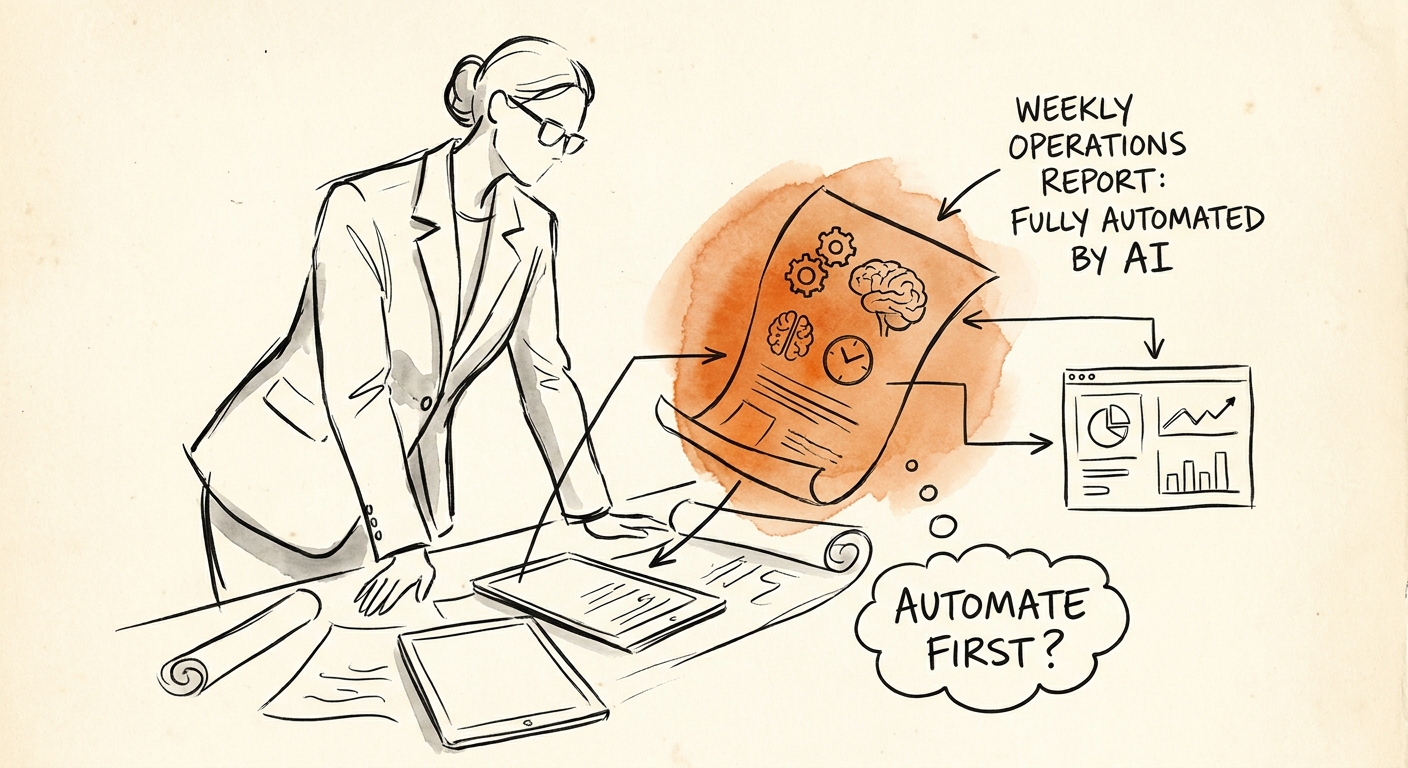
The report nobody reads, assembled by the person who hates assembling it
Picture the Thursday-night ritual at a 120-person professional services or tech-services firm. Someone in operations is toggling between a project tool, a ticket queue, a finance export, and four Slack threads from delivery leads who answered "status?" with a paragraph each. By the time the weekly operations report goes out Friday morning, it's part transcription, part guessing, and entirely resented. Leadership skims it. The author knows they skim it. The cycle repeats.
This is exactly the workflow to automate first, and not because it's flashy. It's because the cadence is fixed, the inputs are bounded, and your audience can tell you within one week whether the output is useful. The RSM middle-market AI survey shows adoption among firms your size is moving fast, but Deloitte's State of AI in the Enterprise 2026 is blunt about why most of it stalls: governance and operating discipline, not model quality, decide whether a workflow ever earns trust.
So scope the first release narrowly. The AI pulls status from your approved project system, the service queue, finance notes, and the manager updates. It normalizes the language, flags every input that didn't arrive, and drafts a tight operating summary. What it must never do: invent a status, quietly drop an exception, or turn a delivery lead's vague "going fine, mostly" into confident green. If you've already built the project-status knowledge workflow, this is the cross-functional sibling that sits one level up.
Decide what counts as evidence before you decide what the AI summarizes
Here is the trap specific to weekly ops reporting: it touches more sensitive data than almost any other early workflow. A single Friday report can reference client account health, margin on active engagements, a utilization dip on a named team, and an at-risk renewal. That's why the CISA AI Data Security Best Practices guidance belongs in scope from day one, not as an afterthought. Write down the approved systems, the specific fields the AI may summarize, and the lines that always require a human read before anything leaves the building.
Then own the report's spine yourself. A weekly ops report that leaders actually act on answers five questions in the same order every week: what changed, what's blocked and who owns unblocking it, what needs a leadership decision this week, what evidence backs each claim, and what moved since last Friday. The AI collapses the formatting drudgery. It does not get to decide the structure, and it never gets to make a claim without a source link attached.
That last point is where most of these projects quietly fail. A delivery lead reads "Account Northstar: stable" and remembers a fire drill from Tuesday. Now the whole report is suspect. The fix isn't a better summarization prompt. It's a rule that every line carries a link to the system of record and the timestamp on that data, so a reader can check the receipt in two clicks instead of mentally discounting everything.
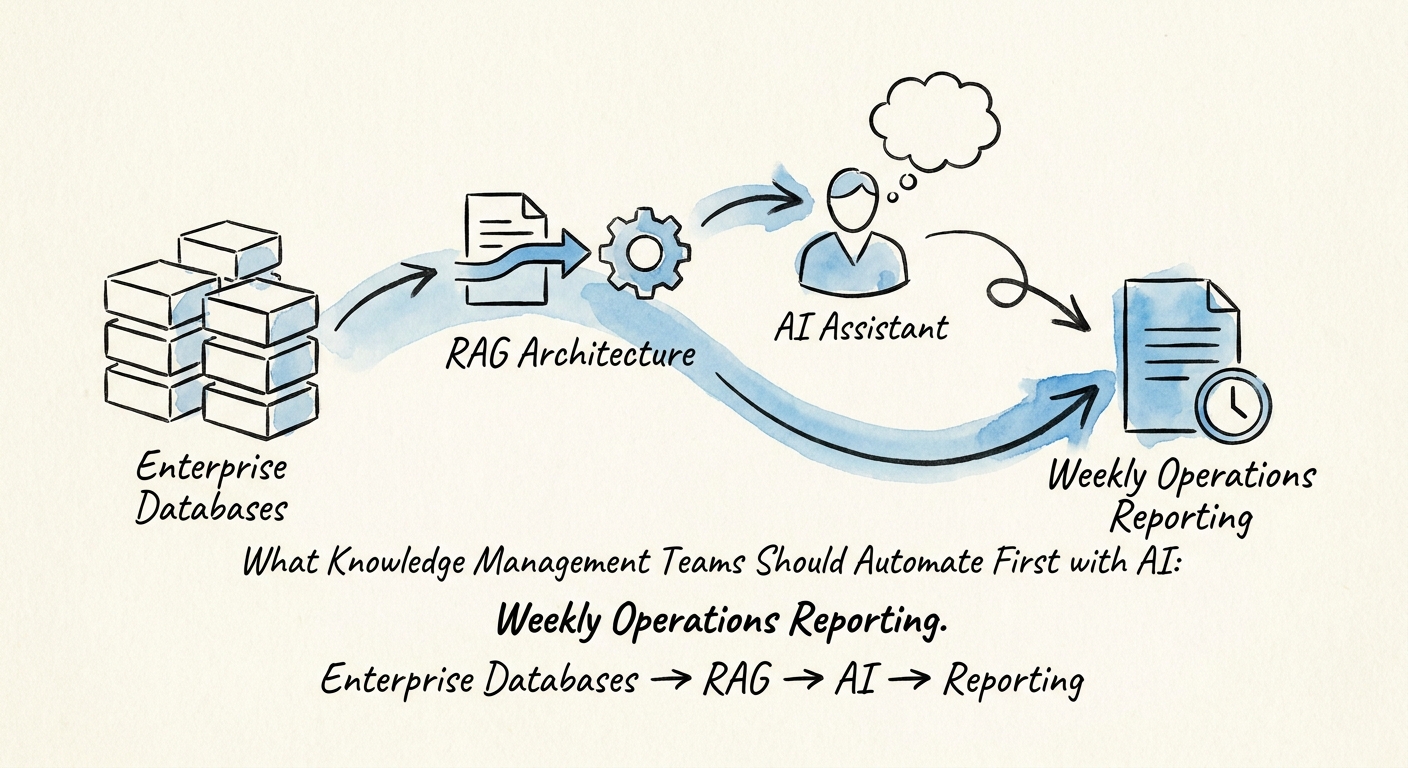
Run it for 90 days and watch behavior, not output
The NIST AI Risk Management Framework gives you the loop: map the context, measure the output, manage the controls. For a weekly report the measures are refreshingly concrete. Track the missing-input rate (how often a source didn't show up on time), the correction rate (how many lines a human had to fix before send), the prep time saved before the Monday leadership meeting, and the number of follow-up actions the report triggered. The signal that matters most isn't any single number; it's whether decisions start happening on Friday instead of waiting for someone to re-confirm the data on Monday.
Give it about 90 days. Two outcomes are possible. The healthy one: the report becomes the artifact the leadership meeting opens with, because people trust the receipts and stop re-doing the work. The failure one: it's another tidy document that gets skimmed and ignored, because the data underneath never earned trust and a clean summary just made the staleness harder to spot.
If you want one move for Monday: pick the two source systems your last three reports leaned on most, and add a visible "data as of" timestamp to every line drawn from them. Trust follows verifiability. To structure the full rollout, use a 90-day AI implementation plan so the workflow stays owned, measured, and improving instead of drifting back to a Thursday-night scramble.
