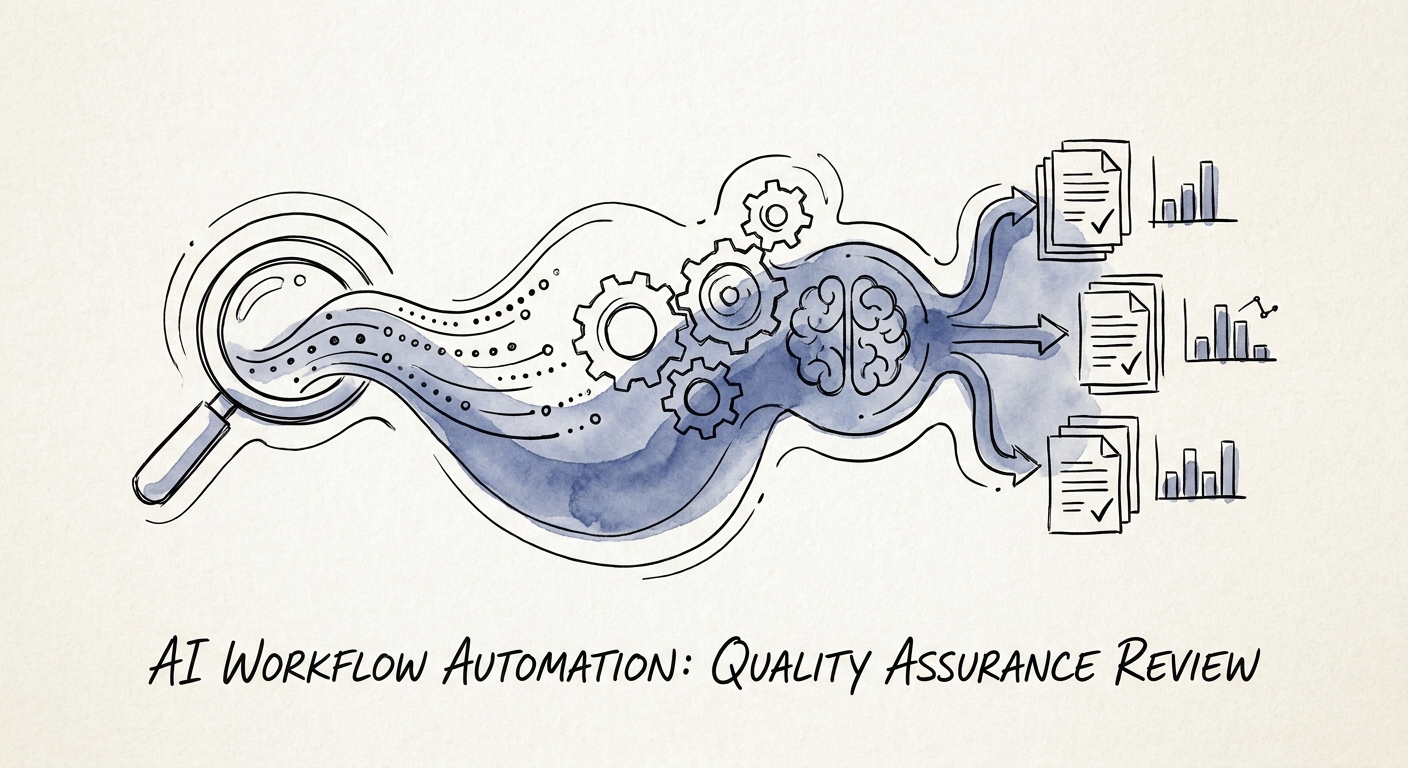
Your QA program reviews 3% of the work and pretends it's representative
Here's the math most customer-success and support leaders quietly live with. A QA analyst can carefully review maybe 4 to 6 tickets or calls per agent per month. With 30 agents, that's a sampled sliver — call it 3 percent of volume — and from that sliver you draw conclusions about coaching, onboarding gaps, and renewal risk across the whole book. The escalation that blew up last Thursday? It almost certainly wasn't in the sample.
This is the actual problem AI solves in QA, and it's narrower than the vendor demos suggest. Deloitte's 2026 AI research describes a market shifting from experimentation to production value. In a QA workflow, production value is not a robot grading your reps. It's the model reading 100 percent of transcripts, tickets, and implementation notes and surfacing the ten conversations a human manager should look at this week — the ones with an unresolved customer commitment, a missing required disclosure, a handoff that dropped silently between support and the account team.
The distinction that decides whether this works: AI expands what gets seen. The human still decides what it means. Cross that line — let the model assign the score that feeds a performance review — and you've automated the most contested, judgment-heavy step while leaving the cheap, high-volume reading step manual. That's exactly backwards.
What a B2B ticket actually contains — and why that changes the build
A QA artifact in B2B technology and services is not a tidy retail call. One ticket thread might span three weeks, four reps, a Slack-Connect side channel, an implementation runbook, and a renewal date sitting 60 days out. The signal a manager cares about — "did we close the loop on the commitment we made in message 12?" — is buried across all of it. That richness is the case for AI reading everything, and the reason the build needs guardrails most QA tooling skips.
Start by defining what the model is allowed to flag, in plain operational categories your managers already argue about: a required disclosure or contractual term that's missing, a customer commitment left open, documentation too thin for the next rep to act on, a policy deviation, mounting customer frustration, or a coaching moment worth a manager's time. Calibrate those categories against real examples of good and bad work before anything touches live data. Skip calibration and the model inherits every unresolved disagreement already baked into your scorecard — now wearing a confidence score that makes the disagreement feel objective.
NIST's AI Risk Management Framework gives you the spine here: state the intended use (evidence collection, not adjudication), measure the model's error patterns against human reviewers, assign an owner, and document the boundary where the AI stops assisting and a person takes over. And because these threads carry customer identifiers, contract terms, and employee-performance context, CISA's guidance on data used to operate AI systems is not optional reading — redact where you can, enforce role-based access so a team lead can't see another team's HR-adjacent flags, log every sampled item, and route low-confidence classifications straight into the calibration meeting instead of into a dashboard number.
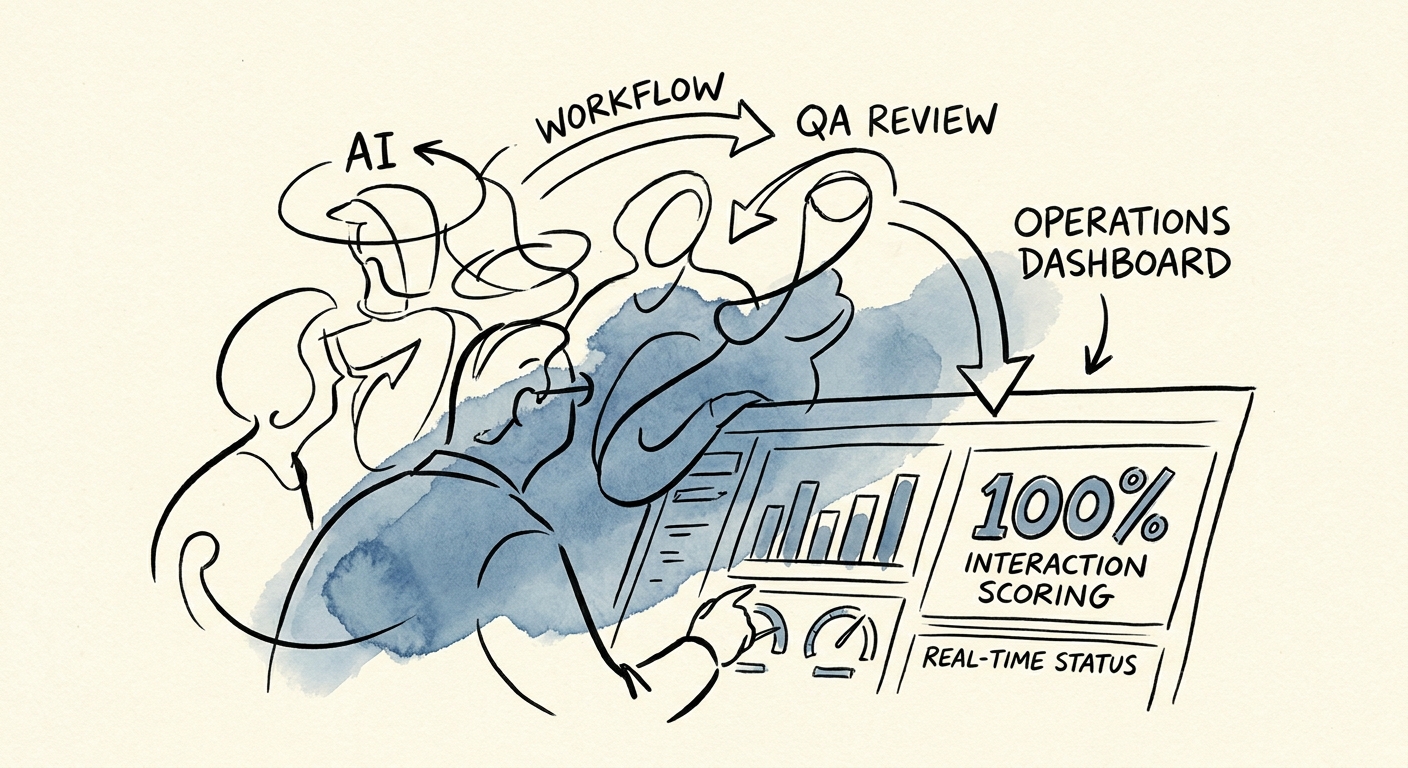
The packet a manager can argue with on Monday
Here's the deliverable that tells you whether you built it right. For each flagged conversation, the manager gets a one-screen packet: the source record (which ticket, which call, which line in the transcript), the AI's recommendation in your calibrated language, and — critically — an empty field where the manager records what they actually decided. Then you connect that decision to what happened next: did the flagged ticket reopen? Did the account escalate? Did the renewal slip? A flag that never correlates with a downstream outcome is noise dressed as insight, and you want to find that out in week three, not quarter three.
Run the first pilot on one team with a stable rubric. Track four things: how much of your volume now gets reviewed (coverage should jump from single digits toward 100 percent), how much manager calibration time it costs, whether reps find the coaching genuinely useful, and the dispute rate. If coverage goes up but arguments about scoring also go up, that's your signal — stay in evidence-assist mode and do not hand the model scoring authority. The win you're after is better management attention, not a new black box that reps learn to game.
Say you run a 40-rep support and CS org: buy or configure off-the-shelf transcript capture and flagging, but build the custom layer where it pays off — joining QA flags to renewal dates and implementation status, the context no generic QA tool has. Before you expand past team one, write down what stays out: which fields are required, which are optional, and the exclusion and escalation rules. If the evidence doesn't move coverage and calibration in the right direction, fix ownership, permissions, or source quality before adding more automation. Some judgment calls — a contractual commitment, a sensitive churn signal — should never leave the account owner's hands; that's worth deciding deliberately, which is why a QA pilot pairs naturally with explicit automation stop conditions and a sequenced AI transformation blueprint.