The bug the model approved
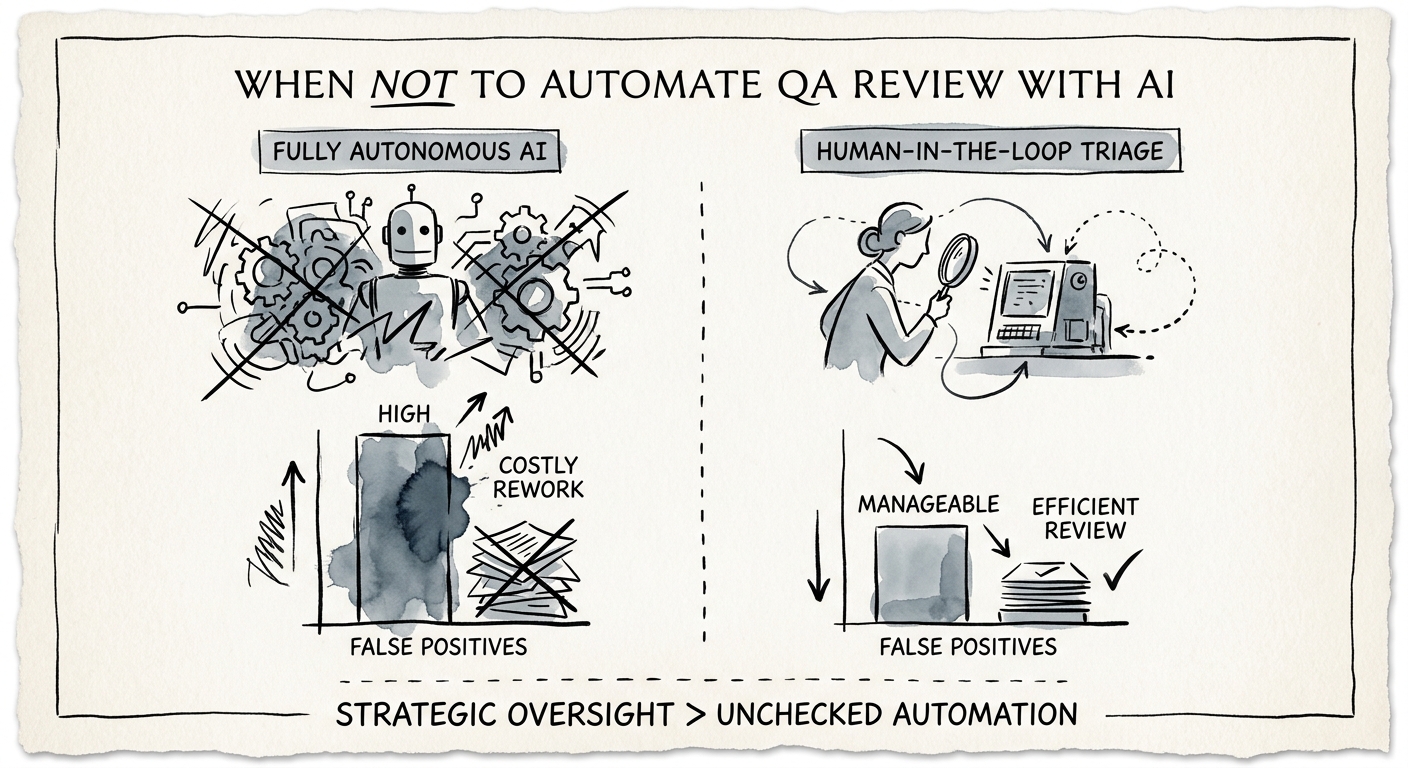
Picture a 120-person SaaS company. The release passed every automated check. An AI review agent scanned the pull request, cross-checked it against the acceptance criteria, found no gaps, and tagged it green. It shipped Thursday night. By Tuesday, three enterprise customers had filed tickets: the new feature worked perfectly and quietly broke a billing webhook that nobody had documented in the spec. The AI did exactly what it was asked. It confirmed the code matched the requirements. It had no way to know the requirements were incomplete.
That is the trap with automating QA review in a technology shop, and it is different from the trap in any other function. QA is not about checking whether work matches the stated rules. The valuable QA reviewer is the one who notices the rule everyone forgot to write down, the edge case the ticket author never imagined, the dependency two systems over. AI is exceptional at the first job and structurally blind to the second. The pressure to hand it both is intense right now: the Census Bureau put AI use among U.S. businesses at 17% to 20% from December 2025 to May 2026, with the larger firms moving fastest. But Deloitte's 2026 enterprise research shows the governance to manage that handoff is still rare, and OECD work on smaller firms tracks the same readiness lag at mid-market scale.
Draw the line at "looks right" versus "is right"
The useful question is not "can AI do QA review?" It is "which half of QA review?" Sort your review work into two stacks. The first stack is verification against a known, complete spec: does the response code match, is the field validated, does the test cover the path the ticket describes, did the schema migration touch the columns it claimed to. This stack is mechanical, the source of truth is written down, and a wrong answer is cheap to catch on the next pass. Hand it to AI all day. It will work tirelessly and never get bored on review number 200, which is where your human reviewers start rubber-stamping.
The second stack is judgment against unwritten context: is this spec missing a case, does this change interact badly with something undocumented, is "technically passing" actually the wrong product behavior, would a real customer hit a flow nobody modeled. The NIST AI Risk Management Framework gives you the vocabulary to keep these stacks apart: AI can assist, flag, and prepare, but it should never hold final authority over an irreversible decision or quietly bury its own uncertainty from the engineer who owns the release. And there is a hard security boundary underneath all of it. If your review agent can read production data, customer records, or contract terms to do its job, CISA's AI data security guidance says it needs inherited access controls, logging, and source protection before it touches anything live. No audit trail, no production access. Keep it in a supervised pilot until that exists.
What to ship Monday
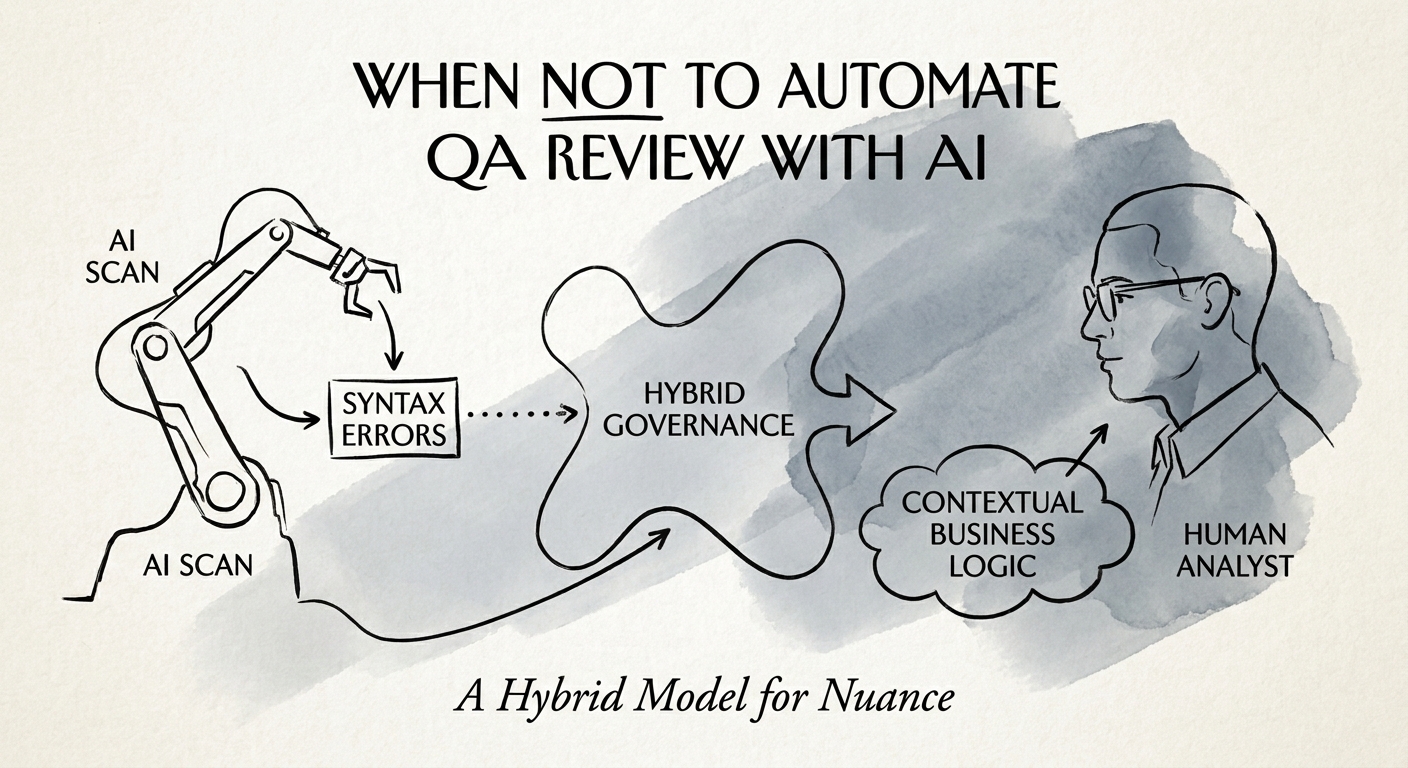
Make AI your QA triage layer, not your QA approver. Let it open every ticket or pull request, summarize what changed, pull the related spec and prior incidents, list what it could verify, and flag what it could not, then route the package to a human with a one-line "here is why this needs your eyes." The reviewer spends their time judging the gray cases instead of gathering context, and every override they make becomes training signal for the next batch. You get the throughput without surrendering the call. Research from the Federal Reserve Bank of San Francisco on smaller firms points the same direction: the gains show up when the tool augments the operator, not when it replaces the accountable decision.
Practically, that means writing down the line: which checks AI can close on its own, which it must escalate, and who signs the release. We use a responsible AI governance structure and pilot-to-production controls to set exactly those boundaries before a review agent ever touches a live build. The AI Transformation Blueprint turns that into a concrete roadmap so your team automates the boring half of QA and keeps a human on the half that ships bugs to customers on a Tuesday.