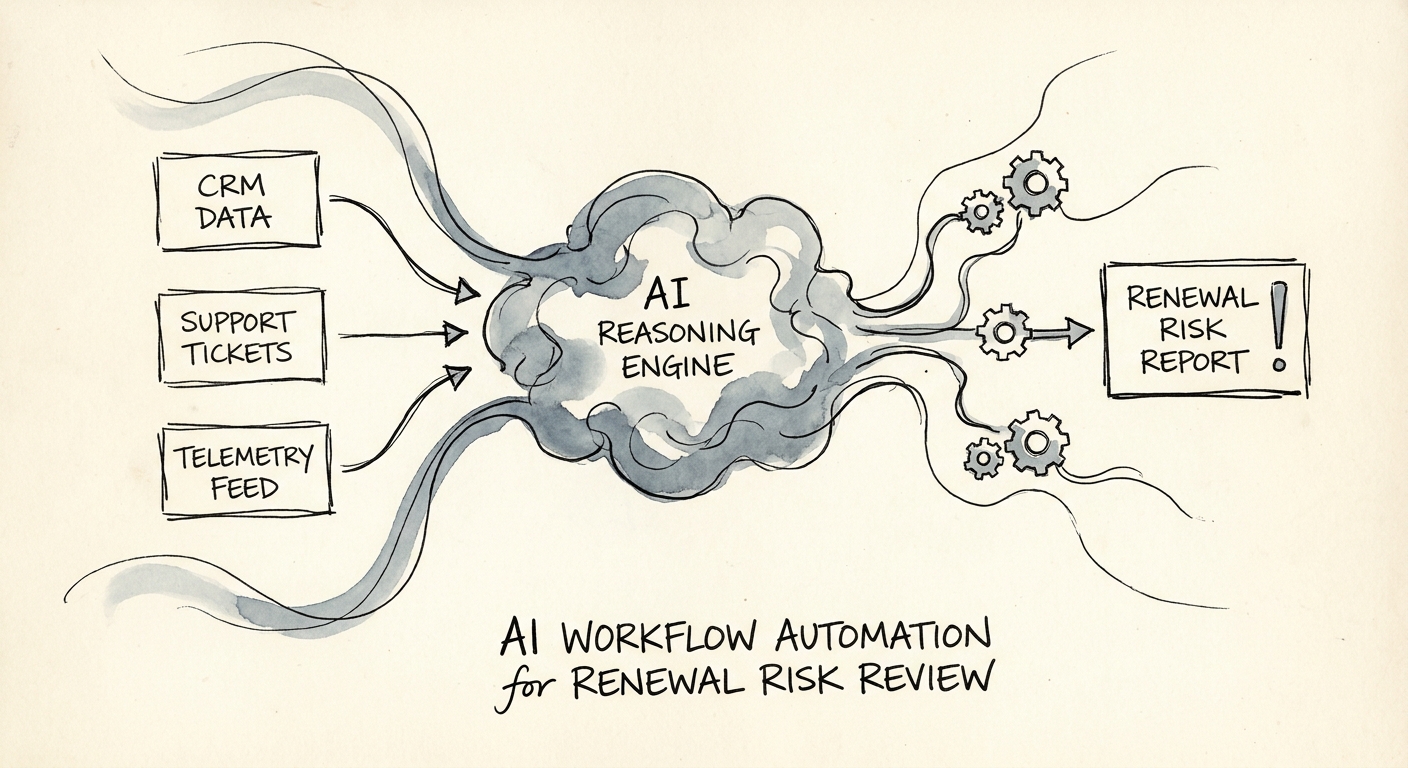
The account didn't churn in the QBR. It churned six months earlier.
Picture a B2B software vendor, maybe 90 people, a few hundred accounts on annual contracts. A $140K renewal lands in the at-risk column 45 days out. The CSM scrambles, pulls a save play, offers a discount. Sometimes it works. But by then the story is already written: the power user who championed the rollout left in February, ticket volume doubled in March while resolution times crept up, and logins from the executive sponsor went to zero in April. None of that showed up in the forecast until the renewal date forced someone to look.
That gap is the whole problem. Renewal risk is loud across your systems and silent in your pipeline. The Salesforce State of Service report tracks how customer service operations now lean on unified data and faster resolution precisely because fragmented signals slip past human review. The support queue knew. CRM notes knew. Usage telemetry knew. They just never sat in the same place at the same time as the account owner's attention.
The job of automation here isn't to predict churn with a magic score. It's narrower and more honest: assemble the four signals that actually move a B2B renewal — product usage trend, support burden, stakeholder engagement, and commercial context from the deal record — into one review the account owner reads before the conversation, not after it. The Salesforce State of Sales report makes the commercial half of that case: revenue teams consistently cite visibility and execution support as where they lose deals, and a renewal is a deal you already won once.
What separates a useful signal from a noisy one
The fastest way to kill a renewal-risk workflow is to flag everything. A CSM who gets ten "at-risk" pings a week stops reading them by week three. So the hard work is upstream: deciding what counts as a signal for a B2B software account specifically, and what's just normal variance.
Concretely, for this kind of business: a 30%+ drop in weekly active seats over a trailing month means something; a quiet week in late December doesn't. A sponsor who hasn't logged in for 60 days while the renewal is inside 120 days is a real flag; a heavy power user going on parental leave is not. Three escalated tickets touching the same workflow is a pattern; three unrelated how-to questions is adoption. Stale data deserves its own rule — a "risk summary" built on a CRM last touched four months ago should say so, loudly, rather than launder old notes into false confidence.
This is where a control model earns its keep. The NIST AI Risk Management Framework gives you the structure to classify each signal, define how degraded or missing inputs are handled, and set the line where an AI-generated summary has to be validated by the human who owns the relationship before it triggers any account action. And the IBM Institute for Business Value AI capabilities research is a useful reality check on what makes this stick: clean source data, genuine adoption by the CS team, and a measurement cadence — not a clever model. A renewal-risk view your CSMs don't trust is a dashboard nobody opens.
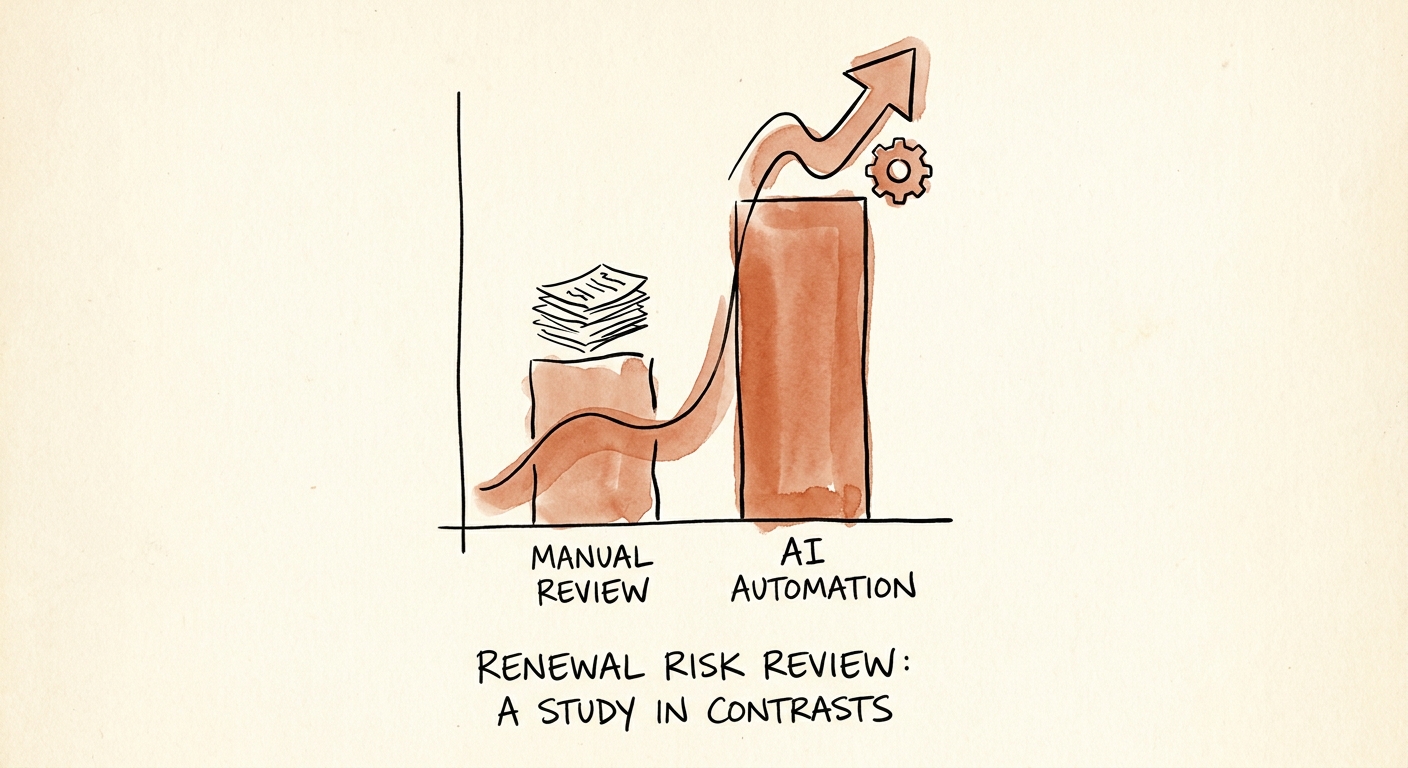
Measure whether it changed what the team did — not whether it ran
Most teams measure the wrong thing. "We generated 200 risk summaries this quarter" tells you the pipe is flowing. It tells you nothing about whether a single renewal got saved. The McKinsey State of AI 2025 finding holds here: value shows up when the workflow is redesigned around the action and the outcome, not when the AI simply produces output.
So track the chain that ends in a save. Time from first risk signal to the CSM's first account action — that's the number you most want to shrink, because every week early is a week of leverage. Then: what share of summaries the account owner actually reviewed and acted on, your false-positive rate (flags that turned out to be nothing, the thing that erodes trust fastest), prep time saved per account review, and finally renewal outcomes sliced by risk tier so you can see whether early-flagged accounts renew better than they used to.
If you want one thing to do Monday: pick your ten largest renewals due in the next two quarters and manually assemble the four signals for each — usage trend, ticket pattern, sponsor engagement, deal context. The accounts where you're surprised by what you find are your proof the automation is worth building. To slot this between service recovery and commercial follow-up, see Customer Service AI and Sales and Marketing AI.
