The renewal is lost in week three, not month eleven
Picture a B2B software vendor closing a 60-seat deal. Contract signed Friday. The customer's champion told their boss the tool would be live in two weeks. Then onboarding starts: an intake form with seven required integrations, a data export the customer has never run before, an implementation manager juggling eleven other accounts, and a kickoff call that gets pushed twice. By week three, the champion is quietly drafting an internal note about whether they bought the wrong thing. That note is the renewal. It just won't show up in the dashboard for nine more months.
This is the part people get backwards when they reach for AI in onboarding. The instinct is to bolt a chatbot onto the help center and route new customers through it, then celebrate the drop in support tickets. But onboarding is not a support queue. A deflected ticket here often means a confused customer stopped asking and started disengaging. Bain's work on loyalty economics has long made the point that the cost of keeping a customer is a fraction of replacing one — and the window where you earn that loyalty is narrow and early.
The useful question is not "how do we answer onboarding questions faster?" It is "what background work is keeping the implementation manager from spending their hour on the customer instead of on the customer's paperwork?" Forrester's B2B onboarding research frames onboarding as a coordinated handoff, not a self-serve maze — and most of the drag in that handoff is data wrangling, not relationship work.
Put AI on the plumbing, keep humans on the moments
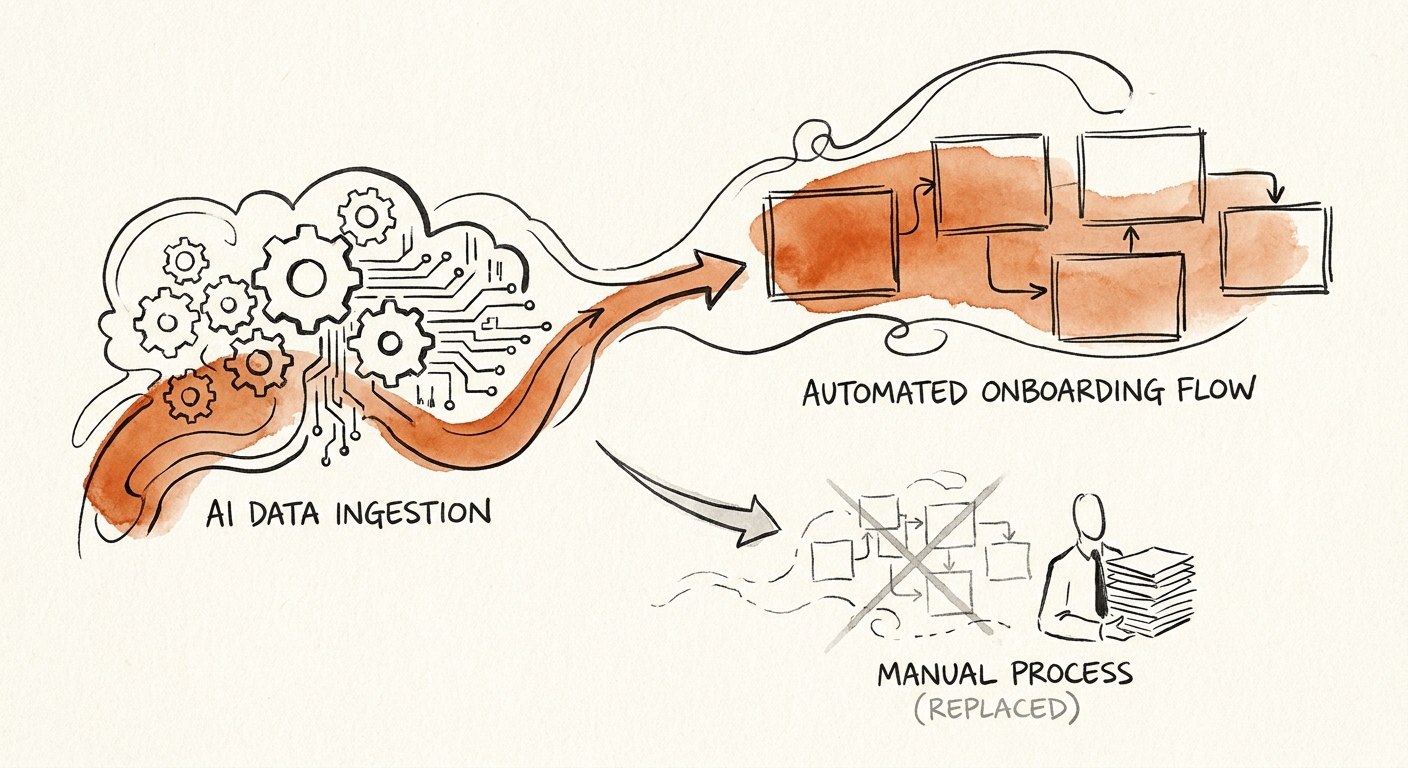
Draw a hard line down the middle of your onboarding flow. On one side: the moments where a human relationship is the product — setting expectations with the champion, aligning the executive sponsor, navigating the "our IT team is nervous" conversation, deciding which scope to cut when the timeline slips. On the other side: the plumbing — parsing the intake form, checking whether the customer actually filled in the SSO domain and the API key, mapping their field names to yours, drafting the implementation checklist, and summarizing the kickoff call into next steps before the implementation manager forgets half of it.
AI belongs entirely on the plumbing side, and it earns its keep there because that work is repetitive, evidence-based, and reviewable. A practical first build: an intake validator that reads the customer's submitted form, flags the three integration fields that are blank or malformed, and drafts the exact follow-up email — so the gap gets caught the day the form comes in, not at the kickoff call where everyone discovers the data export is missing. That single loop is often the difference between a two-week and a five-week setup.
Two rules keep this from going sideways. First, low-confidence cases route to a human immediately — a blank field might be a technical dependency, a buyer who misunderstood scope, or a customer team that simply is not ready, and only a person can tell which. Second, governance is decided before launch, not after an incident: where customer data is allowed to go, what gets retained, who can see it, and what the workflow does when it cannot parse an upload. The correct behavior when AI is unsure is to stop and ask for review, never to invent a plausible-looking next step. McKinsey's analysis of generative AI's economic potential consistently points to customer operations as a high-value zone — but the value lands in the prep work, not in replacing the conversation.
The metric that protects you: days to first value
Here is the trap that catches good teams. You automate onboarding prep, internal hours drop, the operations report looks great — and the customer is still waiting longer than before, because the automation optimized your effort instead of their outcome. PwC's customer experience research is blunt about how fast a frustrating early experience erodes trust, and internal-hours-saved is exactly the kind of vanity metric that hides that erosion.
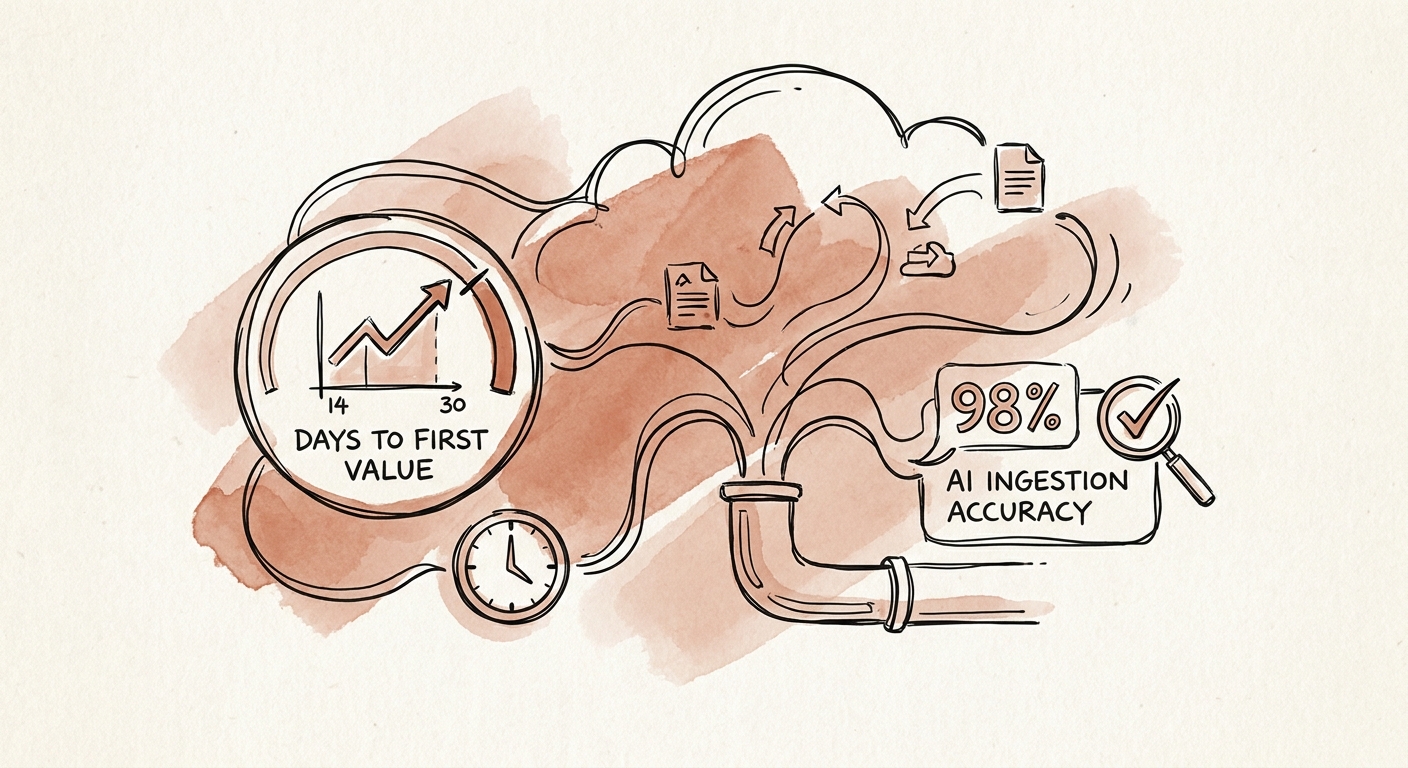
So pick the metric that points at the customer, not at you: days from contract to first business outcome. Track five things and nothing more before you scale — days to first value, rework rate (how often the customer has to resubmit something), missing-data cycles per onboarding, implementation manager load, and a simple champion-confidence check at day 14. If AI cuts your effort but any of those move the wrong way, you built the wrong automation. Rip it out.
You can prove this in 90 days without a platform overhaul. Month one: map the actual onboarding path for your last ten customers and find the single highest-friction data handoff — it is almost always one specific form or export. Month two: build one human-reviewed workflow against those real ten examples, not against a hypothetical. Month three: run it side by side with your current process and compare speed, rework, and how it handles the weird exceptions. Only then add a second intake type or a new customer segment. If you want the broader sequencing, the 90-day implementation plan lays it out, and the AI Workflow Automation service lane is where this work lives.