
The practical answer
- Short answer
- Going from AWS Advanced to Premier costs a 30-engineer shop ~$250k in year one, mostly in lost billable hours — plus the ACE metric that earns it back.
- Best fit
- Industry: Cloud Consulting / MSP. Function: Alliances & Strategy
- Operating path
- Unit Economics → Commercial Performance → Transaction Advisory Services
- Key metric
- $250k+ True Year 1 cost of achieving AWS Premier Tier (including lost billable hours)
A 28-engineer shop, $11M in revenue, and a $250k decision nobody modeled
A founder runs a profitable AWS consultancy. Twenty-eight engineers, around $11M in services revenue, healthy delivery margins. He has an Advanced tier badge and a recurring fantasy: if he can just claw up to Premier, the "flywheel" turns. Amazon account managers start forwarding deals. The badge does the selling. He's been told this by three peers and one channel-marketing deck.
So he greenlights the push. Eighteen months later he has the Premier badge, an EBITDA line that dropped by a quarter, and a co-sell pipeline that looks suspiciously like the one he had as an Advanced partner. The badge generated, by itself, zero net-new revenue. What it generated was a recurring fixed cost he never put on a spreadsheet.
This is the trap, and it's specific to how the AWS Partner Network Services Path actually works in 2026. The APN is not a lead-gen subscription. It's a co-sell validation layer sitting on top of AWS's own field sales org. The tier badge tells Amazon you can deliver. It does not tell an account manager you'll help him close his number this quarter — and that second thing is the only thing that moves deals from his Salesforce into yours. An Advanced partner who walks an AM a net-new logo will out-earn a Premier partner sitting by the inbox every single quarter. The badge is necessary for some doors. It is never sufficient to walk through them.
Your AWS account manager has never once looked at your tier badge before forwarding a deal. He looks at one thing: did the last partner he introduced make him look good in front of the customer, or did they not? Premier doesn't answer that question. Your Launched rate does.
The certification tax is the line that quietly eats your margin
The direct cost of Premier is rounding error: a $2,500 annual program fee, a $3,000-ish MSP audit fee. Founders look at those numbers, shrug, and approve. That's the visible tip. The mass under the waterline is the certification requirement, and for a services firm it lands directly on your billable utilization.
Advanced asks for 6 technical certified individuals. Premier asks for 25 — and not the easy ones. You need a stack of Professional and Specialty certs, the exams a working engineer can't pass on a weekend. Budget 40 to 80 hours of focused study per Professional-level exam for someone who's also billing full-time. Now multiply that across the delta of certifications you don't yet hold. A firm climbing from 6 to 25 is staring at roughly 800 hours of engineer time pulled off client work. At a $200 blended bill rate, that's a $160,000 opportunity cost in study time alone — invisible because it never shows up as an invoice, only as a softer utilization number you'll blame on something else.
Then add the MSP or DevOps Competency audit. The AWS MSP Program validation is a real third-party review, and prep routinely burns 300+ hours of your most expensive people — CTO, VP of Engineering — assembling evidence and rehearsing the on-site. Stack the study time, the audit prep, and certification maintenance churn (certs expire; people leave; you re-spend every cycle) and a 28-engineer shop is looking at a year-one cost north of $250,000 to put on the badge and keep it on.
Here's the breakeven nobody runs. If your project margin is 40%, that $250k of non-billable load demands roughly $625,000 in incremental revenue attributable to the badge itself — not revenue you'd have won anyway — just to get back to even. Before you approve the climb, pressure-test whether your margins can carry that load at all using a clear-eyed unit economics review. Most firms discover the answer is no, and discover it eighteen months too late.
The metric that pays the tax back is your ACE Launched rate
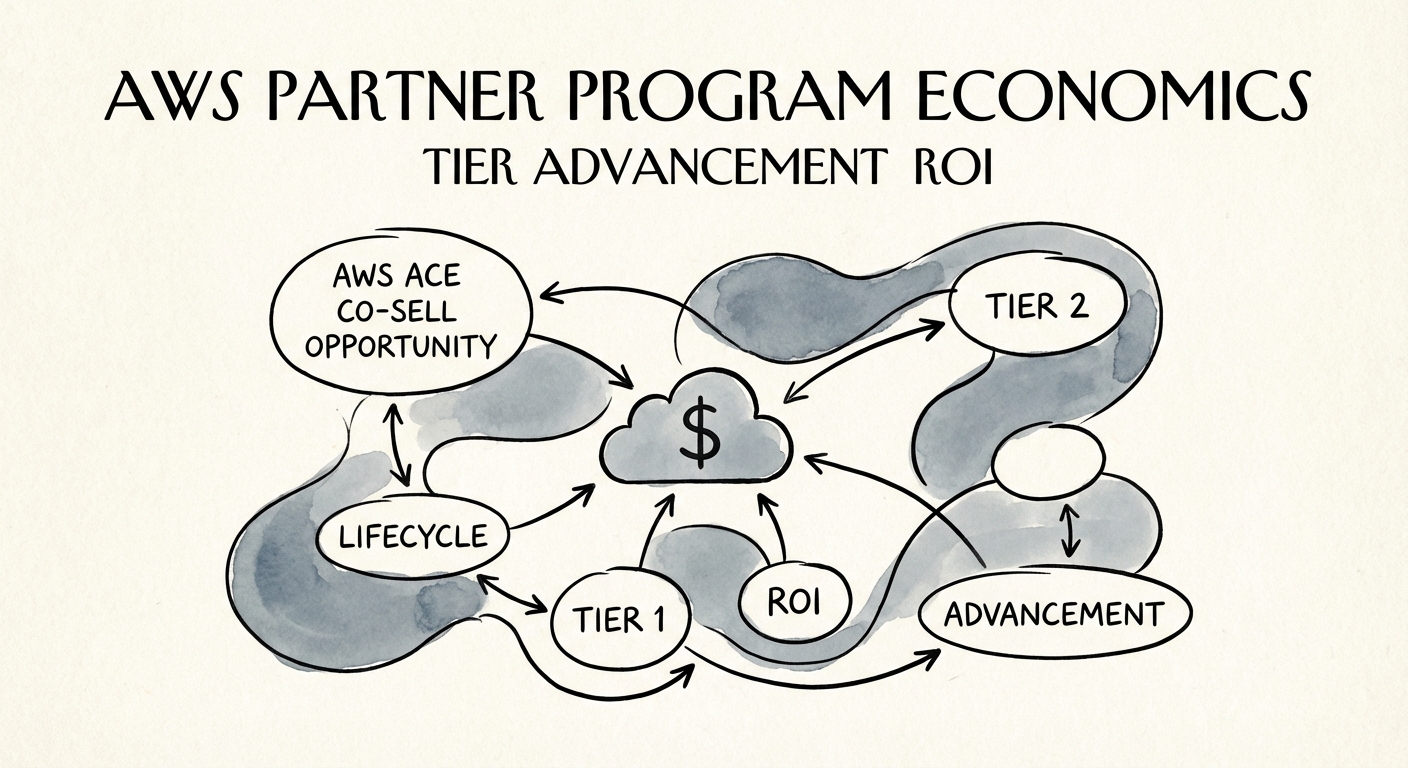
If the badge doesn't generate revenue, what does? Co-sell motion, measured by one number AWS actually rewards: your APN Customer Engagements (ACE) Launched rate. Premier requires 50 Launched opportunities — and "Launched" has a hard definition. The workload is live and billing. Not scoped, not signed, not in flight. Consuming. That single requirement forces the shift that makes Premier worth anything: from selling consulting hours to driving consumption.
The lazy way to hit 50 is to dump opportunities into ACE flagged "Visibility Only" and call it pipeline. It's theater. In 2026 AWS weights its incentives toward partners who actually transact — through Private Offers and CPPO on Marketplace — and who drive consumption in the areas Amazon is paid to grow, GenAI and data foremost. A partner with 50 Launched workloads consuming in those areas is one the field protects. A partner with 50 visibility-only entries is a partner the field has learned to route around. Same badge, opposite economics.
So before you spend a dollar chasing certs, build the engine. Three moves you can start this week: (1) Hire or assign a real Alliances lead whose only job is owning the AM relationship and the ACE hygiene — sub-$20M shops that run alliances as a side-of-desk task get nothing back. Co-selling is a far cheaper path to qualified pipeline than badge-collecting; treat it as a CAC question, not a credentials question. (2) Move your top three reference customers onto Marketplace Private Offers now, so "transacting partner" is true the day you submit for Premier, not a scramble at audit time. (3) Audit your bench honestly — if 25 certifications would tie up more than ~15% of your engineering capacity, the badge will starve delivery, and no co-sell multiplier outruns missed client commitments. Don't paper over that gap with expensive paper-tiger hires bought to fill a quota.
Omdia pegs the prize at $7.13 of partner opportunity for every $1 of AWS spend. Real number, real opportunity — but it accrues to capable partners, not merely certified ones. Build the revenue engine first. Buy the badge second. Do it in that order and Premier becomes an accelerator. Reverse it and Premier is the most expensive vanity metric on your balance sheet.