
The practical answer
- Short answer
- Is reaching HubSpot Elite status worth the cost? We analyze the unit economics, 2025 program changes, and the hidden 'Badge Tax' that erodes agency EBITDA.
- Best fit
- Industry: Marketing & Technology Services. Function: Operations
- Operating path
- Unit Economics → Commercial Performance → Transaction Advisory Services
- Key metric
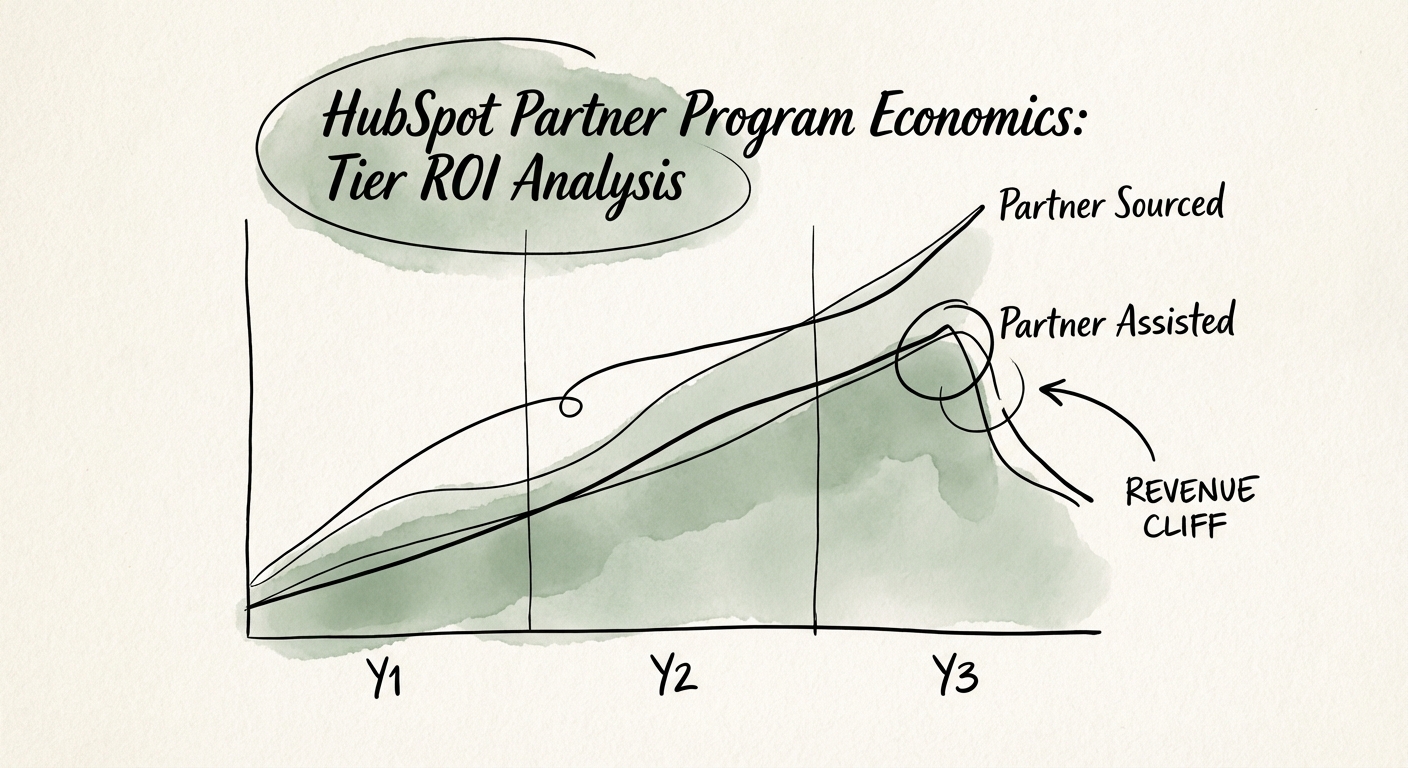
- 20% Commission drop-off (Year 2 & 3) for Partner Assisted deals vs. Sourced deals.
The 2025 'Sourced' Squeeze: A Commission Cliff
For years, the playbook for scaling a HubSpot agency was simple: ride the ecosystem's wave. You implemented the software, maybe referred a few deals, and let the rising tide of HubSpot's market share lift your boat to Platinum or Diamond. In 2025, that tide has gone out, and it’s revealed who is swimming naked.
The critical shift in the July 2025 Partner Program update isn't just about point thresholds—it's the hard pivot from 'Sold' to 'Sourced.' HubSpot has drawn a line in the sand: if you aren't bringing the deal to the table (Partner Sourced), you are a second-class citizen in the ecosystem.
The 3-Year vs. 1-Year Commission Gap
Here is the math that is killing your unit economics. Under the new rules, Partner Sourced deals (where you originate the lead) earn you 20% revenue share for three years. Partner Assisted deals (where you co-sell or implement) earn 20% for only one year.
This creates a massive discrepancy in Customer Lifetime Value (LTV) for your agency. If you are operating as a 'delivery-first' shop, relying on HubSpot's direct sales team to feed you implementation work, your commission stream now evaporates after 12 months. Yet, your cost of account management remains. You are effectively subsidizing the vendor's retention metrics with your own margins.
To maintain the same revenue derived from channel commissions, you now have to act like a software sales organization. This forces you to increase your Customer Acquisition Cost (CAC) by hiring expensive sales talent to 'source' deals, rather than relying on organic referrals or partner channel managers. If your sales efficiency isn't elite, you are trading 20% EBITDA margin for a badge.
The Elite badge is a vanity metric if it forces you into a generalist bench model where you compete on rate rather than value. Buyers don't acquire badges; they acquire high-margin, recurring revenue.
The Hidden 'Badge Tax': Calculating the Cost of Elite
Agency founders often view the 'Elite' tier as a marketing asset—a trust signal that allows them to charge premium rates. But when we audit the P&L of agencies chasing this status, we often find a 'Badge Tax' that outweighs the revenue lift.
Consider the requirement for Elite status: 100+ certifications. Let’s break down the utilization impact.
- Average time per certification: 4-6 hours (including study and testing).
- Total non-billable hours: ~500 hours annually to maintain.
- Opportunity cost: At a blended billable rate of $200/hour, that is $100,000 in lost billable capacity per year just to maintain compliance.
That $100k hit hits your bottom line directly. And it gets worse. The usage and retention signals and retention requirements mean your team must spend unpaid hours 'customer success-ing' the portal—ensuring clients are using features to keep HubSpot's churn low, not necessarily to drive your own service revenue. You are paying your consultants to be HubSpot's CSMs.
The 'Generalist' Margin Compression
The data from 2025 benchmarks is clear: Generalist agencies (those who do 'everything HubSpot') are seeing net margins compress to 6-15%. Why? Because the barrier to entry for 'setting up HubSpot' is zero. You are competing with thousands of Gold and Platinum partners on price. Meanwhile, 'Specialist' agencies—those who ignore the tier game and focus on vertical-specific IP (e.g., 'HubSpot for Healthcare' or 'RevOps for FinTech')—are commanding 25-43% net margins.
The Elite badge is a vanity metric if it forces you into a generalist bench model where you compete on rate rather than value.
The Profitability Playbook: Systems Over Status
If you are a Founder stuck at $5M-$10M revenue, stop obsessing over the tier and start obsessing over your Revenue Per Employee. The goal is not to be a 'HubSpot Shop'; the goal is to be a business problem solver that uses HubSpot.
1. Decouple Services from Resale
Stop forecasting commission checks as core revenue. Treat channel commissions as 'icing'—pure profit distributions or bonuses for the team—but do not build your OpEx budget around them. If your agency is unprofitable without the 20% kickback, you have a broken business model.
2. Specialize to Survive
The 'Sourced' point requirement favors agencies with strong, independent marketing engines. The only way to build that engine without blowing up CAC is specialization. You cannot effectively market 'HubSpot Implementation' to the entire world. You can market 'Patient Acquisition Systems' to Dental Networks. Specialized agencies source deals naturally because they solve expensive business problems, not software configuration tickets.
3. Audit Your 'Partner Seat' Usage
Review your 'Managed MRR' portfolio. Are you servicing 50 small clients just to hit a tier threshold, while losing money on 40 of them? Fire the bottom 20% of your client base that drags down your utilization. It is better to be a highly profitable Diamond partner than a breakeven Elite partner dying of delivery fatigue.
The Verdict: The badge looks good on a slide deck, but EBITDA looks better in a bank account. Don't let the partner program run your business.