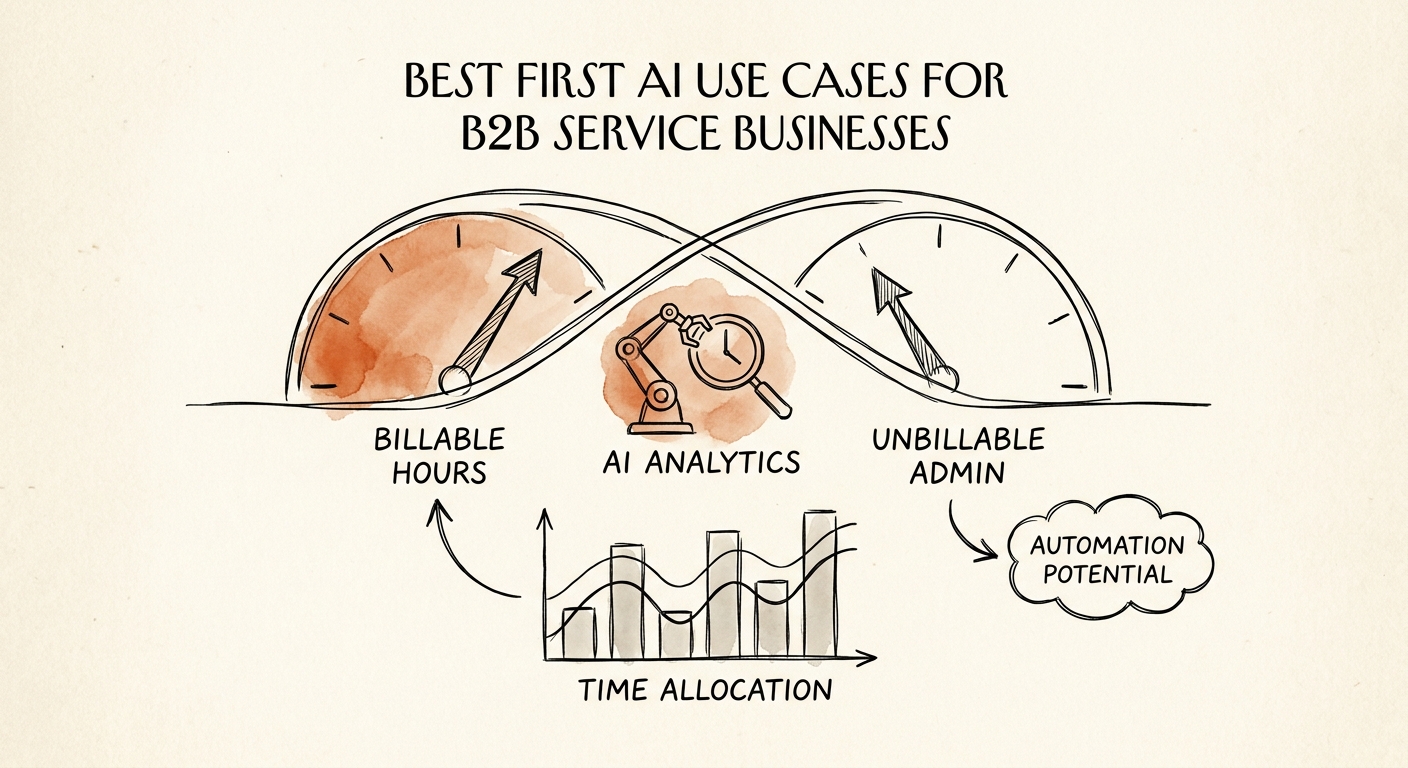
Watch where the billable hour leaks
Picture a 30-person consultancy on a Tuesday. A senior associate spends forty minutes pulling a prospect's last three contracts, two project recaps, and an old scope doc into one place before she can even start the proposal. The next morning a project lead retypes his own meeting notes into action items, then re-explains the same status in three different formats for three different stakeholders. None of that is the work the client pays for. All of it bills against utilization — or worse, doesn't bill at all.
That gap is the first place AI belongs in a service business. Not the advice, not the deliverable, not the relationship — the connective tissue around them: document intake, proposal assembly, meeting follow-up, account research, and status reporting. These are the tasks that consume senior attention without requiring senior judgment, which is exactly the profile of a good first use case.
This isn't a hunch about where the value is. McKinsey's 2025 State of AI finds the durable gains concentrating in redesigned workflows rather than scattered tool adoption, the IBM Institute for Business Value ties returns to embedding AI in defined processes, and PwC's 2025 Responsible AI survey shows the firms with guardrails outpacing the ones running open-ended experiments. Translation for a partner: pick one coordination task that recurs every week, and govern it.
The deliverable carries your name — so build the review path before the output
Here's what makes service firms different from, say, a warehouse or a call center. When AI ships something wrong in a logistics flow, you reship a pallet. When AI drops a wrong assumption into a client proposal or a board update, you've spent trust you can't reorder. The output goes out under a partner's name, and the client assumes a person stood behind every line.
So the rule for a service firm is inverted from most playbooks: design the review path first, then connect the AI. Before a single proposal draft gets generated, you should be able to answer four questions. Which source systems did it read — CRM, the project workspace, the contract folder? What did it flag as missing or assumed rather than quietly guessing? Who signs off before it reaches the client? And what does "good" look like, written down, so the reviewer isn't grading vibes?
Take meeting follow-up as the starter. The AI listens, drafts action items with owners and dates, and produces a recap — but it routes to the engagement lead for a thirty-second confirm before anything hits the client thread. The associate stops retyping notes; the lead still owns the commitment. That's the shape of every good first workflow: AI does the assembly, a human owns the judgment. A governed approach for professional services is the difference between a firm that scales delivery and one that scales its error rate.
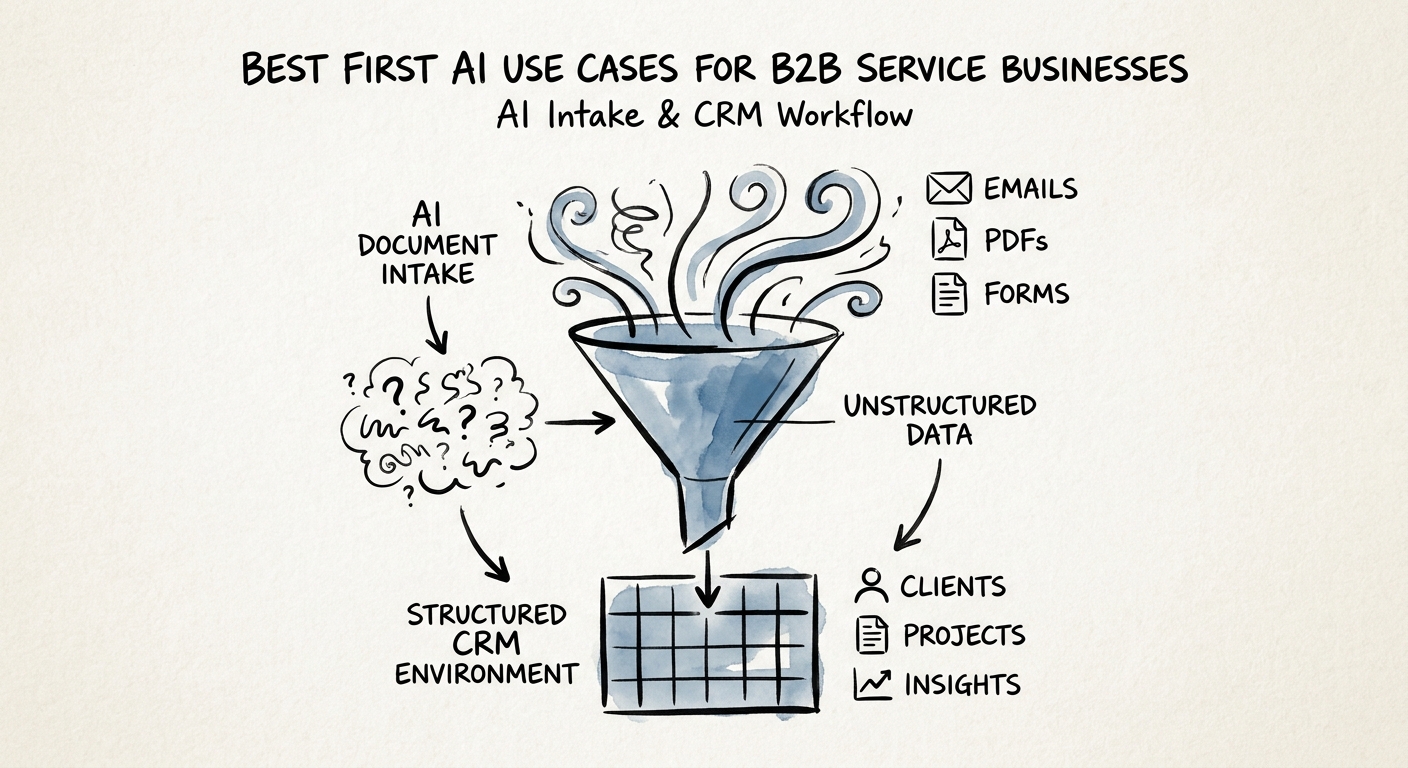
Measure the drag you removed, not the magic you added
The wrong scoreboard for a service firm is "how impressive is the AI." The right one is "how much coordination drag disappeared." Pick a handful of numbers you can actually read on a narrow pilot: how complete intake packets are before work starts, proposal cycle time from request to send, the lag between a meeting ending and tasks being assigned, the time it takes to produce a status report, and — the one partners feel in their gut — how much rework lands back on senior staff.
Keep the first pilot small enough that you can inspect every output by eye for a few weeks. If associates start trusting the drafts and an engagement lead can point to hours that came back, you've earned the right to expand into the next workflow over. If they're quietly redoing the AI's work, you've learned that cheaply, before it touched a client. Either outcome beats a firm-wide rollout you can't measure.
The sequence matters more than the tooling. Name the one workflow that costs you the most senior attention this quarter, map its sources and its sign-off, and run it. When you're ready to design the process around it, AI Workflow Automation is the build path, and the AI ROI Calculator turns "less rework, faster follow-through" into a number you can put in front of partners.