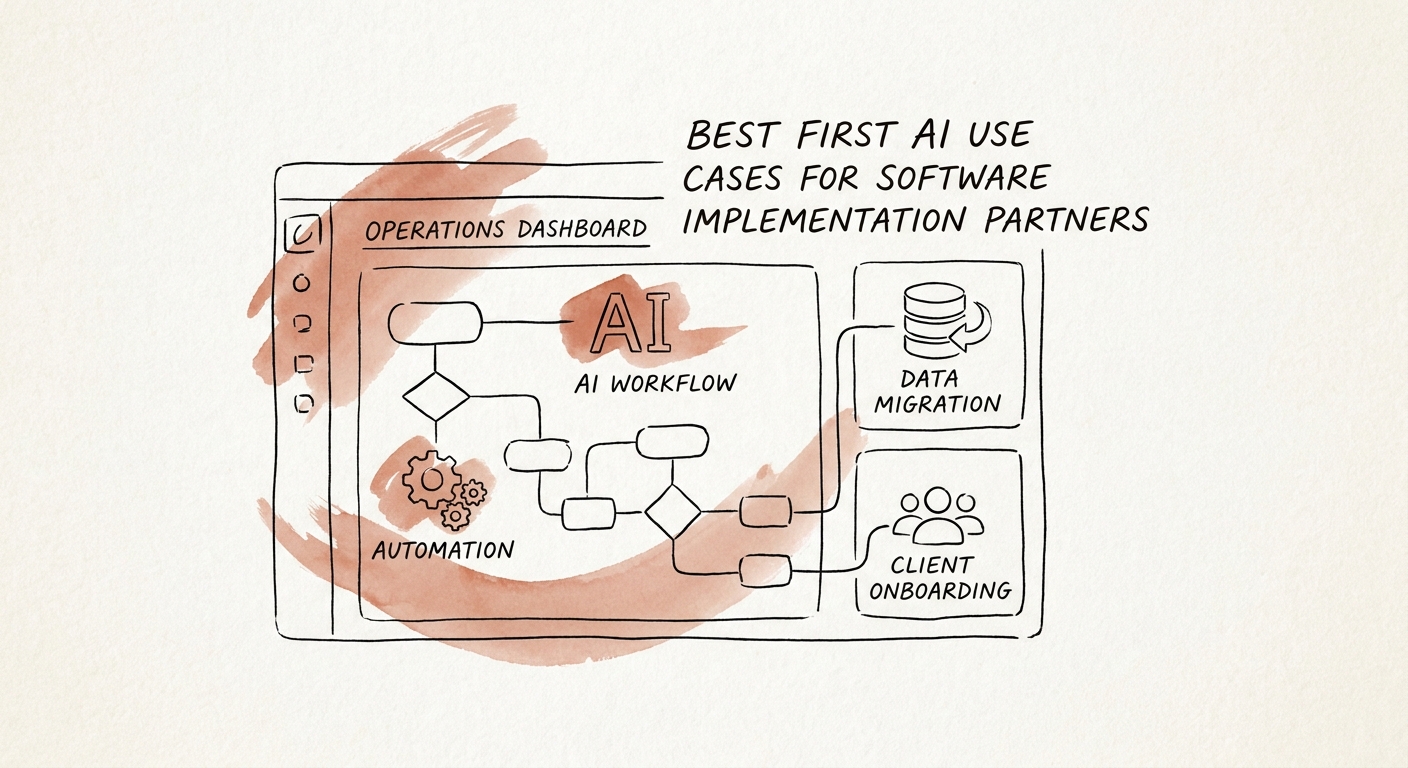
The decision was made in week one. Nobody can find it in week nine.
Picture a 90-day NetSuite or Salesforce rollout. In the kickoff workshop, the client's controller says approval routing has to skip managers under a $5K threshold. The consultant nods, scribbles it on a whiteboard, and three weeks later configures it from memory. At UAT, finance flags that the threshold is wrong, and now you're in a he-said-she-said about a decision made on day three that nobody can produce. That gap, between what was agreed in the room and what ended up in the system, is where implementation partners bleed margin: unbilled rework, scope arguments, and a client who stops trusting your notes.
That is exactly where your first AI use case belongs. Not a chatbot. Not "AI strategy." A workshop-to-decision-record workflow: AI ingests the recording and shared notes from a requirements session, extracts the configuration decisions, the open questions, and who owned each one, and produces a structured record your consultant reviews and signs off the same day. The job is to capture the threshold, the routing rule, the integration dependency, while the room still remembers it, and tie it to a named owner.
Public research from McKinsey's 2025 State of AI, the IBM Institute for Business Value, and PwC's 2025 Responsible AI survey all land on the same point: the value shows up when AI is wired into a workflow with a clear owner and a governance check, not when it's bolted on as a side tool. For implementation work, the owner is your delivery lead, and the check is their sign-off on the decision record.
Sequence by where the evidence trail breaks, not by what demos well
There are five recurring delivery surfaces an implementation partner touches on every engagement: requirements intake, configuration rationale, UAT/test evidence, status reporting, and knowledge retrieval across past projects. The mistake is trying to AI-enable all five at once, or starting with the one that looks impressive in a partner all-hands. Start with the one where your evidence trail breaks today and costs you in disputes.
For most implementation shops, that's the configuration-to-test handoff. Say a 30-person partner runs eight concurrent ERP rollouts. The decisions live in Slack, the config sits in the system, and the test cases are written by whoever's free that week, often disconnected from what was actually agreed. AI's job here is narrow and unglamorous: take the decision record from intake, generate draft test cases that map one-to-one to each decision, and flag any configured setting that has no corresponding agreed decision behind it. That last flag is the money: it surfaces the rogue config a junior consultant added without a paper trail, the thing that detonates at go-live.
Before you automate anything, write down four things for that one workflow: the required fields (decision, owner, threshold/value, source timestamp), who approves the output, where it lands (your PSA or project workspace, not a stray doc), and the exception path when AI can't find a source. AI prepares and cites; it never invents a client commitment. If AI for Technology Services is the lane, this is the concrete first build inside it.
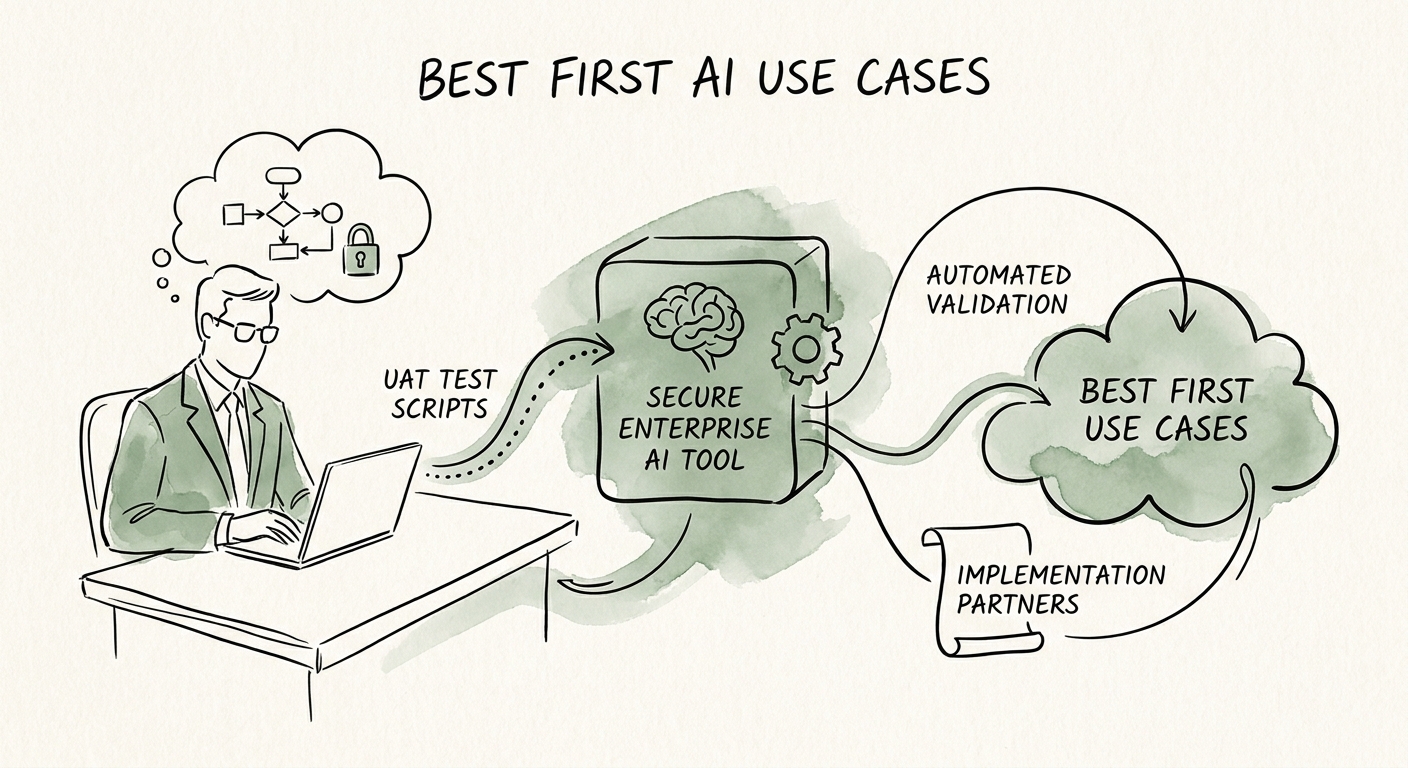
The metric that proves it: decisions with no traceable source
Vanity metric: "documents generated." Real metric: the number of configured settings at UAT that can't be traced back to an agreed decision. Track that count per project before and after the pilot. If it drops, you've cut the exact rework and scope-dispute class that eats implementation margin. Pair it with two more: average lag between a requirements session and a usable decision record (target: same day, not next week), and consultant hours spent reconstructing "what did we agree to" mid-project.
Run the pilot in shadow mode on one active engagement: AI produces the decision record and draft test cases, the delivery lead keeps doing it the old way in parallel, and you compare for three or four sprints. The moment the lead trusts the AI trail enough to act on it without rebuilding it, you've earned the right to extend the pattern, next to status reporting (which the decision record already feeds), then to cross-project retrieval so a new consultant can ask "how did we handle multi-entity tax config last time" and get a cited answer instead of a Slack archaeology dig.
To stand up the retrieval layer over your past delivery records, start with AI Knowledge Systems and RAG; to design the approval and exception path around it, AI Workflow Automation. The Bain 2025 agentic AI report and the NIST AI Risk Management Framework both reinforce starting narrow with a human accountable for the output, which is precisely how a delivery lead should treat their first pilot.
