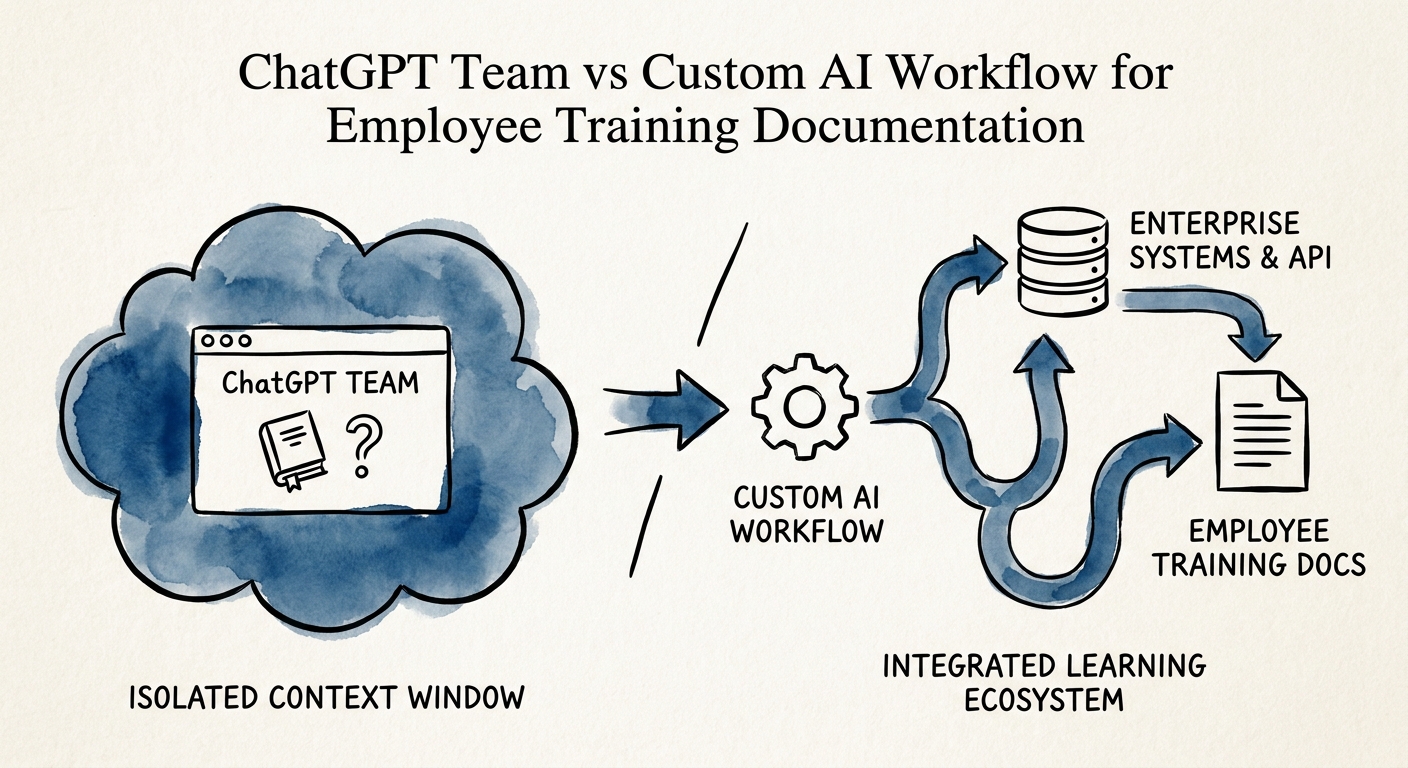
The module looked great. The process it taught was retired in Q1.
Picture a 90-person services company. Someone in enablement pastes the "client onboarding" SOP into ChatGPT Business, asks for a clean lesson plus a five-question quiz, and ships it to the LMS by lunch. It reads beautifully. The problem: that SOP describes a handoff step that the operations team quietly changed two quarters ago. So every new hire now learns, with confidence, a process that no longer exists — and the polish makes the error harder to catch, not easier.
This is the specific failure mode of AI for training documentation. The model is excellent at the part that was never your real bottleneck (turning a procedure into a readable lesson) and structurally blind to the part that is (knowing whether that procedure is the current, approved one). ChatGPT Business can rewrite an SOP into a quiz. It cannot tell you the SOP is dead.
Broad adoption research from RSM, the San Francisco Fed, and the OECD keeps landing on the same point for companies your size: the win is practical, not magical. For training docs specifically, practical means fewer modules teaching retired steps, clear ownership of each source procedure, and updates that reach the LMS before the next cohort starts.
So the first question isn't "can AI write a good lesson." It's "when an operations manager changes a step on Tuesday, what makes the training module reflect it by Friday?" If the honest answer is "nothing — enablement reauthors from memory whenever someone complains," a chat tool will just produce prettier versions of the gap.
Chat is fine for the writing. The thing you actually need to control is currency.
Here's the clean division of labor. ChatGPT Business gives a shared space to draft lessons, generate quiz items, and tighten language — and OpenAI's privacy guidance covers the business-data controls you'll want before pasting internal procedures in. Use all of that only once the source owner confirms the procedure is live. The drafting is genuinely good and probably good enough for a while.
What chat can't hold is the spine that keeps training honest: which SOP version is approved, who owns it, what changed and why, which LMS module that version produced, and whether a manager signed off before publish. That's a state machine, not a conversation. A new step ships, the owning manager approves it, the linked training module gets flagged stale, the rewrite routes back through that owner, and only then does it go live. No employee ever sees an unapproved process change wearing the "official training" badge.
This is also where two governance references earn their place. The NIST AI Risk Management Framework gives you the accountability and monitoring vocabulary for "who is responsible when a training output is wrong." And CISA's AI data-security guidance matters the moment your SOPs contain the things training SOPs love to contain — customer-data handling examples, security procedures, escalation paths. A drifted security procedure in a training module isn't a typo; it's a teaching error that propagates to every hire.
So don't grade a training-doc AI on prose. Grade it on three things: can a source owner challenge and override what the model produced, does an unapproved step get blocked from reaching a new hire, and is the publish action logged well enough that a manager can reconstruct "why did the May cohort learn it this way" six months later. If chat can't answer those — and on its own it can't — that's your build signal.
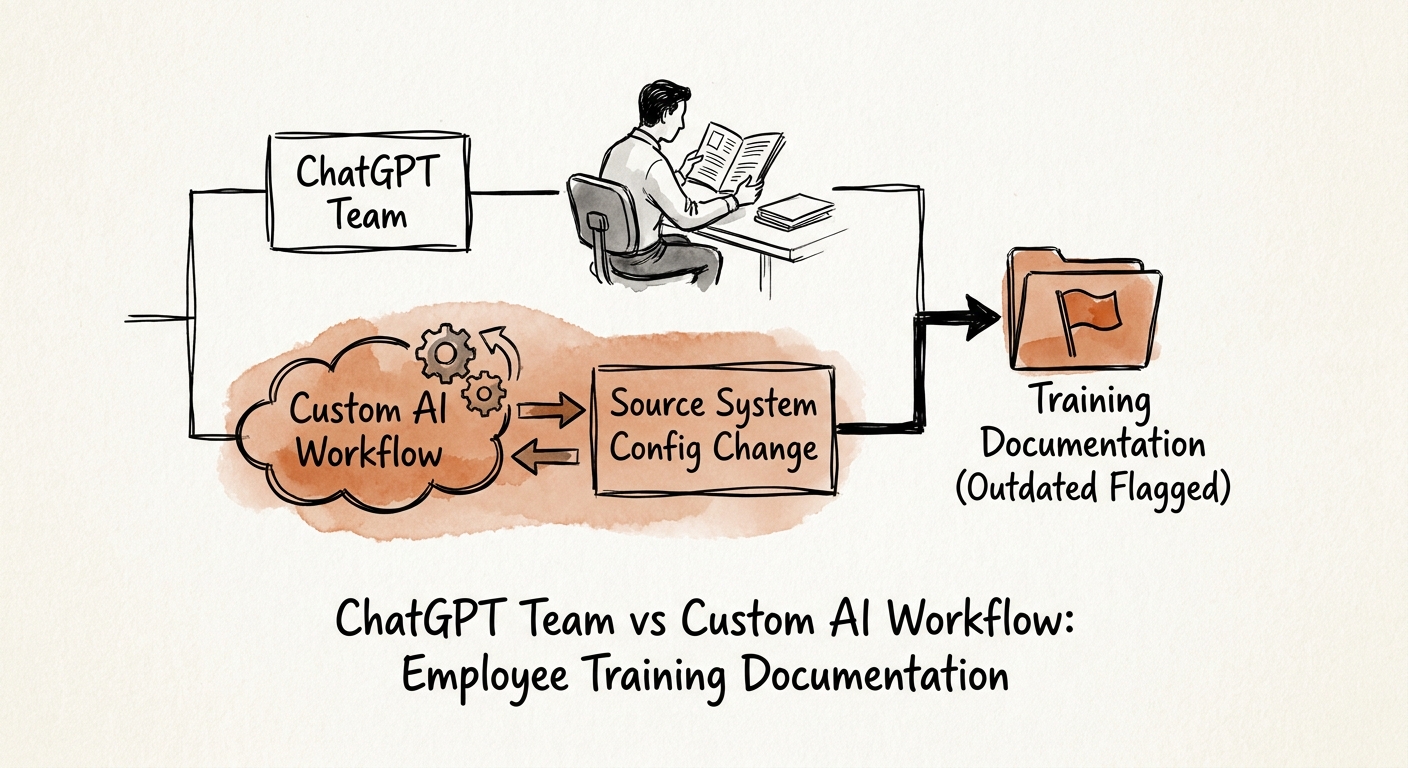
Let the friction numbers, not the demo, tell you when to build.
Deloitte's State of AI in the Enterprise 2026 tracks the same maturation everywhere: teams graduate from individual tools to production systems once the manual coordination cost shows up. For training docs, the payoff of building is concrete — faster ramp, fewer "that's not how we do it anymore" manager corrections, and modules that don't decay the week after you publish them.
You don't need a roadmap to find the threshold. Count five things for one month: how many published modules are tied to a stale source SOP, how long approval takes from "step changed" to "training updated," your manager correction rate on new-hire work, the lag between a process change and the LMS reflecting it, and how many support tickets trace back to someone following outdated instructions. If those numbers are ugly because writing is slow, keep ChatGPT Business — drafting is the bottleneck. If they're ugly because nobody knows which version is current and updates never reach the LMS, that's a version-control problem, and chat will not fix it.
Start narrow. Pick the one training family where drift is already visible — usually the process that changed most recently or generates the most "wait, is this still right?" questions. Use manual-work scoring to confirm the pain is real, then prove out the hard parts on that one family: source ownership, version routing, and LMS sync. Don't expand until the owner can point to a real before/after — shorter approval cycle, fewer corrections, lower drift — rather than "the lessons read nicer now." A pilot that only improved writing quality proved the wrong thing, and expanding it just scales the original problem with better grammar.
