The 47-minute webinar that should have been twelve assets
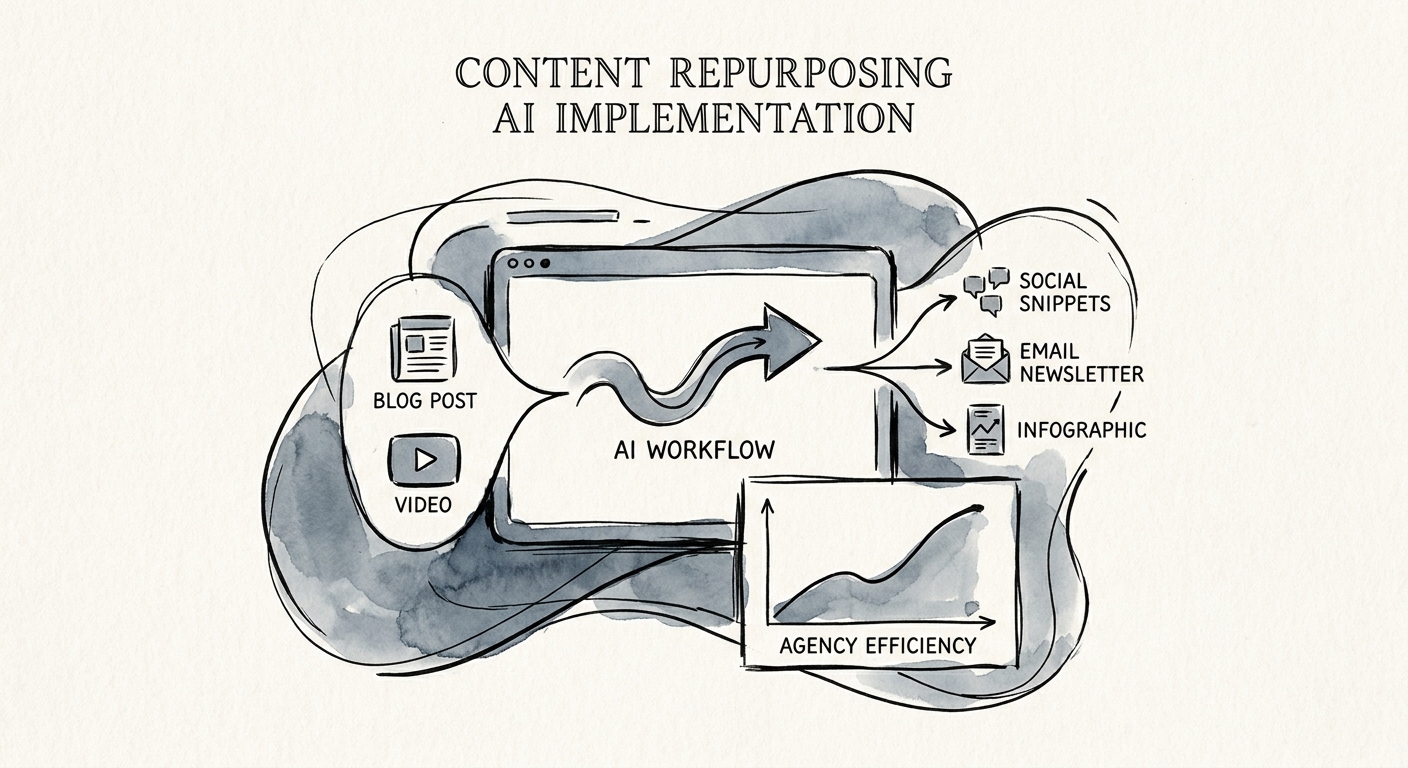
Picture a 30-person agency that just ran a client webinar. Forty-seven minutes of recorded expert content, a polished slide deck, a registration page, and a transcript. Three months later, that asset has produced exactly one thing: a "watch the replay" email. The content team meant to chop it into LinkedIn posts, a blog recap, a few short clips, a nurture sequence, and a sales one-pager. They never got to it, because slicing one long-form asset into a dozen channel-native pieces is grinding, low-judgment work — and there is always a live client fire that outranks it.
This is exactly where content repurposing earns its keep as an agency's first serious AI workflow. The source material already exists and is already approved: webinars, briefs, case notes, recorded calls, podcast transcripts, campaign pages. You are not asking a model to invent a point of view. You are asking it to re-cut material a client already signed off on into the shapes each channel needs. The Salesforce State of Marketing report documents how marketing teams are leaning on AI and data to personalize and scale engagement — and repurposing is the cleanest place to start, because the personalization is constrained by what was already said.
The operating question is not "can AI write this." It is "can we keep brand quality intact while deleting the mechanical resizing and summarizing." The HubSpot State of Marketing report shows marketers actively adjusting to AI-assisted content and shifting channel expectations. Notice the constraint that keeps you out of trouble: repurpose from approved source material, never from a blank page. Blank-page generation is where hallucinated stats and off-brand voice creep in. Re-cutting a transcript the client already approved is a far smaller surface area for error.
What most agencies get wrong: one prompt, all clients
The failure mode is predictable. An agency wires up a single repurposing prompt and runs every client's content through it. The output reads fine in isolation and completely wrong in context — a SaaS client's measured, compliance-aware voice comes out sounding like a DTC brand's exclamation-point energy, and a financial-services client's carefully hedged claim comes out as a flat promise the legal team never cleared.
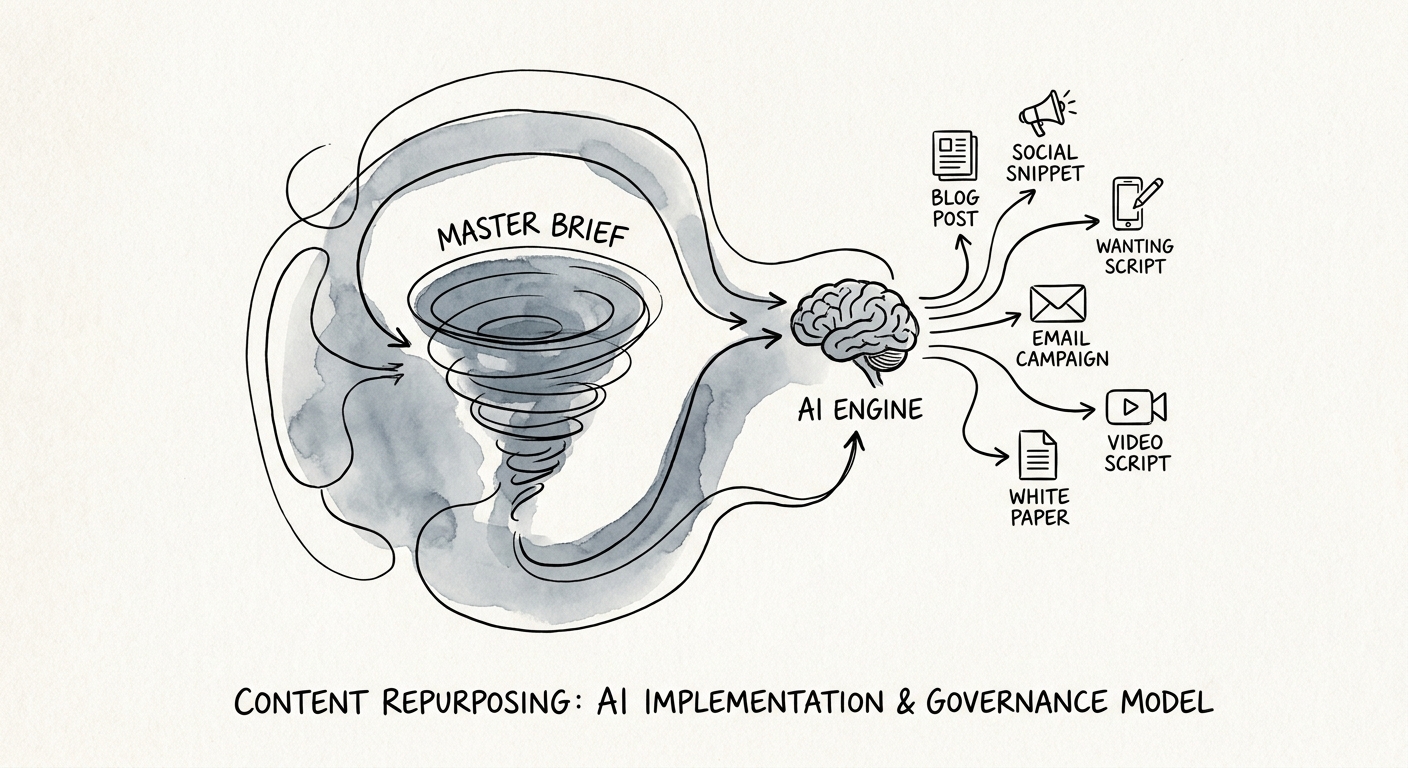
Repurposing AI has to be governed per client, not per agency. That means each client gets its own brand voice guidelines (sentence rhythm, banned words, the difference between "guarantee" and "help you"), its own claim-substantiation list (which numbers are approved, which require a citation, which can never appear), and its own disclosure requirements where regulated. The PwC Responsible AI survey lays out the control logic for adopting AI responsibly: you let the model generate variants, but a human reviewer verifies meaning, evidence, and tone before anything ships to the client or the public.
Here is the workflow that actually holds up. Source asset goes in (the approved transcript or report). The model produces channel variants against that specific client's voice and claims file. A human reviewer checks three things in order — did it change any factual claim, did it stay in voice, did it preserve the original meaning — and the variant either passes or goes back with notes. The McKinsey State of AI 2025 finding that matters most here: value comes from redesigning the workflow, not from bolting a tool onto the old one. Define the inputs, the review roles, the channel outputs, and the feedback loop explicitly — or you will just be generating more low-quality drafts faster.
The number that tells you whether to scale: approved-variant rate
Most agencies measure the wrong thing. They count variants produced and declare victory at volume. Volume is meaningless if a senior strategist has to rewrite every piece. Track the approved-variant rate — the share of AI-generated variants that ship with light edits versus heavy rework — alongside reviewer edit depth, cycle time saved per source asset, and downstream performance by channel. If the model is producing twice the variants but your approved-variant rate is dropping and your reviewers are doing more rewriting, the workflow is producing busywork dressed up as leverage. Do not scale it yet.
What you can do Monday: take your single highest-value piece of approved source material — last quarter's best webinar or report — and run it through this loop once, for one client, by hand. Write that client's voice-and-claims file first. Generate five variants. Have a reviewer log how many shipped clean. That one measured pass tells you more about whether repurposing AI belongs in your agency than any vendor demo will.
To place content repurposing inside the broader campaign and revenue workflow rather than treating it as a standalone hack, see Sales and Marketing AI.
