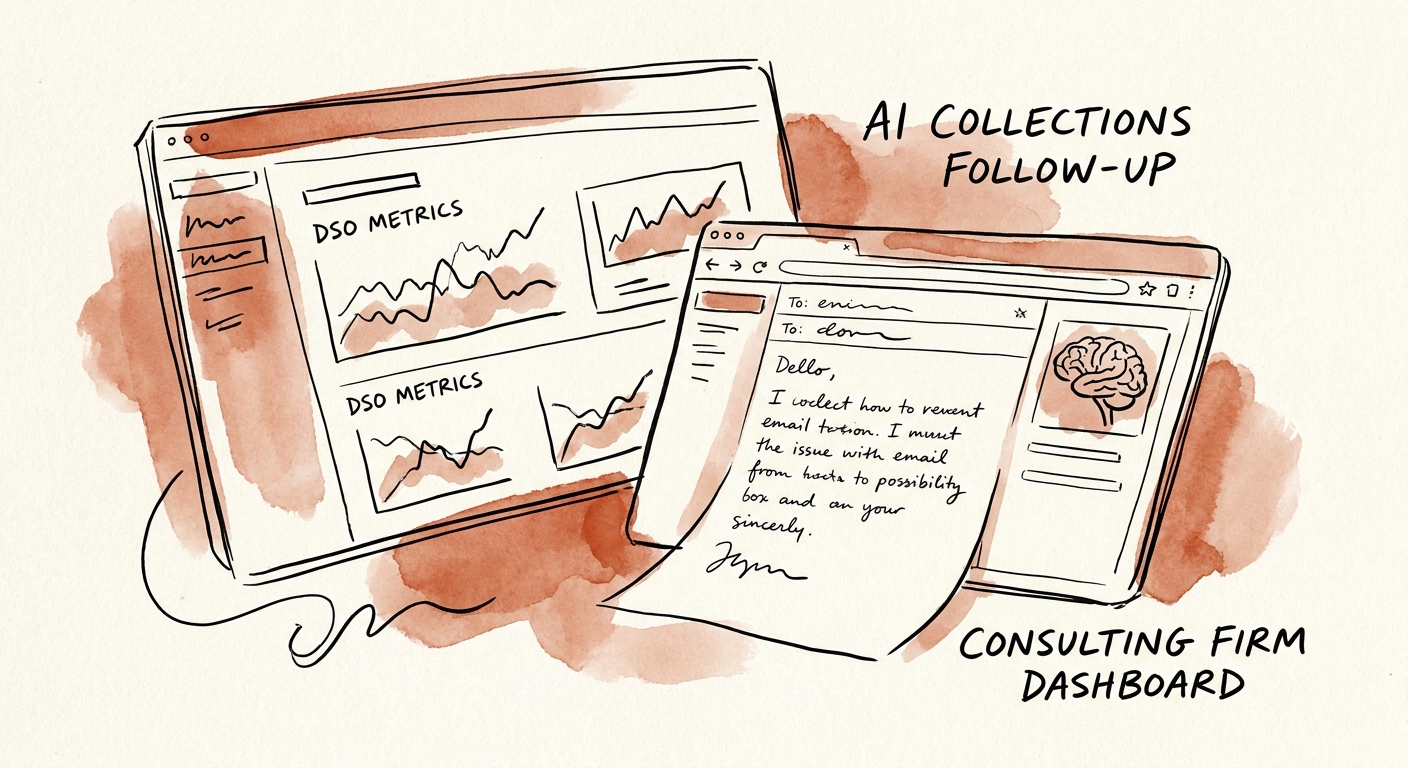
The 90-day invoice nobody wants to send
Picture a 40-person consulting firm closing the month. There's a $48K invoice that's been open 74 days. The partner who owns that account knows exactly why it's stuck — the client disputed two line items on the phase-two scope, the engagement manager promised to revise the SOW, and that revision is still sitting in someone's drafts. Finance doesn't know any of that. They just see an aging bucket turning red. So the dunning email never goes out, because the only person with the context is the same person who's hoping to sell this client a renewal next quarter, and chasing money feels like the fastest way to lose the deal.
That's the specific failure mode in consulting collections: the context that makes a follow-up safe to send lives in a partner's head, while the trigger to send it lives in the finance system. The two never meet in time. The RSM middle-market AI survey shows adoption climbing across firms this size, and the OECD report on AI adoption by small and medium-sized enterprises lands on the same condition: it works only when someone owns the process and the underlying data is actually readable.
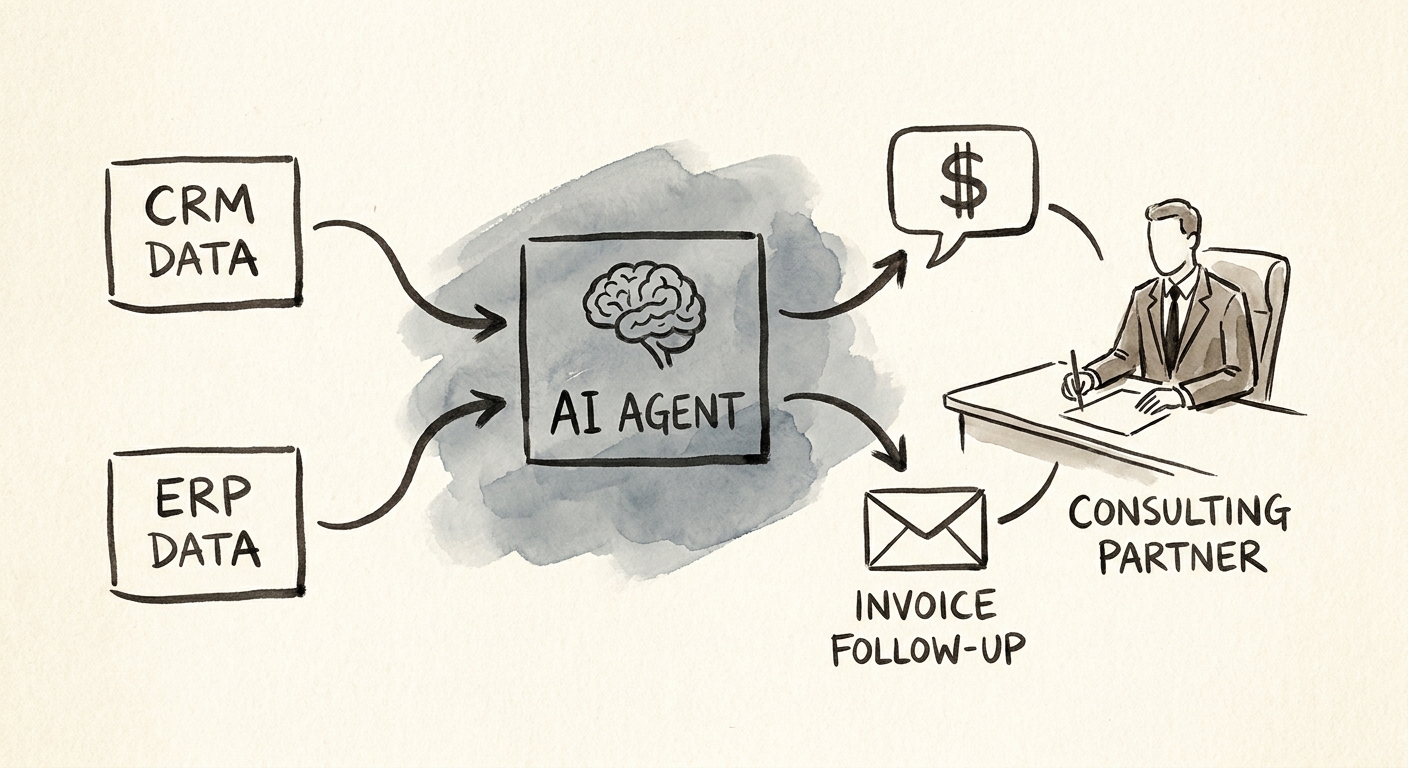
The first build isn't a sending bot. It's an assembly job. For every aged invoice, AI pulls the invoice age and amount, the engagement status from the PSA, any open disputes or revised-SOW threads, the last client touchpoint, the payment terms, and which partner owns the relationship — then drafts a follow-up and a one-paragraph escalation summary the partner can read in fifteen seconds. The draft is the easy part. The context bundle is the asset. Start by running workflow discovery on where your aging report goes to die today.
The controls that keep AI away from the client's inbox
The single rule that makes this safe: AI never sends a collections message to a consulting client. It prepares one. The partner or finance lead reads the draft, edits the tone, and decides whether today is the day. The NIST AI Risk Management Framework gives you the structure to enforce that — govern the workflow, map where the context comes from, measure the risk, manage the controls — but in a consulting firm the controls are specific. Approved data sources only (your billing system and PSA, not a partner's personal notes). An escalation ladder that distinguishes a 30-day nudge from a 90-day "we need to talk" — because the firm that emails a strategic account the same template it sends a one-off project client is going to lose the strategic account. And an audit log of every client communication, so when a partner says "did we already chase them?" there's an answer that isn't a shrug.
Here's where consulting differs from a product business chasing receivables: a late invoice is often a relationship signal, not a cash-flow accident. A client who's slow to pay phase one is frequently a client who's quietly unhappy with phase one. The AI summary should surface that — flag invoices attached to engagements with no recent activity, or with an open dispute, as "do not auto-nudge, partner attention required." That flag turns a collections workflow into an early-warning system for churn, which is worth more than the cash it recovers.
Measure it honestly with a disciplined AI ROI model. The numbers that actually move: days sales outstanding on project invoices, the share of aged invoices that get a touch within the cadence instead of slipping, time partners spend reconstructing "why is this open," and how often a dispute gets caught before it becomes a write-off.
Make it a fifteen-minute Monday, not an autonomous agent
The thing that turns this from a one-time draft generator into recovered cash is rhythm. Once a week, the collections owner opens a single AI-assembled view: every invoice past terms, sorted by amount and age, each with its engagement status, owner, suggested next action, and any "partner attention" flags. Fifteen minutes, top to bottom. Disputes get routed, nudges get approved, the two genuinely awkward strategic accounts get handed to the partner with the context already written. The Deloitte State of AI report makes the same point firms keep relearning: the value isn't in the draft, it's in moving from scattered drafts to a cadence somebody owns.
Resist the urge to skip straight to autonomy. The Gartner agentic AI project forecast warns that a large share of agentic projects get killed because teams automated something relationship-sensitive before the cost, value, and controls were clear. Collections to a consulting client is exactly that kind of work — one tone-deaf automated email can cost a renewal worth ten times the invoice. Keep the human on the send button.
If you want a concrete starting point, the realistic target is roughly 30 days to stand up a governed version: the owner model, the escalation ladder, the "partner attention" flags, and the ROI checks. Map it with a 90-day implementation plan built around your billing system, your PSA, and the handful of accounts where the relationship matters more than the receivable.
