You don't own the vendor. You own the client's opinion of the vendor.
Here's the spot a consulting firm is actually in. A 60-person firm is running a systems implementation for a client. The client doesn't talk to the software vendor, the hosting provider, or the integration partner. They talk to you. So when a vendor sits on a ticket for nine days, that silence doesn't land on the vendor's reputation. It lands on yours, usually at the worst possible moment, which is the weekly client steering call where someone asks "why is this slipping?"
The frustrating part is that the warning was sitting right there. It was buried across forty vendor tickets, three email threads, and a Slack channel nobody on the account team reads end to end. The pattern, say, the same authentication dependency bouncing between two vendors for three weeks, was visible in the data and invisible to the human who needed it. That gap between "the signal exists" and "the account owner saw it in time" is the entire problem worth solving here.
This is why adoption surveys are worth reading skeptically rather than as permission slips. The RSM middle-market AI survey, the San Francisco Fed small-business AI analysis, and the OECD SME AI adoption report all confirm that firms your size are experimenting. None of them tell you whether a vendor-ticket summary will change who picks up the phone on Thursday. That question is yours to answer, and it's the only one that matters.
A pretty summary that doesn't name a vendor owner is worse than no summary
The trap is fluency. A general assistant will happily produce three tidy paragraphs about "ongoing integration challenges across multiple vendors" that read beautifully and tell your account director nothing she can act on. She can't email "the integration" or escalate a paragraph. She needs to know that Vendor A owes a sandbox credential, the client's go-live commitment is now at risk, and nobody has chased it since the 14th.
So design the output as a structured record, not prose. For each summarized cluster, the workflow should emit: the source ticket IDs, the named vendor owner, the impacted client account, the blocker type, an explicit client-risk flag, the follow-up owner on your side, and its status in this week's delivery review. If the model can't fill the "vendor owner" field, that's a real finding, not a formatting glitch. It means the account has a vendor with no accountable contact, which is its own escalation.
Two governance decisions sit underneath this. The NIST AI Risk Management Framework is your tool for defining who reviews the brief, what "wrong" looks like, and how you measure whether it's helping. And because vendor tickets often carry client SLA terms, contract language, and contact details, CISA AI Data Security Best Practices should govern what ticket history the model is allowed to see, retain, and log, especially when one client's vendor data must never bleed into another client's brief. In consulting, cross-account leakage isn't a bug, it's a confidentiality breach.
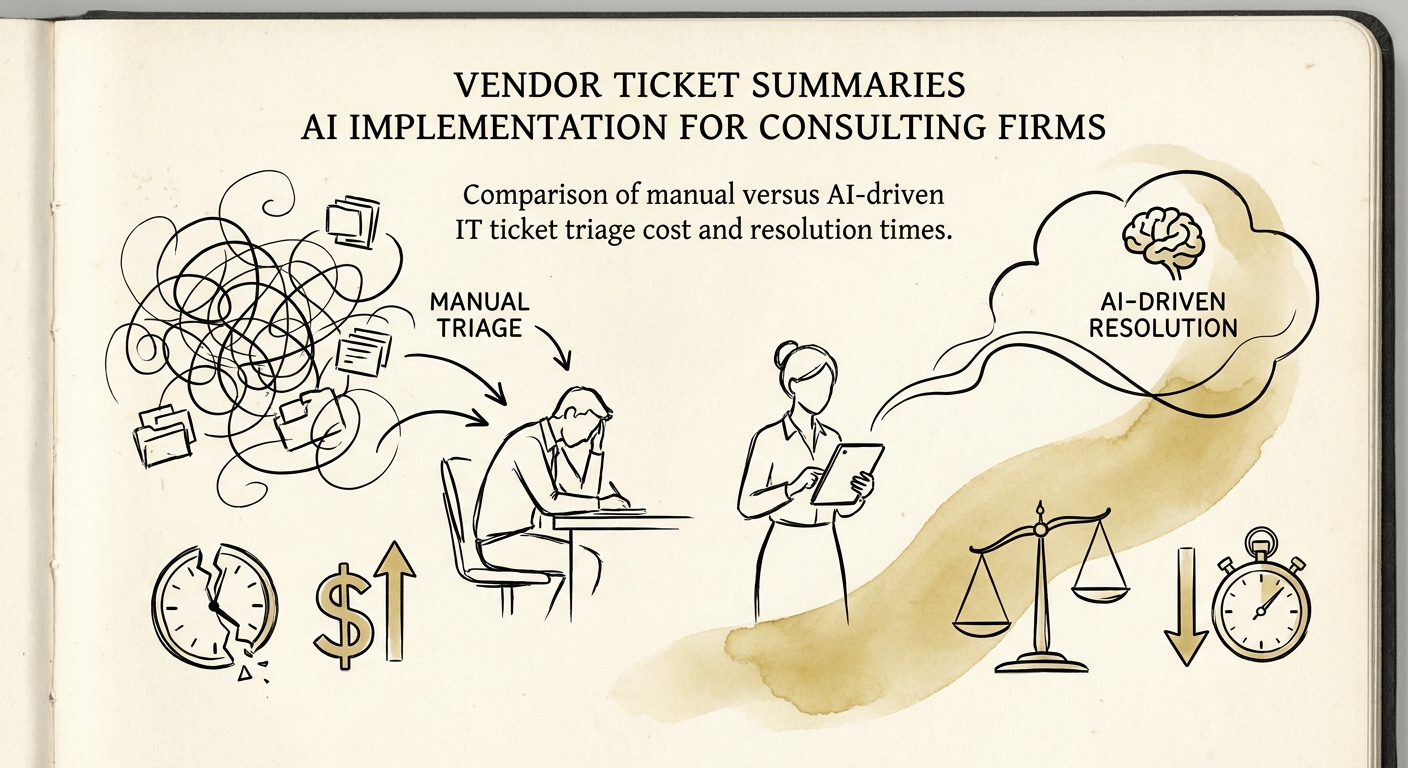
The only success metric: did the account owner act sooner?
The point of the Deloitte State of AI in the Enterprise 2026 read is that the hard part isn't the pilot, it's getting production value. For a vendor-ticket brief, production value has exactly one shape: an account owner escalated a stalled vendor before the client raised it. If your pilot produces gorgeous weekly summaries and the time-to-escalation doesn't move, you built a newsletter, not a workflow.
So instrument the behavior, not the document. Track time from blocker-first-appearance to account-owner action, the count of repeat blockers per vendor, aging on unresolved dependencies, and how many client-risk flags got closed before the next steering call. Watch for the failure signal specifically: if the same person follows up at the same speed they did before the brief existed, the summary changed nothing and you should fix the underlying ticket hygiene before adding more AI on top of it.
Start narrow and let one account prove it. Use the manual-work scoring guide to confirm vendor-risk triage is genuinely worth a standing workflow on this account, then use the 90-day AI implementation plan to sequence the cleanup, the prototype, and the reviewer training. Pick your messiest multi-vendor engagement, group tickets by vendor and blocker type, and make one rule for the first 90 days: every flagged item gets a named next action from the account owner in the weekly review. Roll it to a second account only after a leader can point to a client escalation that didn't happen because someone saw it coming.