The exception that hides until it's a credit memo
Here's the one that stings: a 50-seat security suite at one of your managed clients auto-renews on the anniversary date. Nobody cut a PO. The client offboarded a site eight months ago and is now paying for 14 phantom seats. You find out when their controller forwards the invoice and asks why. Now you're issuing a credit, eating margin, and explaining a process gap to the person who renews your contract.
Inventory exception reporting is a natural first AI workflow for an IT services firm precisely because your "inventory" is the messiest kind: it isn't your own stock sitting in one warehouse. It's client laptops in your RMM, software licenses scattered across vendor portals, warranties in a spreadsheet, spare-pool hardware in a closet, and agreements living in your PSA. The exceptions you care about — an asset that dropped off the RMM 19 days ago, a license renewing inside 30 days with no matching PO, a serial number on a closed ticket that never came back to the spare pool — live in the gaps between those systems. That's exactly where the RSM middle-market AI survey and the OECD report on AI adoption by small and medium-sized enterprises both land: AI pays off when it's pointed at one concrete operating workflow, not when it's sold as a productivity vibe.
So scope it narrowly. The AI reads from your PSA, RMM, and license tracker; it surfaces a single exception family — say, renewals due in 30 days with no PO; it writes a plain summary, cites the exact source records, and routes the item to the named owner. It does not renew the license, deactivate an agent, or adjust a seat count. It hands a clean packet to a human and stops. Before you build it, run the candidate workflow through the manual-work scoring guide to confirm the process is stable enough to automate — if your renewal data is half-tracked in someone's head, fix that first.
Read-only against the systems your clients trust
An MSP's inventory data is unusually sensitive: it's customer device records, contract terms, vendor pricing, and in regulated clients, asset registers that show up in audits. CISA's AI Data Security Best Practices is the right frame here — the automation should pull from approved systems through scoped credentials, honor the same role permissions a technician has, and log the exact PSA ticket, RMM device ID, and license SKU behind every line it flags. If an exception summary can't show its receipts, your dispatcher will (correctly) ignore it, and a flag nobody trusts is worse than no flag at all.
Match the review weight to the consequence. A flagged renewal that touches a billable seat count or a client SLA needs a named owner — usually the account lead or vCIO — to approve the next action before anything moves in a vendor portal. A daily "stale asset" digest that just nudges a tech to re-check why a workstation went dark on the RMM can ride a lighter review, as long as each item still traces back to its source. The line is simple: anything that changes what a client pays or what you've committed to deliver gets a human signature.
Resist the dashboard instinct. The temptation is to ship one screen that watches renewals, stale agents, warranty expirations, and spare-pool drift all at once. Pick one family, run it for a few cycles, and prove it reduces open exceptions without generating corrections you then have to clean up. A narrow workflow that retires real exceptions beats a wide one that produces noise the team learns to swipe past.
The number that matters is the exception that didn't reach the client
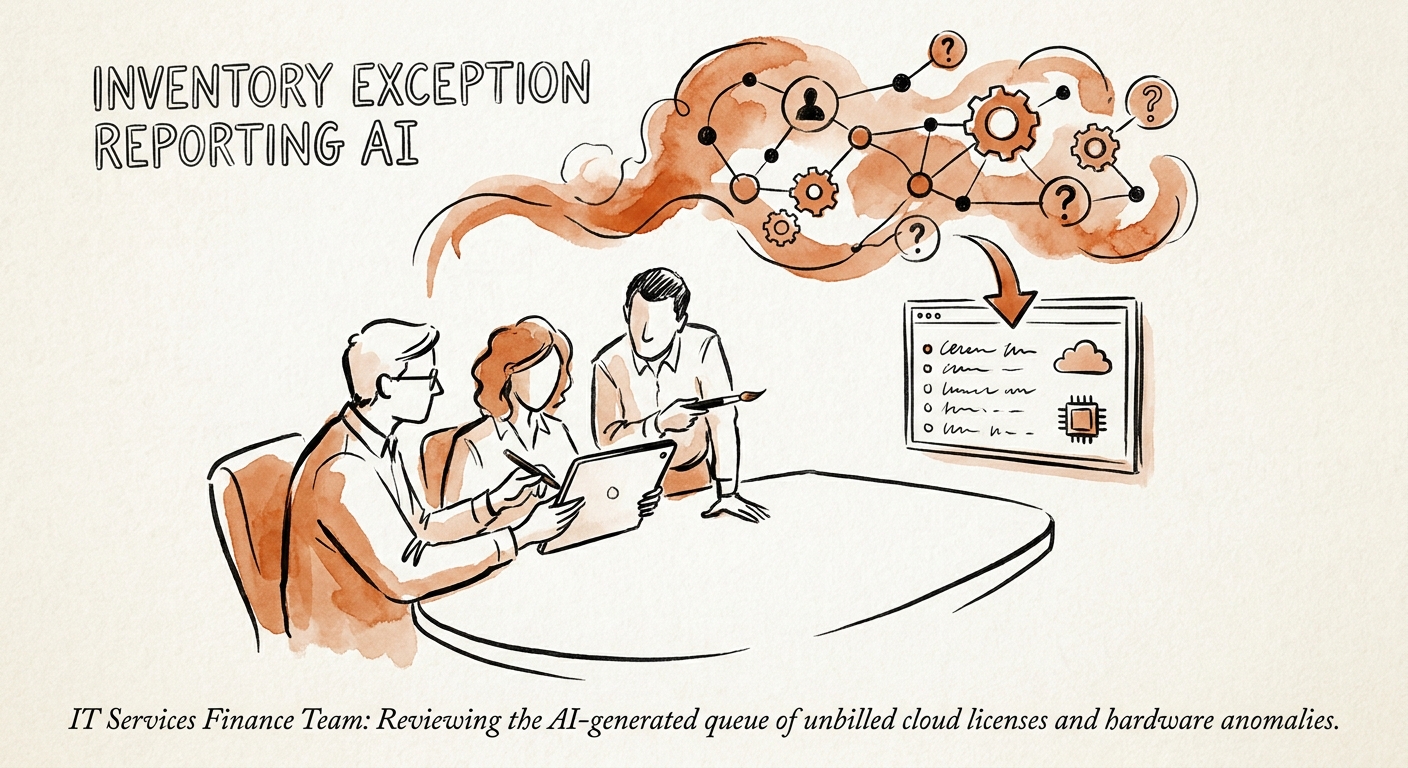
Faster report-writing is not the win. The win is the silent renewal you caught three weeks early, the offboarded site you stopped paying seats on, the laptop you recovered before a client noticed it was missing. NIST's AI Risk Management Framework gives you a clean structure for setting controls and measures before you expand, so track operating outcomes, not output volume: how old the average open exception is when an owner first sees it, owner response time, the correction rate (how often the AI flagged something that wasn't real), and — the one your contract renewals actually depend on — how many client-facing inventory surprises you prevented this quarter.
Apply a hard test before you call it production. If a technician still has to open the PSA, the RMM, and the vendor portal to reconcile every item the AI summarized, the AI saved you nothing — it just added a step. The summary has to be trustworthy enough that the owner acts on it directly, escalating only the genuine edge cases. Until that's true, you have a demo, not a workflow.
Keep the payback honest with AI ROI measurement without fake savings, and when you're ready to sequence this against the rest of your operations stack, build the AI roadmap so the first workflow proves itself before you scale to the next.