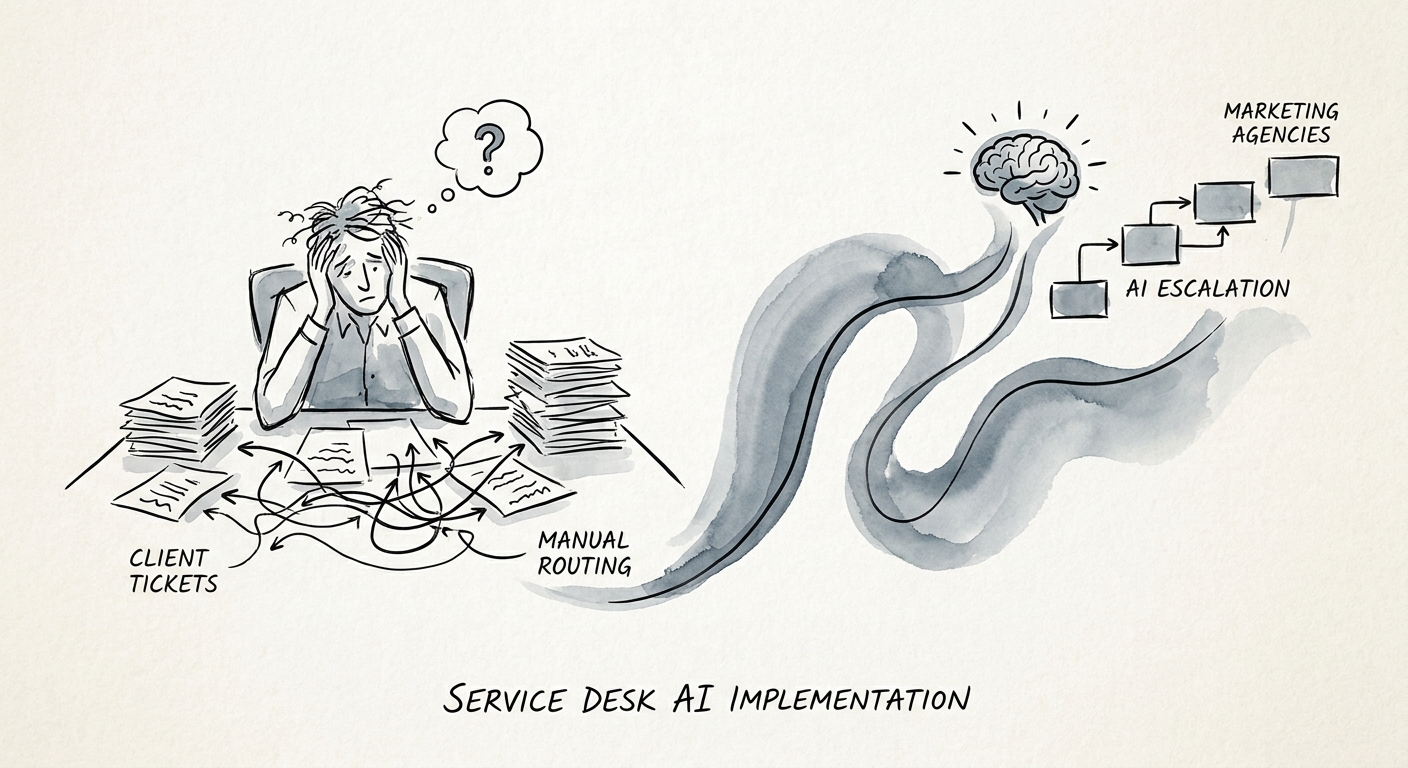
The 4:50 p.m. Friday email
A client account manager forwards a message: "This isn't what we signed off on, and the campaign goes live Monday." Is it a real escalation, a scope dispute dressed up as a fire, or a misread of last week's revisions? In most marketing agencies the answer depends on who happens to read it first, how busy they are, and whether they remember the original SOW. That inconsistency — not the volume — is what makes agency service desk escalation a good first AI workflow. The decision is repeatable, the inputs (the brief, the thread, the deliverable history) are knowable, and the cost of getting it wrong is a renewed-or-churned retainer.
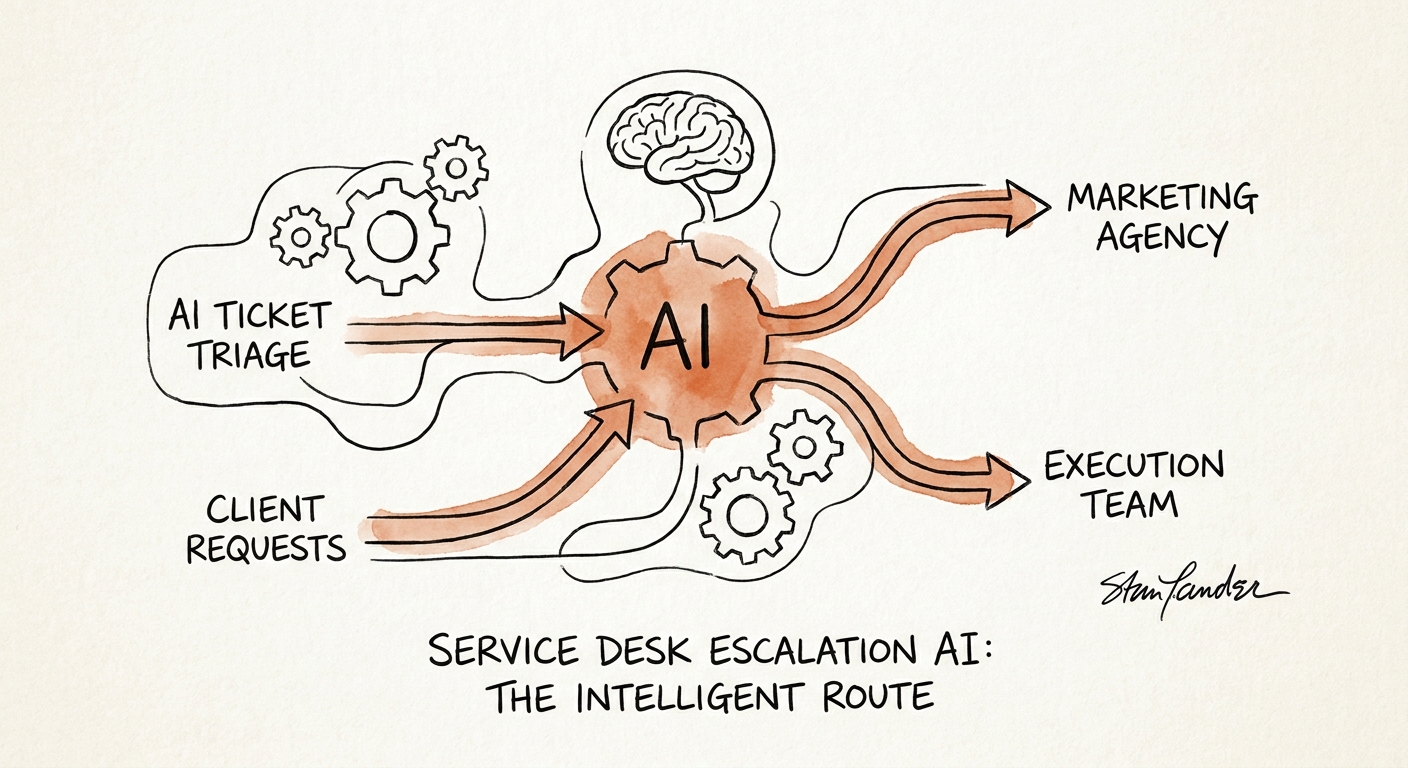
AI adoption is already real at the size where most established agencies sit. The U.S. Census Bureau reported in May 2026 that 32% of firms with 100 to 249 employees are using AI. So the question for a 40- or 120-person shop is no longer whether to start, but where. Escalation triage is a strong candidate precisely because it's bounded: the AI gathers context and proposes a route — handle at the account-manager level, bump to the senior strategist, or pull in the partner — and a human still owns the call to the client. It makes a trained employee faster and more consistent. It must never quietly reset a deadline, agree to out-of-scope work, or invent what the contract says.
What "production" means when the output is a judgment call
The gap between a slick demo and something your account team actually trusts is operating design, not model quality. Deloitte's 2026 State of AI research found that only 25% of leaders moved 40% or more of their AI pilots into production. For escalation triage, the way you close that gap is unglamorous: pull 50 real escalations from the last two quarters, label what actually happened (and what the right call would have been), and measure whether the AI retrieves the correct SOW and revision history, applies your escalation policy, and — most important — flags when it isn't sure instead of guessing. An agency escalation often hinges on one line in a kickoff doc. If the system can't cite that line, it has no business proposing a route.
Keep governance practical, not theatrical. The NIST AI Risk Management Framework gives you a clean map-measure-govern-manage loop for the workflow. Client work carries data you don't own — brand assets, unreleased campaigns, customer lists — so use CISA's AI data security guidance to keep that material inside its permission boundary and out of any model's training set. If you're evaluating a commercial assistant, nail down privacy, retention, and data-use terms during procurement. An agency that leaks a client's unannounced launch into a vendor's logs doesn't get a do-over.
A 90-day path that survives a busy launch week
First 30 days: instrument the current reality. How long does it take an escalation to reach the right person today? How often does it bounce, get sat on over a weekend, or land on a partner who didn't need to see it? Baseline cycle time, mis-routes, and the rework caused by a late catch. Days 30 to 60: run the AI alongside the humans — it drafts the escalation packet (the thread, the relevant SOW clause, a proposed route, and a confidence flag), an account lead reviews every one, and you log where it was right and where it overreached. By day 90 you make a real decision: promote it to production, keep it as a supervised assistant that only suggests, or shelve it because your project history is too scattered for it to cite reliably.
The Federal Reserve Bank of San Francisco's small-business AI research points the same direction: adoption sticks when leaders tie AI to a concrete operating need rather than a vague mandate — and the OECD's work on SME adoption shows smaller firms win by starting narrow. Get escalation triage working and you've built the muscle for the next one. We connect that first workflow to internal knowledge search and pilot-to-production controls, then map the broader sequence in the AI Transformation Blueprint.
