
The practical answer
- Short answer
- Generalist Google Cloud Partners are under pressure. Analysis of the $7.54 ecosystem multiplier, the 12% resale margin cliff, and why Specializations are the only path to 10x exits.
- Best fit
- Industry: Cloud Services / B2B Tech. Function: Operations & Strategy
- Operating path
- Unit Economics → Commercial Performance → Transaction Advisory Services
- Key metric
- $7.54 Partner revenue generated for every $1 of Google Cloud consumption (2025 Projection).
The "Member" Badge Is a Participation Trophy
If you are displaying the standard "Google Cloud Partner" badge on your footer and waiting for leads to roll in, you are already behind. You just haven't looked at your P&L lately.
For the last five years, I've watched mid-market consultancies play the volume game. They sign up as a transacting partner, resell Workspace or GCP credits, and fight for a 20% margin that has now aggressively corrected to 12% (or less) for renewals. They call themselves "Cloud Partners." The market calls them "low-margin resellers."
The economics of the Google Cloud ecosystem have bifurcated into two distinct realities:
- The Generalist Reseller: Survives on shrinking resale margins, competes on price, and trades at 0.8x - 1.2x Revenue.
- The Specialized Expert: Focuses on consumption-driving services (GenAI, Data, Security), charges $250+/hour, and trades at 2.5x - 4x Revenue (or 10x+ EBITDA).
Google has made its stance clear. They don't need more people selling SKUs; they need partners who can deploy complex workloads that stick. The "participation trophy" era is over. If you aren't specialized, you aren't relevant.
A generalist Google Cloud Partner is just a reseller waiting to be disintermediated. The 12x exit belongs to the firm that speaks fluent 'Consumption' and 'GenAI,' not the one pushing Workspace renewals.
The Math: The $7.54 Multiplier vs. The Resale Trap
According to recent ecosystem studies, for every $1 of Google Cloud technology sold, partners generate an average of $7.54 in their own services and IP revenue. This figure has risen from $5.32 in 2020.
But averages are dangerous. They hide the spread.
That $7.54 is not evenly distributed. A "Premier" partner doing mostly resale might see $1.20 of service revenue for every dollar of cloud sold. Meanwhile, a boutique Data & AI shop holding the Machine Learning Services Specialization is likely seeing $10.00+ in service revenue for every dollar of commit they influence. Why?
1. The "Sell-With" Reality
Google field sales reps have quotas retired by consumption, not your billable hours. A generalist who says "we do everything" is useless to a rep. A specialist who says "we can deploy this specific GenAI use case in 6 weeks and burn $50k/month in consumption" is valuable. Specializations are the only way to signal to the field that you solve their problem.
2. The Funding Multiplier
Google is currently offering up to 10x funding multipliers for Generative AI workloads compared to standard migrations. If you lack the Generative AI Services Specialization, you are locking yourself out of the Marketing Development Funds (MDF) and Partner Services Funds (PSF) that your competitors are using to subsidize their customer acquisition.
3. The Audit Hurdle as a Moat
Achieving a specialization requires a third-party technical audit (typically costing $3,000 - $5,000) and vetted customer success stories. This friction is a feature, not a bug. It prevents credential-only competitors from competing with you. If you aren't willing to invest the ~150 hours of engineering prep and audit fees, you will struggle to defend premium rates.
The Fix: Pick a Lane or Get Off the Road
If you are a $10M - $50M shop trying to be "good at Google Cloud," stop. You cannot compete with the Global Systems Integrators (GSIs) on breadth. You must compete on depth.
Here is the diagnostic to fix your GCP economics:
- Audit Your Revenue Mix: If resale > 40% of your revenue, you are a bank, not a consultancy. You are financing Google's growth at 12% margins while taking credit risk. Flip the mix.
- Choose ONE Anchor Specialization: Don't try to get Infrastructure, Data, AND Security all at once. Pick the one where you have 3 referenceable customers today. (Hint: Data Analytics or Generative AI command the highest multipliers right now).
- Calculate Your "True" Utilization: Are your certified architects actually billing, or are they "bench warming" while waiting for a resale deal? Utilization below 75% for delivery staff destroys the ROI of any partner program.
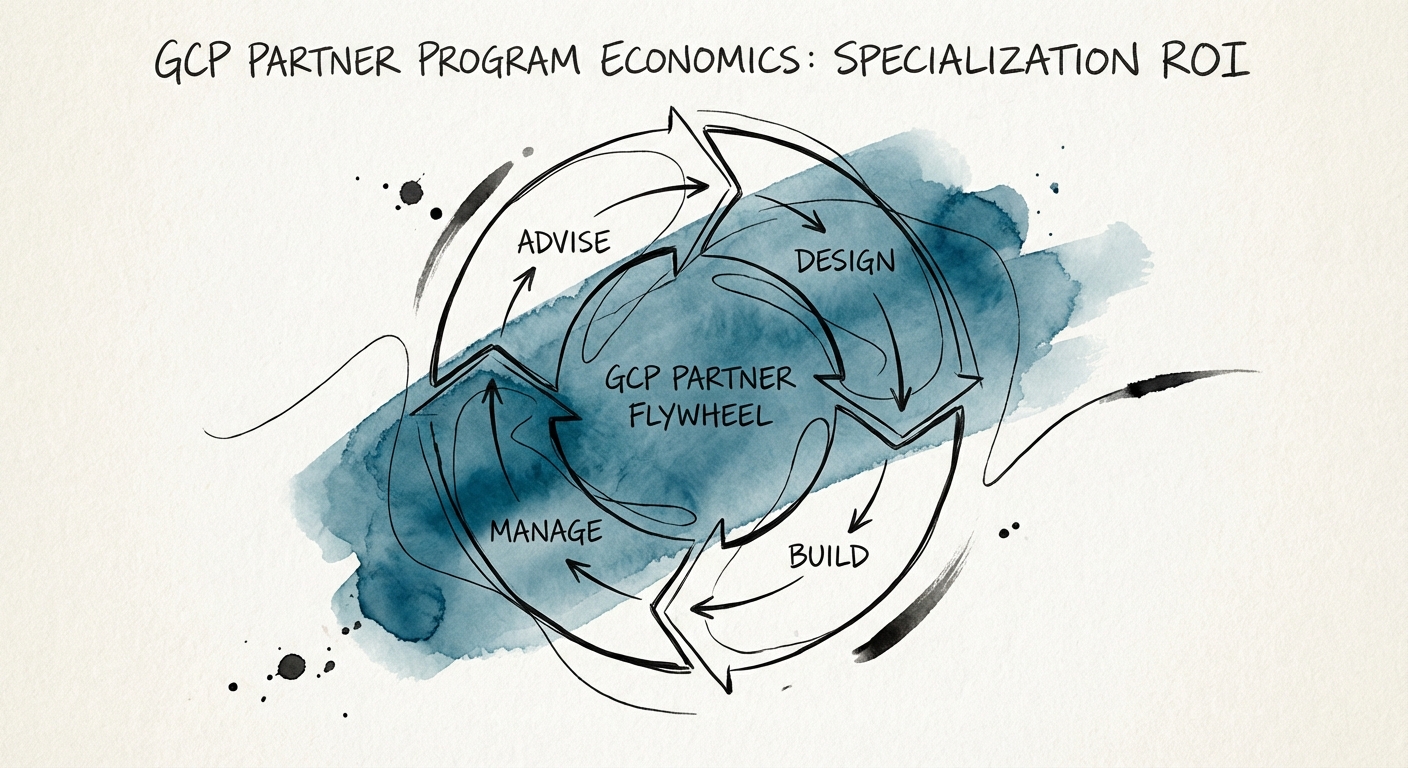
- Leverage the Ecosystem Multiplier: Stop selling hours. Start selling outcomes that drive consumption. Build IP (even simple accelerators) that allows you to claim the "Build" slice of the partner flywheel (24% of the value pie).
The market will not pay a premium for a generalist in 2026. Private Equity buyers certainly won't. They buy predictable unit economics and defensible moats. A Google Cloud Specialization backed by high-margin service revenue is a moat. A "Member" badge is just a sticker.