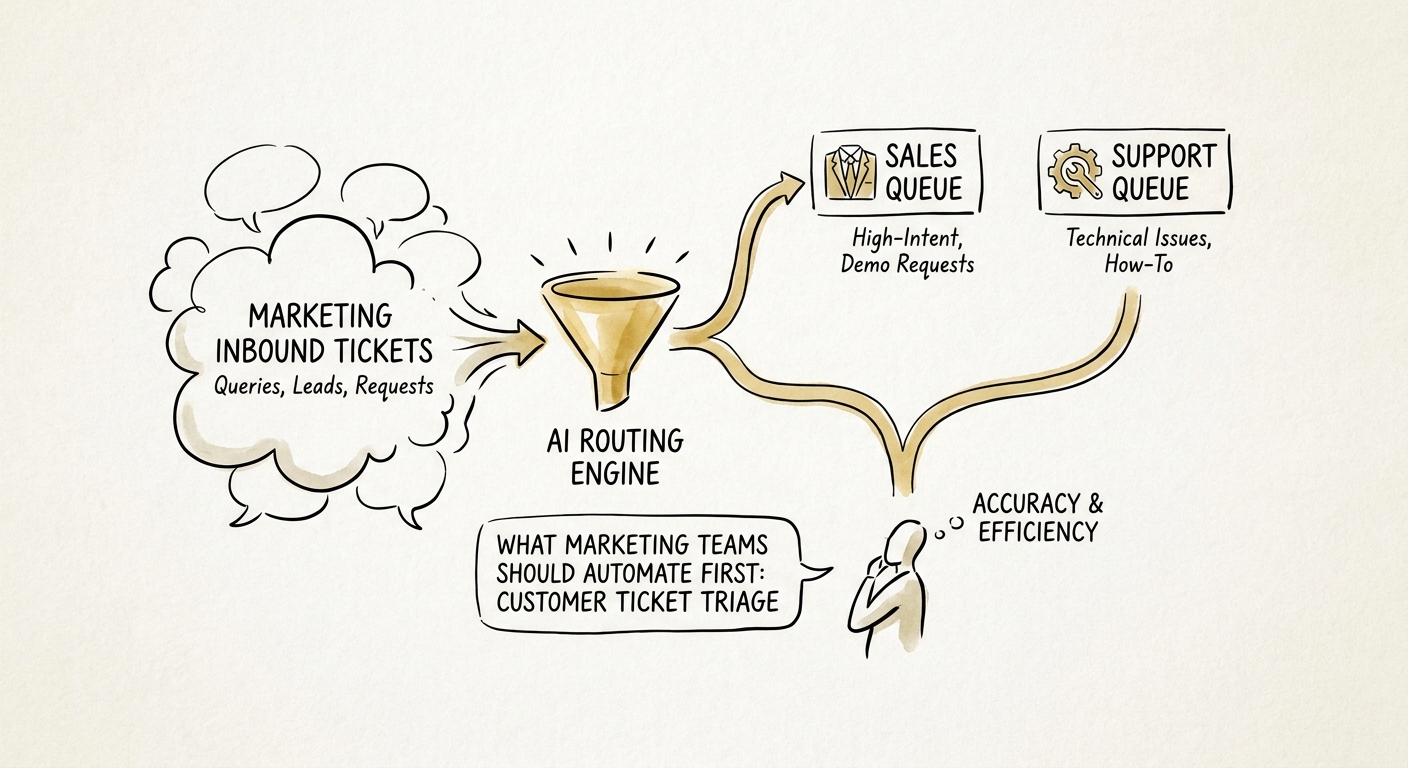
Your support queue is unread market research
Picture the marketing lead at, say, a 90-person SaaS company. They run quarterly surveys, comb through six win/loss interviews, and pay for a brand-tracker. Meanwhile, two desks over, the support team is closing 400 tickets a week — and every one is a customer telling you, unprompted and for free, exactly what confused them, what they expected, and what almost made them leave. That signal goes into a CRM, gets a status of "Resolved," and dies there.
That is the opportunity most marketing teams miss. The instinct is to treat AI ticket triage as a support efficiency play — faster routing, shorter first-response times. For marketing, the prize is different: it is the cleanest, highest-volume voice-of-customer stream in the building, and almost nobody is mining it for message-market fit. The Salesforce State of Marketing report, the Salesforce State of Service report, and Deloitte's State of AI in the Enterprise 2026 all track AI moving fast into these functions, but adoption pressure is not the same as a workflow. The decision you actually own is narrow: what does the model read, what does it tag, and who acts on the tags.
Start there. Point a triage model at a single ticket stream and have it classify against a marketing taxonomy, not a support one: "expected feature we don't market," "pricing confusion," "competitor mention," "onboarding friction," "churn risk language." Not "billing vs. technical." The whole point is to surface the themes that should change a landing page or a nurture sequence — themes a support manager has no reason to flag.
What goes wrong, and the number that catches it
The failure mode here is specific and quiet. A model reads tickets, tags them confidently, and produces a tidy weekly chart of "top customer themes" — and the chart is wrong. It over-indexes on the loud 5% who write paragraphs, miscalls a frustrated power user as a churn risk, or worse, surfaces a ticket containing a customer's full name and account details into a marketing dashboard that twelve people can see. You now have a confident, polished, PII-leaking, mis-weighted artifact driving your Q3 messaging. That is worse than the survey you replaced.
So measure the model against the manual baseline before you trust it. Have a human read the same 100 tickets the AI tagged and track three things: tag agreement rate (does the model's "pricing confusion" match what a person would call it), redaction misses (how often did a name, email, or account number survive into the marketing view), and theme-weight drift (does the AI's "top 5 themes" match what an experienced rep would rank if they sampled the queue). If tag agreement is under, roughly, four in five, you are not measuring customers — you are measuring the model's blind spots. Run that comparison weekly until the gap stops moving. Only then wire the output into a decision: the AI Opportunity Score or the AI ROI Calculator are worth pulling out once each theme has a named owner who has actually changed a campaign because of it.
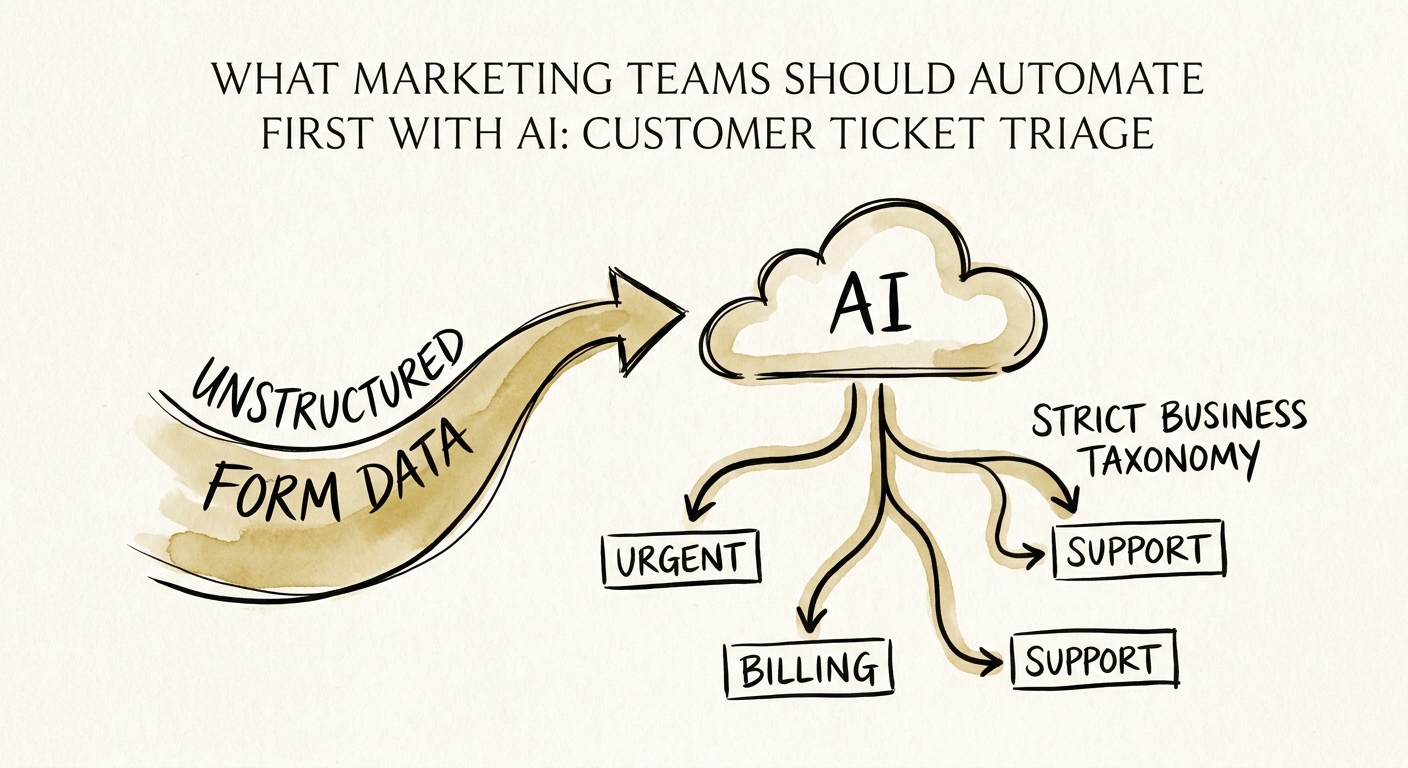
Govern it before it becomes a habit
Two guardrails make this safe to scale, and both are cheap to set up on day one. First, the AI never touches the customer. Marketing's triage model reads and tags — it does not draft replies, does not auto-respond, does not get write access to the ticket. The moment it sends something to a customer, you have left a marketing-insight pilot and entered a support-automation project with a different risk profile and different owners. Keep that wall up. Second, the customer's data is redacted before marketing sees it: name, email, account ID, anything in a free-text field that identifies a person. The CISA AI data-security best practices are the right reference for ticket-field access, retention windows, and where the data is allowed to live; the NIST AI Risk Management Framework gives you the one-page map of intended use, risk, and accountability that a nervous founder or legal contact will actually want to see.
The taxonomy itself needs an owner too, because the categories will drift — a competitor renames a product, a new objection appears after a price change — and an ungoverned tag set quietly stops meaning anything. Assign one person to review low-confidence classifications each week and approve taxonomy changes. Do that, prove tag quality on a single ticket category, and you have earned the right to expand to a second. On Monday: pull last week's 100 tickets, tag them by hand against a marketing-relevant taxonomy, and you will have both your baseline and your first read on what your customers are actually telling you.