Marketing Is Guessing About Objections Your Support Team Heard Yesterday
Picture a 60-person B2B software company. Marketing is rewriting the homepage and arguing in a conference room about whether buyers care more about integration speed or onboarding. Meanwhile, three floors of conversation away, support closed eleven tickets last week from customers who said, in their own words, that the integration looked easy in the demo and took six weeks in reality. Marketing never sees those tickets. So they write from memory, ship copy that overpromises the exact thing support is apologizing for, and the cycle repeats.
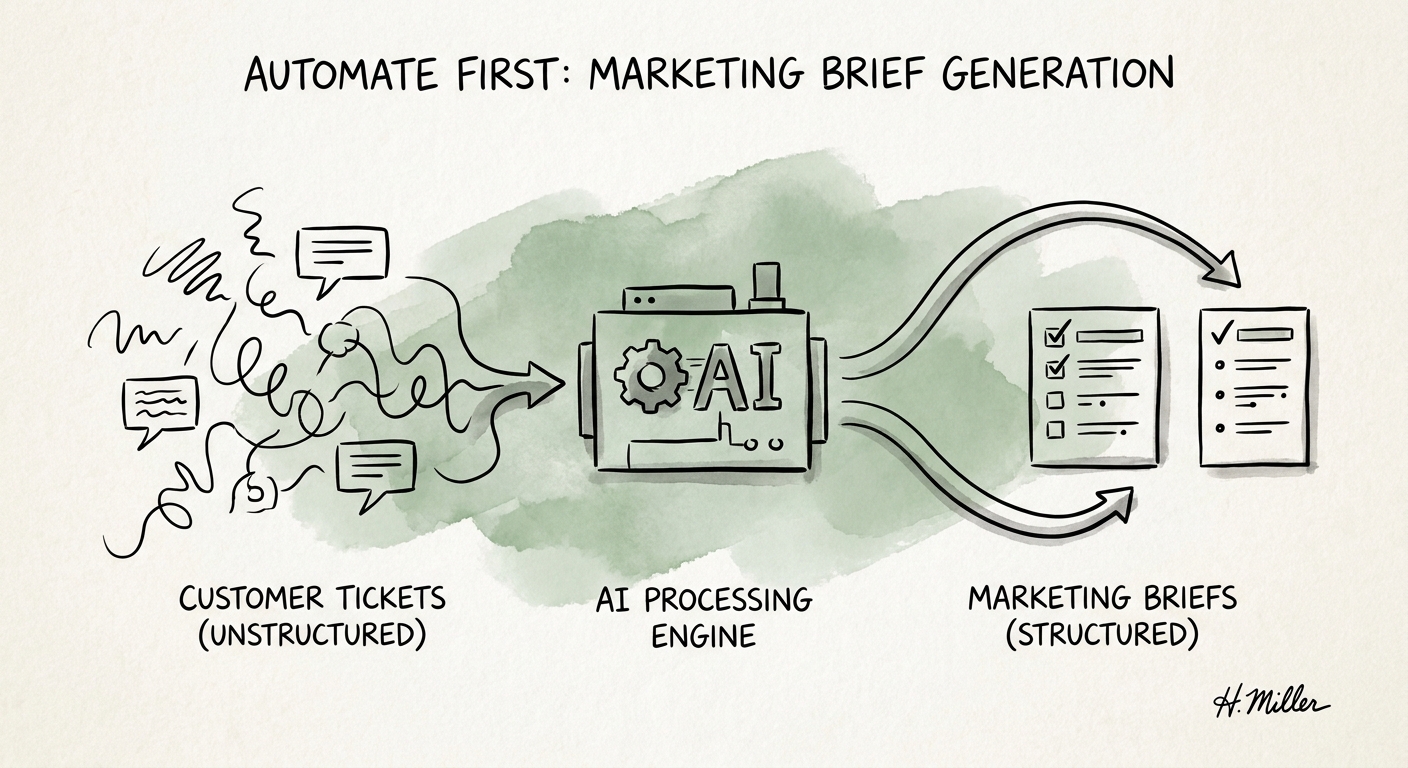
That gap is the opportunity. The first AI workflow worth building for a support team is not a customer-facing chatbot — it is an internal one that reads a week of resolved tickets and produces a structured brief for marketing: the recurring objections, the words customers actually use, the proof they asked for and didn't get, and the promises that turned into complaints. Salesforce State of Service research and Salesforce State of Sales research both point to the same thing operators already know: the front line accumulates buyer intelligence faster than any survey, and most of it evaporates because no one has time to read 200 tickets and synthesize them by Friday.
The reason to start here rather than with a flashier project is captured in the adoption research worth reading before you build — the RSM middle-market AI survey, the San Francisco Fed analysis of AI and small businesses, and the OECD SME AI adoption report all show the same pattern: companies that get value pick a workflow with a clear owner and a measurable output, not a "let's see what the AI can do" sandbox. A weekly voice-of-customer brief has both. Support owns the source. Marketing owns the decision. The output is one document a human signs off on.
The Hard Part Is De-Identification, Not Summarization
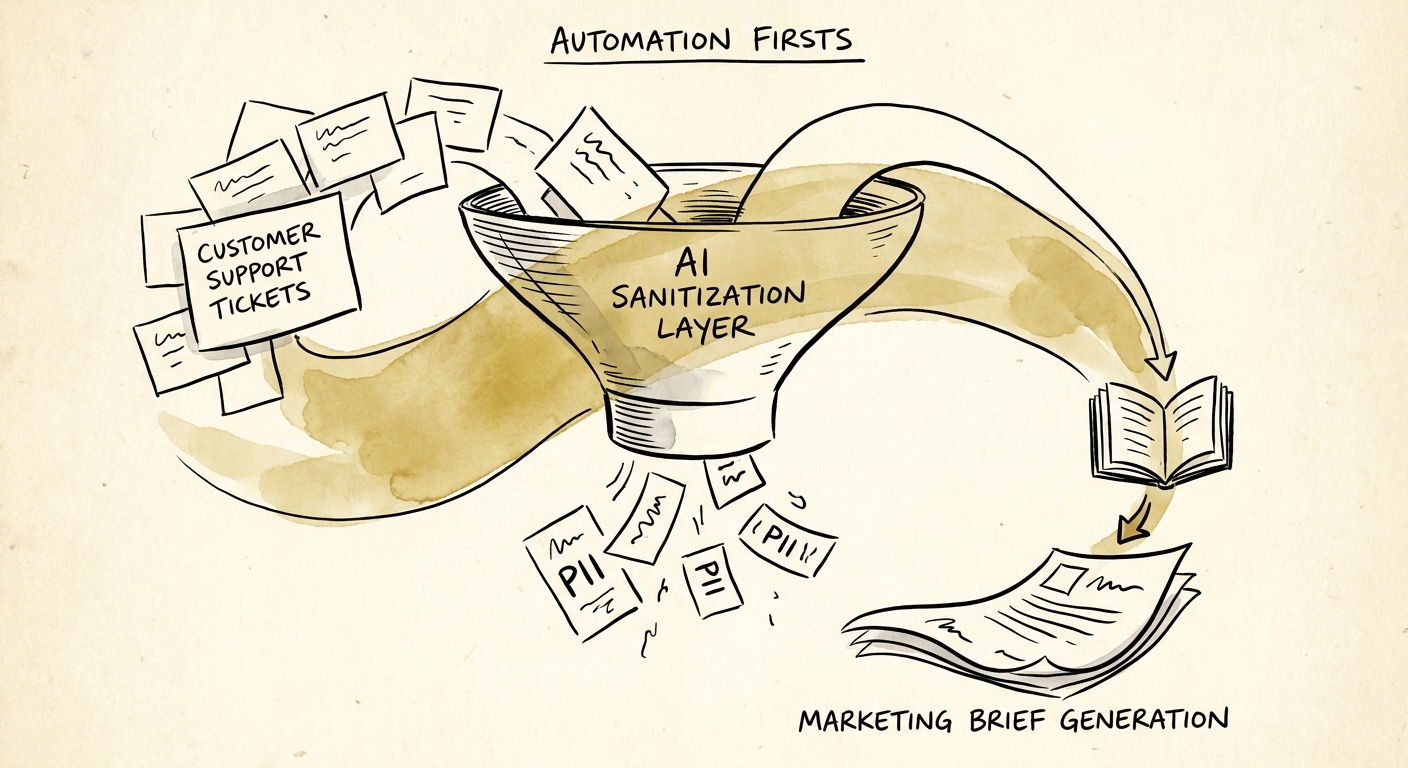
Summarizing tickets is the easy 20 percent. The dangerous 80 percent is that a support ticket is dense with things marketing must never see, let alone publish: the customer's company name, the contact's email, the contract value, the fact that this specific account threatened to churn. Feed that raw into a brief and you have built a machine that smuggles confidential customer data into the marketing org — and eventually into a campaign, a case study, or a sales deck — without anyone deciding to do it. The failure mode isn't a bad summary. It's a quote like "Acme Corp said our reporting is useless" landing in a planning doc that thirty people can read.
So the workflow needs two distinct stages, and the order matters. First, de-identify: strip names, accounts, emails, dollar figures, and anything that ties a theme to a real customer. Then, and only then, cluster the anonymized text into objection themes. The model never produces a sentence that can be traced to one account. The CISA AI Data Security Best Practices are the right reference for deciding what data even enters the pipeline — which ticket fields get passed in, which are masked at ingestion, and what gets logged. Pair that with the NIST AI Risk Management Framework to name an accountable reviewer and define what "acceptable" looks like before a single brief goes out.
Concretely, each weekly brief should carry a short header that a support ops lead and a marketing lead can both audit: which ticket queue it came from, the anonymization rule applied, who removed sensitive details, which proof points are approved for external use versus internal-only, and an explicit "do not publish without verification" flag on anything that reads like a competitive claim. That header turns a fluent AI answer into something with a source trail. A general-purpose assistant can do the clustering. It cannot be trusted to decide what's safe to publish — that decision stays with a named person, every week, before the brief leaves the building.
What to Measure in the First 90 Days
The trap, well-documented in the Deloitte State of AI in the Enterprise 2026 report, is mistaking activity for value — running the workflow every week and never checking whether marketing actually changed anything because of it. So measure outcomes, not output volume. Track how many themes marketing accepts and acts on, how many sensitive details the de-identification step caught and removed (a rising number here is good — it means the filter is working on real risk), how many distinct ticket queues the brief covers, and how many concrete content or messaging requests the brief generated that quarter. If three months in, marketing has accepted exactly zero themes, the problem isn't the model — it's that the two teams aren't actually talking, and no AI fixes that.
Watch for one specific failure: if the workflow keeps surfacing themes that can't be separated from the customer who raised them — a complaint so specific only one account could have said it — that's a signal your ticket data is too thin or your tagging is too coarse to anonymize cleanly. Fix that at the source before you bolt on anything new. A leaky brief is worse than no brief.
Start narrow and prove it before you widen it. Use the manual-work scoring guide to confirm this is genuinely worth automating rather than a problem better solved by getting one analyst to read tickets for an hour a week. Then use the 90-day AI implementation plan to sequence it: clean and tag one support queue, build the de-identify-then-cluster prototype, train the marketing reviewer on what to accept and reject, launch on a single queue, and only then decide whether to scale. The workflow earns expansion when marketing's copy starts answering objections support was hearing last week instead of objections someone guessed at two quarters ago.
