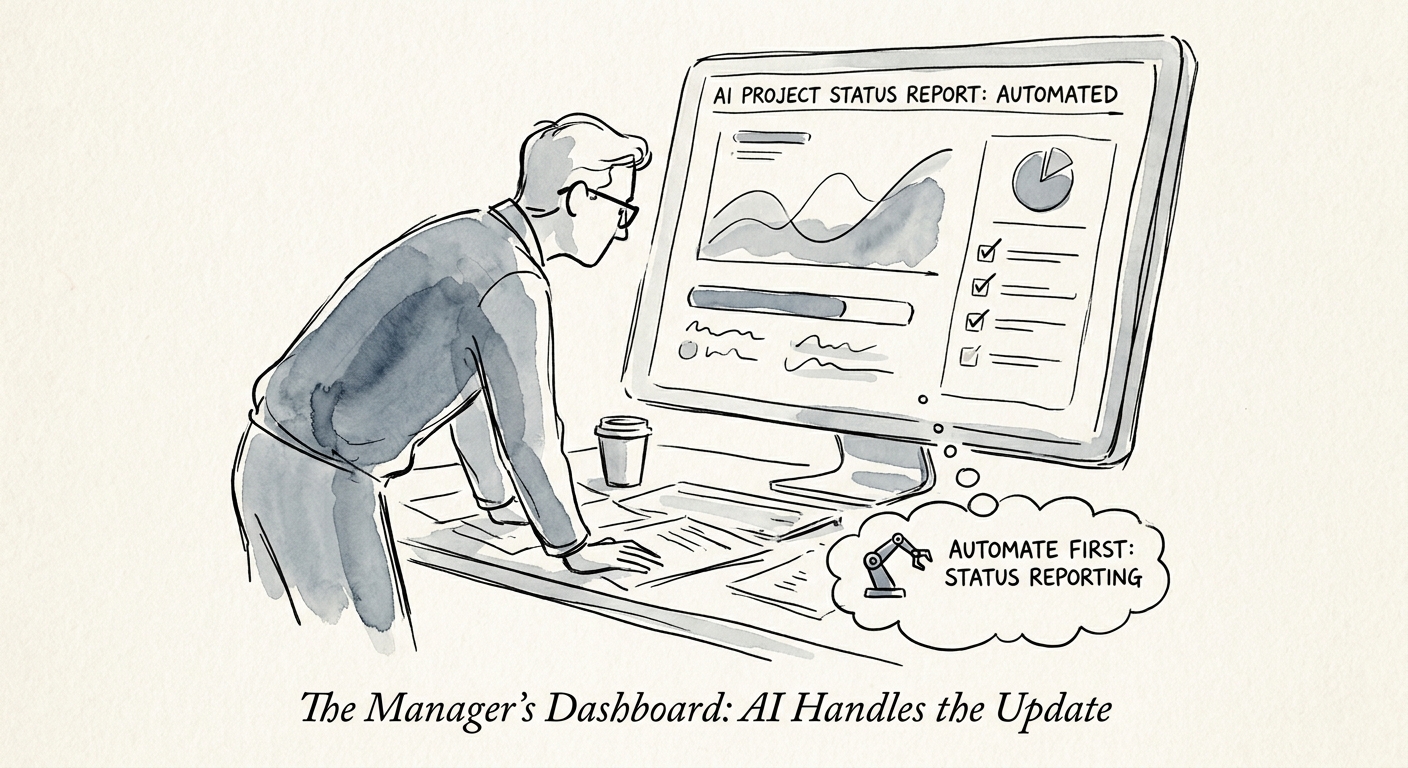
Friday at 4:30, someone is hand-assembling a client update
If you run implementations or customer success at a B2B services or SaaS shop, you know the ritual. Before the Monday client call, a project lead opens four tabs — the ticket queue, the project plan, last week's deck, and a Slack thread where the real blocker actually lives — and stitches a status narrative together from memory and scroll-back. It takes an hour, it's stale by the time it's sent, and the one risk that mattered is the one that got smoothed over because nobody wanted to be the bearer.
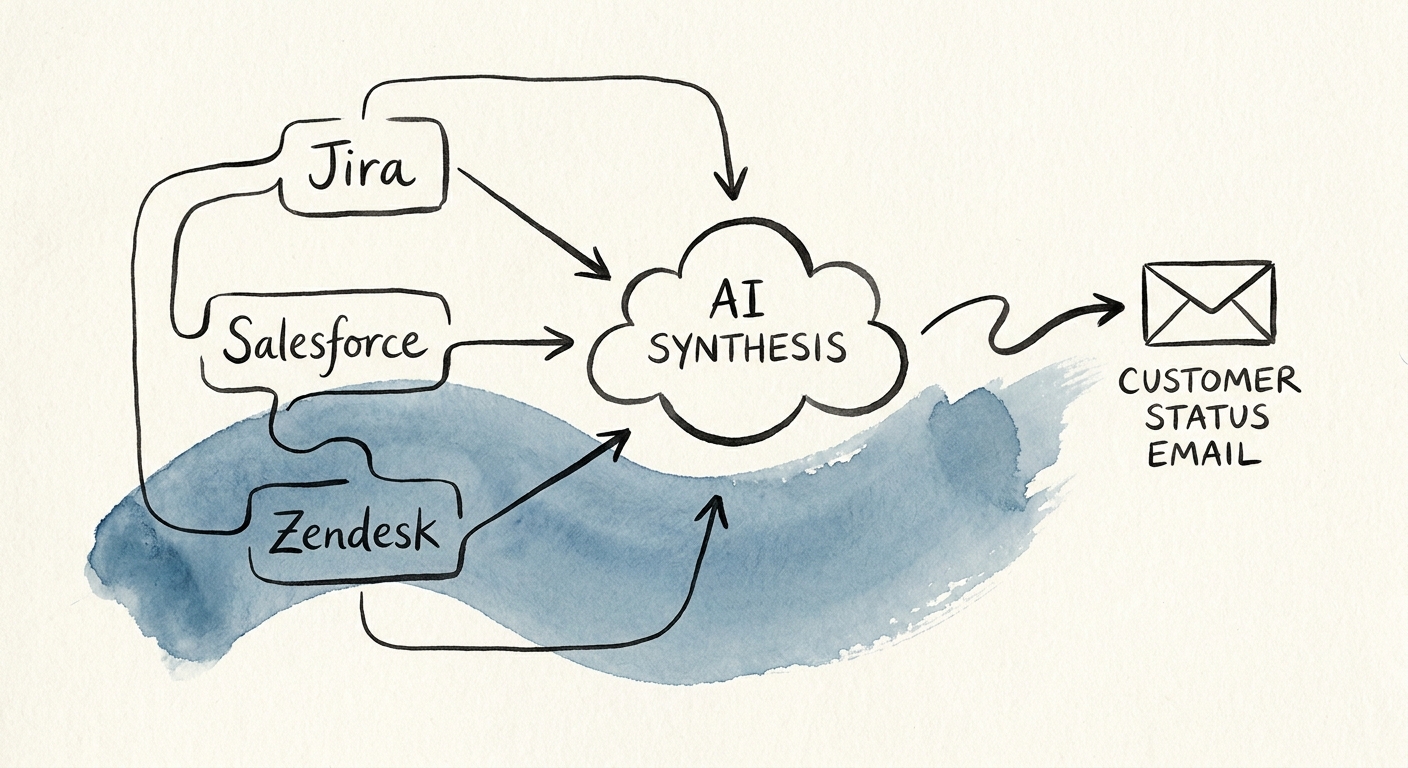
That ritual is exactly why status reporting is the best first AI use case for a service team, not a flashy one. It's repeatable, it's source-based, and the cost of the status quo is measurable. The Atlassian State of Teams 2025 research points at the real failure mode: status work breaks down when people can't find the right answer or agree on what's actually urgent. The hour your lead spends every Friday isn't writing — it's hunting. AI should eat the hunt: pull the milestones, the open tickets, the unresolved blockers, and who owns each one, then assemble the evidence into a draft. Salesforce State of Service 2025 shows service orgs moving hard toward AI-assisted work — but the trust that keeps a client renewing still rides on whether your handoffs and commitments are accurate.
Draw the line at the date
Here's the rule that separates a status workflow that ships from one that blows up a client relationship: the AI drafts the record, the human owns the commitment. Concretely, the workflow is allowed to reconcile the five inputs that make up a status — milestone progress, ticket history, open blockers, named owners, and outstanding customer commitments — and to flag where the evidence is thin or contradictory. It is not allowed to promise a new go-live date, change scope, or soften a real risk into "on track with minor variance" because the phrasing sounds calmer.
Say a 30-person SaaS implementation team is three weeks from a customer's go-live and an integration ticket has been stuck for eight days. A good draft surfaces that ticket, names the owner, and marks the date assumption as unverified. A bad one — the one you're tempted to let run unsupervised — quietly carries forward last week's "on track." The NIST AI Risk Management Framework gives you the vocabulary for exactly this kind of decision boundary: define what the system may decide versus what stays human, and write it down before you turn it on. And the win isn't the saved hour. As McKinsey State of AI 2025 keeps repeating, automation only pays when it changes the operating cadence. A status report becomes an AI win when it produces fewer surprises on the client call, earlier escalations, and clearer owner actions — not when it produces a prettier PDF faster.
The five numbers that tell you it's working
Don't measure this by "time saved." Measure whether the report earned trust. Track five things: source coverage (what share of the status pulled from real systems versus someone's recollection), correction rate (how often the lead has to fix the draft before sending), missed-risk rate (blockers the draft failed to surface that bit you later), approval time (how long from draft to human sign-off), and action closure (whether the owners named in the report actually closed their items by the next cycle). When correction rate drops and your leads start reviewing the draft instead of rebuilding it from scratch, you've crossed the line that matters.
Only then expand to the next adjacent workflow — the renewal-risk summary, the QBR prep, the escalation digest. Get the status report right first because it's the one where the cost of a wrong AI call is a client who stops trusting your word. Map the decision boundaries with customer-service AI workflow design, then build it with AI workflow automation.
