The brief no seller opens
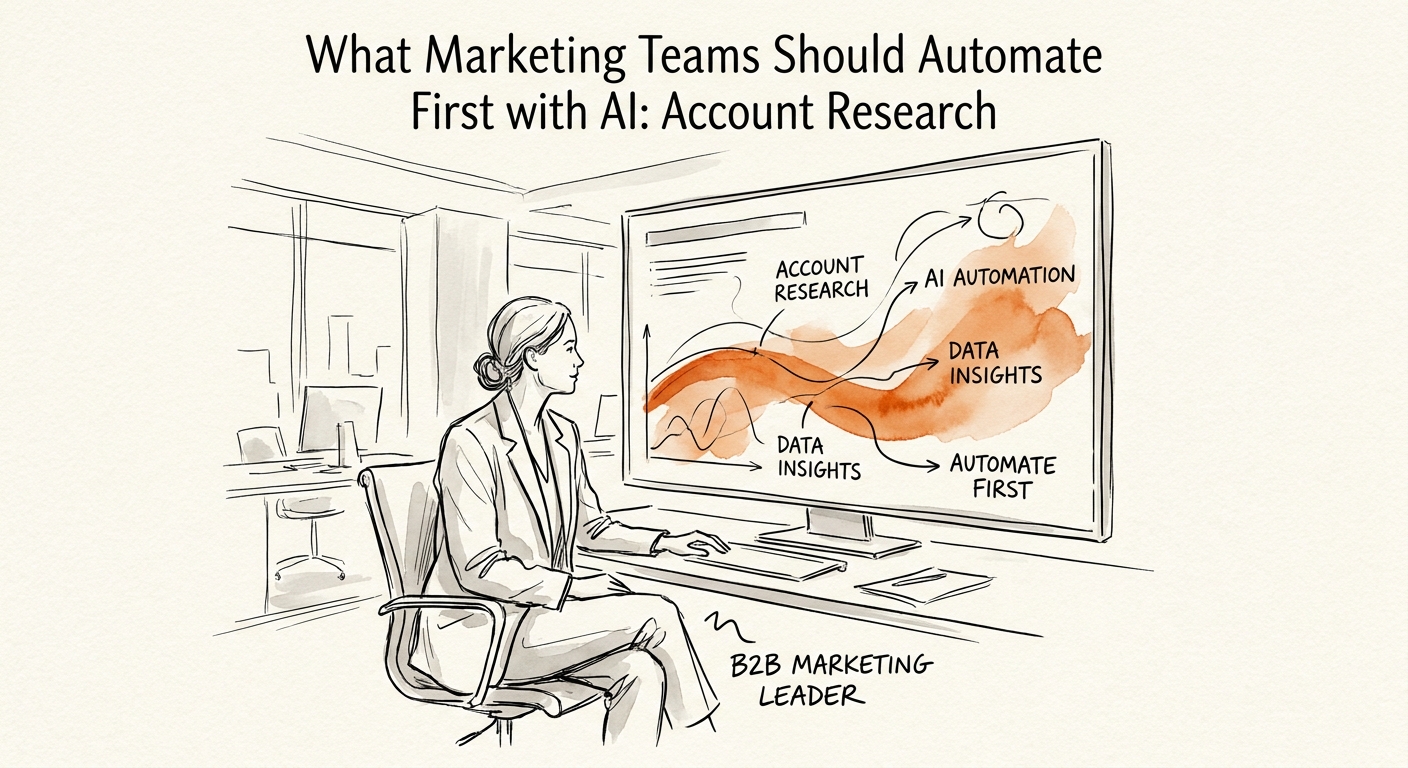
Picture the Monday handoff at a 60-person B2B services firm. Marketing forwards sales a stack of "account intelligence" — twelve target accounts, each with a tidy paragraph about the company's mission, recent funding, and "digital transformation priorities." The account executive skims two, recognizes the language as scraped boilerplate, and never opens the rest. The research took someone half a day. It changed nobody's call list.
That is the exact gap an AI account-research workflow should close, and it is why this is the right first thing for a marketing team to automate. You already have the raw inputs: a defined target list, CRM history, campaign segments, and a repeated manual ritual nobody enjoys. What you don't have is a brief that survives contact with a skeptical seller. The fix isn't a better summary — it's a brief that openly separates what's verified from what's inferred.
Salesforce's State of Marketing research and State of Sales research both sit on the same fault line: account research is the one artifact marketing and sales co-own, and it's where their trust either compounds or breaks. So pilot it on one segment — say your mid-market managed-services prospects in one region — and make every brief carry source links, the CRM fields it leaned on, a confidence label per claim, and one suggested angle for the AE to accept or kill. Marketing ops signs off before it touches an audience build or a sequence.
Four columns, not one paragraph
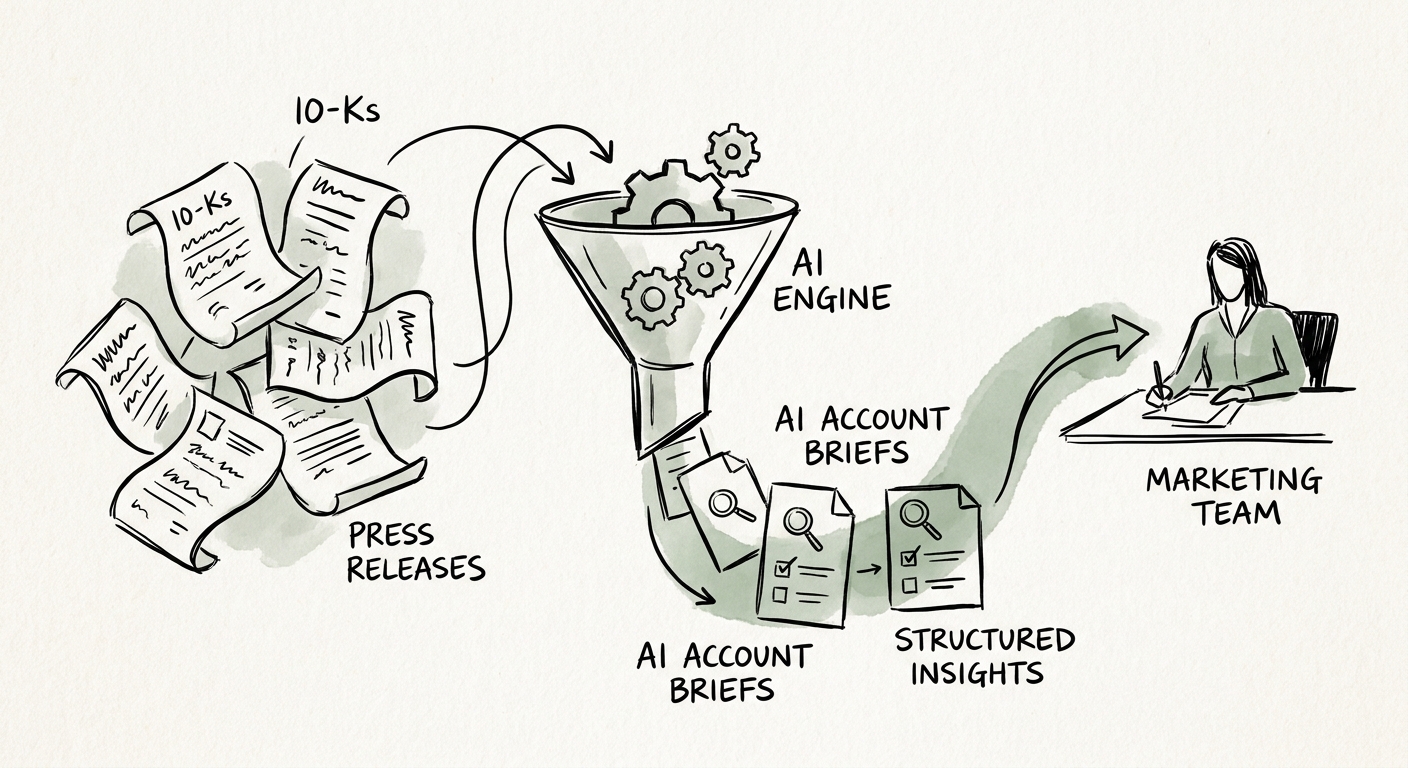
The reason the boilerplate brief fails is structural: it flattens everything into prose, and prose hides where a fact ends and a guess begins. Replace the paragraph with a packet that keeps these apart on the page — the account record, the firmographic field, the approved public source, the prior engagement pulled from CRM, the campaign segment, the inferred buying trigger, the confidence level, and review status. When a model has to file "they're hiring three RevOps roles" under verified-public-source and "so they're probably re-platforming their CRM" under inferred-trigger, it can no longer launder a hunch into a headline.
That visible seam is also what gives sales something to argue with. An AE can look at the trigger column and say "no, I talked to them in March, they froze that budget" — and now the brief got better instead of getting ignored. The NIST AI Risk Management Framework is useful here not as compliance theater but as a setup checklist: define the research context, name the reviewer, write the confidence rules, and decide what you'll measure before a single brief reaches a campaign.
Then measure the things that actually predict whether this scales: source coverage per account, the count of claims a reviewer rejected, seller acceptance rate, how many briefs changed a real targeting decision, and minutes saved per account. None of those is "briefs produced." If the model can't name the source behind a company fact, or can't tell a known account history from an inferred trigger, the brief stays in review. That's not a failure of the pilot — that's the pilot working.
What scales, what doesn't
Account research is unusually messy because it pulls public web data into the same workspace as CRM notes, prior sales-call summaries, product usage, support tickets, and live opportunity context. Some of that is fine to surface in a campaign. Some of it would be a problem the moment it shows up in an email. Decide the source boundaries, retention, and logging before any brief becomes input — CISA's AI data-security best practices are the right reference for drawing that line. Your marketers should be able to point at any account fact and say whether it's safe for outside-facing use.
The expansion decision comes down to a simple read of the pilot data. If sellers keep rejecting briefs because the model inflates urgency or misses context they already have, don't add accounts — fix the source hierarchy. If sellers start trusting the source trail and marketing is cutting unsupported triggers before they ship, the next workflow can extend into personalization or follow-up support. Use the AI Opportunity Score to weigh account research against an adjacent build, and the AI ROI Calculator to price the hours you're getting back.
Here's the one trap to avoid: do not use this to manufacture personalization at volume. A B2B services pipeline doesn't have a thousand accounts — it has fifty that matter, and the win is selectivity, not output. Judge the pilot on a single question: after a marketer reads the cited evidence, does the brief change which account gets called first, which segment gets the budget, or what the opener says? If every brief lands on the same generic value proposition, your source set is too broad or your scoring is too shallow. A brief that's earning its place tells the AE why this company is worth a call this quarter, which claim is solid, and exactly where they still need to do the human work.