The quote that came back in nine minutes and lost you $1,400
Picture a 60-person industrial distributor. A field rep emails in a request for 14 line items, half of them special-order, and the inside-sales desk usually takes two days to turn it around because someone has to chase current pricing, check the customer's contract tier, and confirm lead times. You drop an AI assistant into that workflow and the quote comes back in nine minutes. Everyone cheers. Then the order ships, and finance finds the assistant pulled list price instead of the negotiated tier, or quoted stock that was actually allocated to another job. The fast quote became a margin leak with a faster timestamp.
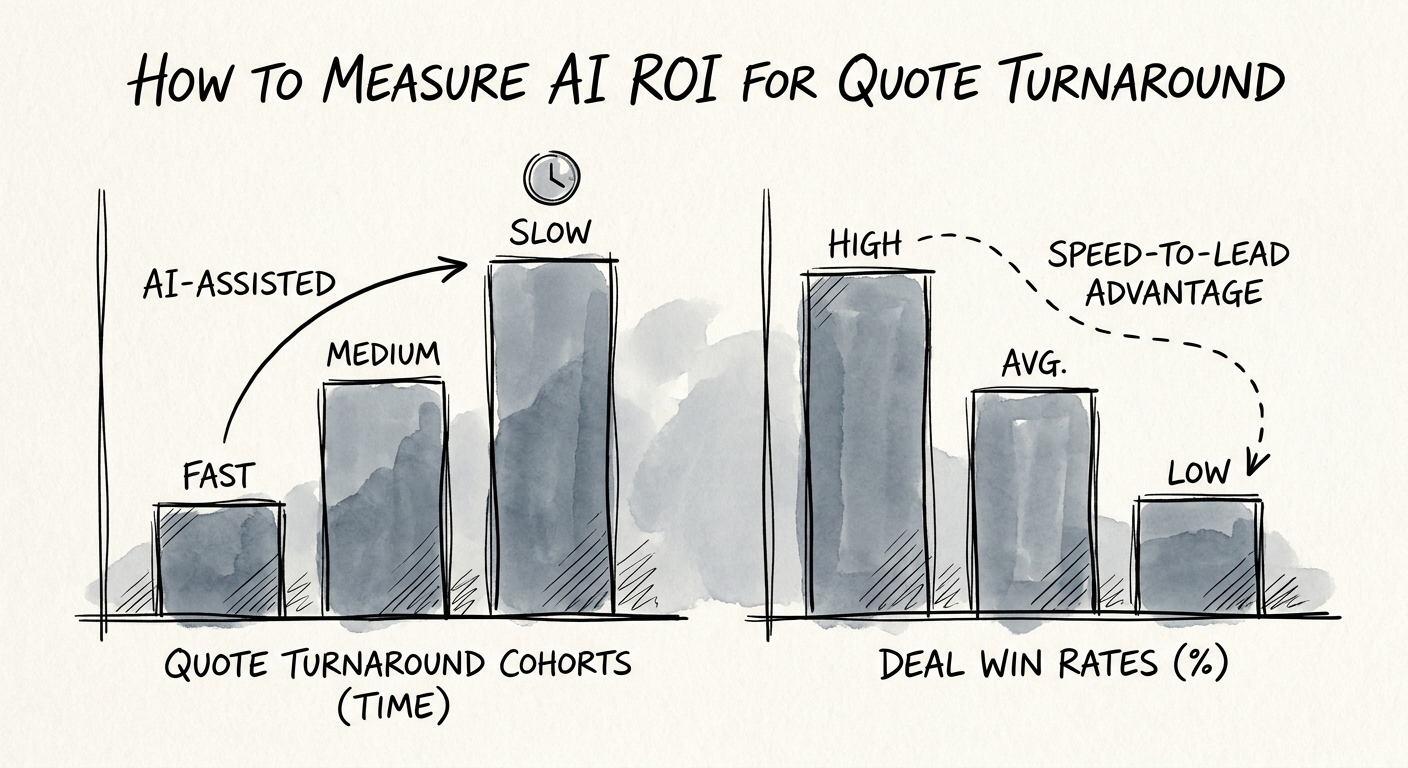
That is the trap with quote-turnaround AI: the metric everyone reaches for — cycle time — is the one most likely to flatter you. Before you add anything, write down the before state in numbers. Median and worst-case quote cycle time. Percentage of incoming requests that arrive missing inputs (no quantities, no ship-to, no spec). How many quotes bounce through more than one approval loop. Your rework rate: quotes reissued because something was wrong. And the one that actually pays the bills — margin variance between quoted and booked. Salesforce's State of Sales research and its State of Service research are clear that response speed moves win rates, but a fast wrong number doesn't win anything you want to keep.
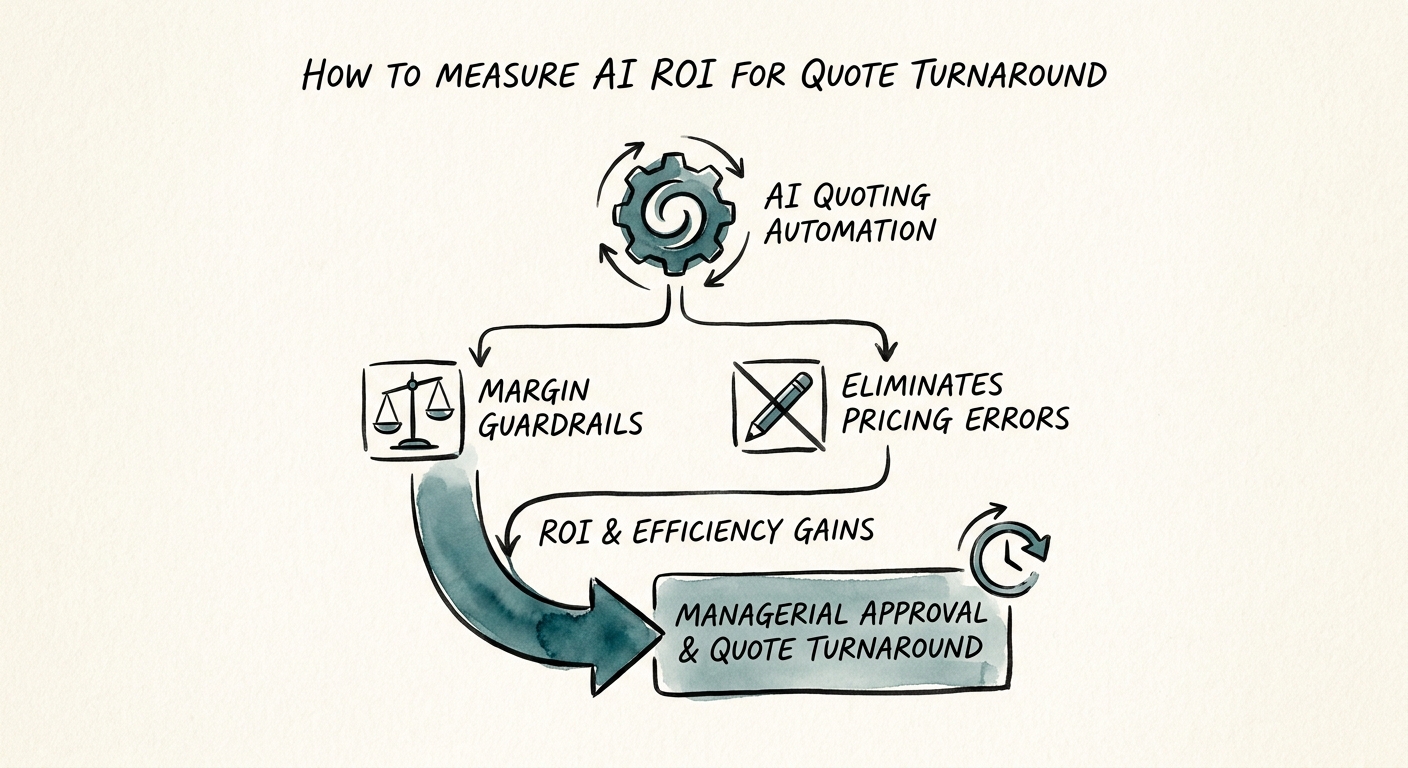
Hold the line on what AI does versus what it touches: it gathers the requirements, assembles a draft packet, and flags what's missing. It does not approve price, tier, or terms. Treat saved time as real only when it shows up as throughput, fewer reissues, or held margin. Measuring AI ROI without fake savings is the finance discipline underneath all of this.
The four numbers that separate a real quote ROI from a demo
Quotes are unusually data-hungry, which is exactly why they're a good AI candidate and a bad one to wing. To draft a quote correctly the assistant needs four things that most distributors keep in four different places: an approved product/pricing source, the specific customer's contract tier and terms, live inventory or capacity context, and a defined reviewer path. The RSM middle-market AI survey shows firms your size moving fast on adoption, while the OECD's report on AI adoption among small and medium-sized enterprises explains why the firms that get value are the ones who fixed data ownership first. If your price book lives in a spreadsheet three people edit and no one owns, the AI will confidently quote yesterday's number.
So measure quality and control alongside speed, not after it. The NIST AI Risk Management Framework gives you the structure: map the workflow, measure output quality, manage the risk that sits squarely on customer commitments and margin. In practice, track four numbers that a slick demo never shows you. Draft accuracy: of AI-prepared quotes, how many passed review with no price or spec correction? Margin variance: gap between AI-drafted price and the price that survived approval. Missing-input catch rate: how many incomplete requests did it flag before a human burned time on them? And approval-loop count: did it shrink from three passes to one, or just relocate the rework? Speed without those four is a faster way to be wrong.
Run a 30-day pilot, then make four people own the answer
The Deloitte State of AI report makes the point that value shows up in operating decisions, not in a faster draft. So judge a quote pilot by what it lets you change. After 30 days, leadership should be able to answer a concrete question: does this let the inside-sales desk handle more requests per head, tighten the response standard you promise customers, or pull margin discipline forward instead of catching exceptions at billing?
Make the first production release name four owners explicitly — and write it down where the team can see it. Who owns price exceptions when the AI draft and the contract disagree. Which product and pricing source is the single authority the assistant reads from. How a margin exception gets reviewed before the quote goes out, not after the order ships. And what weekly number proves customer response actually improved — not "quotes feel faster," but reissue rate down, margin variance inside a band, response time under your stated standard. That turns a one-off demo into an ROI record you can defend to a board.
If you want a sequenced way to scope exactly one quote workflow, one reviewer path, and one weekly cadence before you widen it, work through the 90-day AI implementation plan. Pick the messiest quote type you have — the special-order, multi-approval one — because that's where both the time and the margin actually hide.