The forecast call where nobody trusts the data
Picture the Monday pipeline review at a 120-person software company. The VP of Sales pulls up a $400K opportunity. The rep says it's in "Negotiation." The CRM says "Discovery." There are two records for the same account — one created by marketing in 2024, one by the SDR last month — and the close date on the bigger one is three quarters in the past. Twenty minutes of the call evaporates into "whose number is right," and the actual deal never gets discussed.
That is what CRM cleanup is really about. Not tidiness — forecast trust. The job is answering four questions for every account: which record is the real one, what stage is it actually in, who owns the next action, and whether the entry would survive an auditor. Microsoft 365 Copilot is genuinely useful for the first part of that — it can read the email thread, the call notes, and the last proposal and tell a rep what's going on with an account in thirty seconds instead of thirty minutes. What it should never do is silently merge those two duplicate records or overwrite the stage field, because then you've replaced an argument you can see with a change nobody logged.
The honest first question for a company your size: is your problem that humans can't see the mess fast enough, or that the mess needs to be fixed in bulk with rules and a record of who approved each change? RSM's middle-market AI survey and the OECD's work on AI adoption among small and mid-sized firms both land on the same uncomfortable truth: most companies that size buy the AI before they've defined the job. Define the job first.
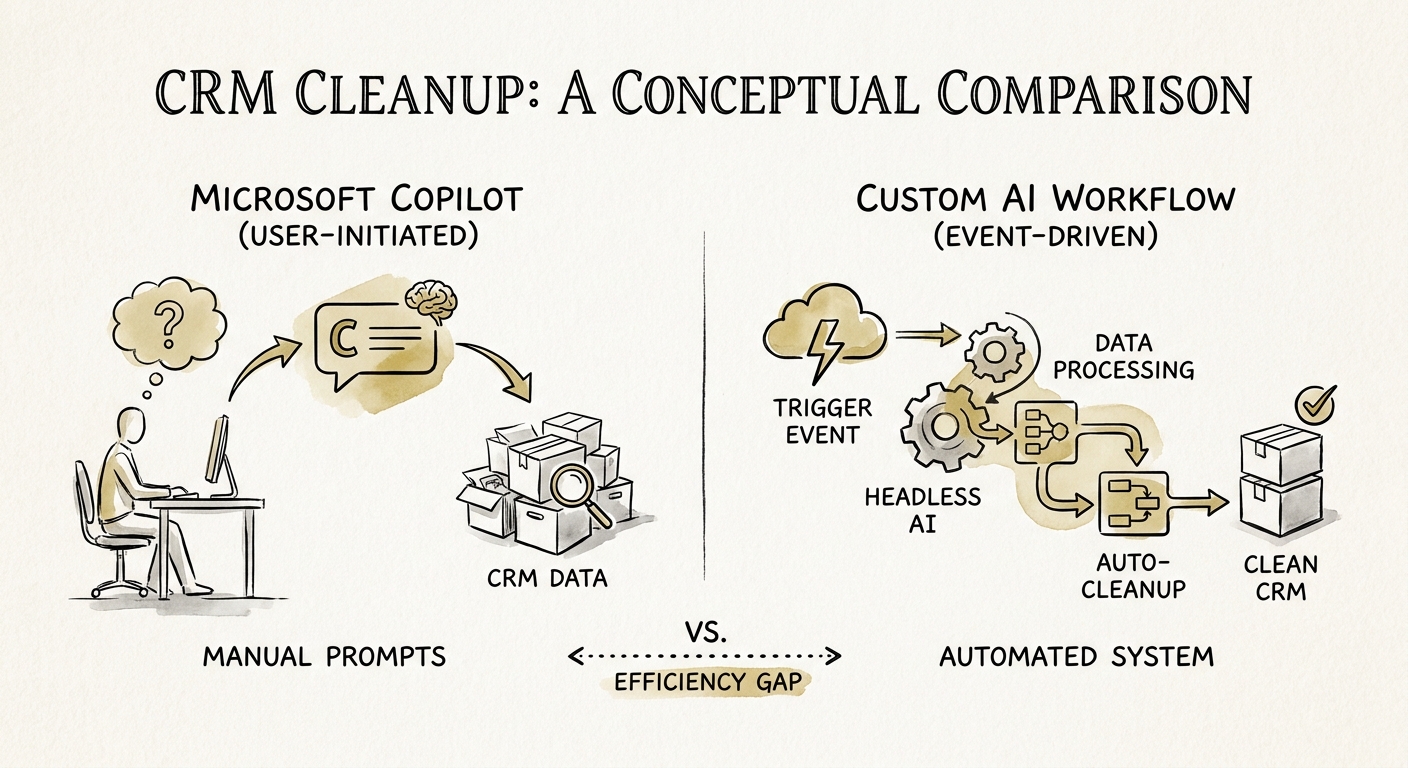
Copilot reads. A workflow writes. Don't let one do the other's job.
Here is the line that matters, and it's a clean one. Copilot operates on content the user is already permitted to see — Microsoft's own privacy and data-protection guidance is explicit that it grounds answers in the user's existing access, and its architecture documentation describes how it pulls that context through Microsoft Graph. That makes it excellent at the read-and-summarize half of cleanup: "show me everything we know about Acme and flag what looks stale." It is the wrong tool the moment the task becomes "now go change 4,000 records."
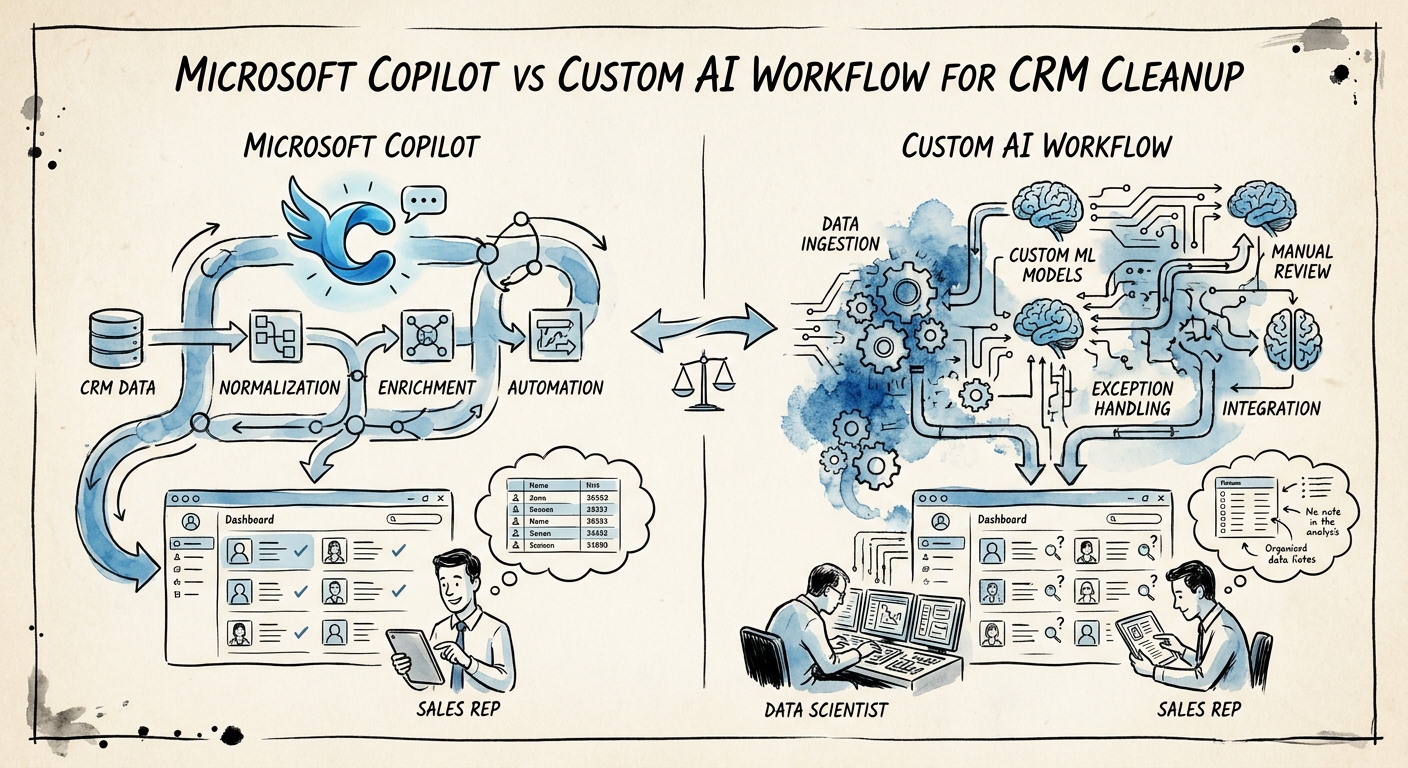
Bulk record change is a different animal, and it's where a custom workflow earns its cost. Deduplicating accounts means a match rule — same domain plus fuzzy name match, say — not a vibe. Repairing a lifecycle stage means reconciling what the CRM says against what the email and meeting history actually show, then writing the correction back through the Salesforce or HubSpot API. And every one of those writes needs a queue a human approves, a log of who clicked yes, and a way to roll the batch back when the match rule fires on a false positive (it will). A worked sequence looks like: workflow proposes 312 merges → RevOps reviews the 40 low-confidence ones by hand → approved batch writes back with a transaction ID → bad merges get reversed from the log, not from memory.
Two things govern that build. Use the NIST AI Risk Management Framework to decide who is allowed to approve a record change, what confidence threshold sends a merge to human review instead of auto-applying, and how you'll know when the system is drifting. Then apply CISA's AI data security best practices to the customer and commercial data flowing through the matching and write steps — because a cleanup pipeline is, by definition, touching your most sensitive account and contact records in bulk.
Pilot the trust problem, not the technology
The trap a company your size falls into is measuring "AI adoption" — seats activated, prompts run — when the thing that actually matters is whether the Monday forecast call stopped being a data fight. Deloitte's 2026 State of AI research keeps documenting the same gap between AI ambition and production value, and CRM cleanup is a place you can close it cheaply because the win is measurable in weeks, not quarters.
Pick one trust problem and attack only that. Duplicate accounts. Stale contacts no one has touched in 18 months. Lifecycle stages that don't match reality. Ownership conflicts where two reps both think they own the deal. Run the pilot on one of these, on one segment of the pipeline, and instrument it: duplicate rate before and after, the percentage of proposed changes a manager accepts, the false-positive rate on writes, and — the one that actually proves it worked — minutes of the forecast call spent arguing about data instead of deals. The San Francisco Fed's analysis of small-business AI use is a useful reality check on where adoption actually pays off versus where it stalls.
So, Monday: open your CRM, run a duplicate report on your top 200 accounts, and put a number on the problem. If the answer is "reps just need context faster," Copilot is your tool and you're done. If the answer is "we need thousands of records corrected with rules, approvals, and a rollback log," that's a governed workflow — and that's the build worth scoping. If you want help drawing that line for your own pipeline, the AI roadmap is where to start.