
The practical answer
- Short answer
- A PE-backed SaaS roll-up consolidated in 60 days and lost 20% at exit. Here is the real 184-day GAAP-alignment sequence, phase by phase.
- Best fit
- Industry: B2B SaaS & IT Services. Function: Finance & Accounting
- Operating path
- Financial Infrastructure → Commercial Performance → Valuations
- Key metric
- 184 Days minimum for achieving GAAP-compliant multi-entity consolidation in PE roll-ups.
The sponsor wanted books in 60 days. The buyer found the seams in an afternoon.
A sponsor I worked with had bolted four regional managed-service providers onto a SaaS platform and told the board they would have a single audited financial view by month three. By day 60 they had a consolidated ledger. It looked clean in the deck. What it actually contained was unrecorded intercompany markups between the entities and three different opinions on when a subscription becomes revenue. Years later, in the exit diligence, the buyer's Quality of Earnings team pulled that thread and the whole sweater came apart. The price came down roughly 20 percent. Nobody in that room could explain why one acquired MSP recognized implementation fees up front while the platform deferred them.
That is the trap specific to consolidating software and IT-services businesses: the numbers that move your valuation — ARR, net revenue retention, gross margin by entity — are exactly the numbers that depend on revenue-recognition policy. When you slam four general ledgers together without first agreeing on what a dollar of revenue means, you do not get a consolidated financial statement. You get a weighted average of four disagreements. The American Institute of CPAs (AICPA) documents how often middle-market deals get repriced over exactly these post-close accounting inconsistencies. The discrepancy does not announce itself on day 61. It sits quietly in your ARR build until a buyer with motivation and a Big Four team goes looking.
Here is the distinction that decides whether your roll-up survives diligence: an audit confirms each entity followed its own stated policies. A QofE confirms those policies describe the same economic reality across all of them. You can have four cleanly audited entities and still have a consolidation that fails QofE, because each was audited against its own rulebook. The difference between Quality of Earnings and an audit is not academic — it is the gap a 60-day consolidation papers over and a 184-day one actually closes.
A consolidated ledger you built in 60 days is not a financial statement. It is a spreadsheet wearing a costume, and the buyer's diligence team will undress it in an afternoon.
184 days, in a sequence you cannot parallel-path
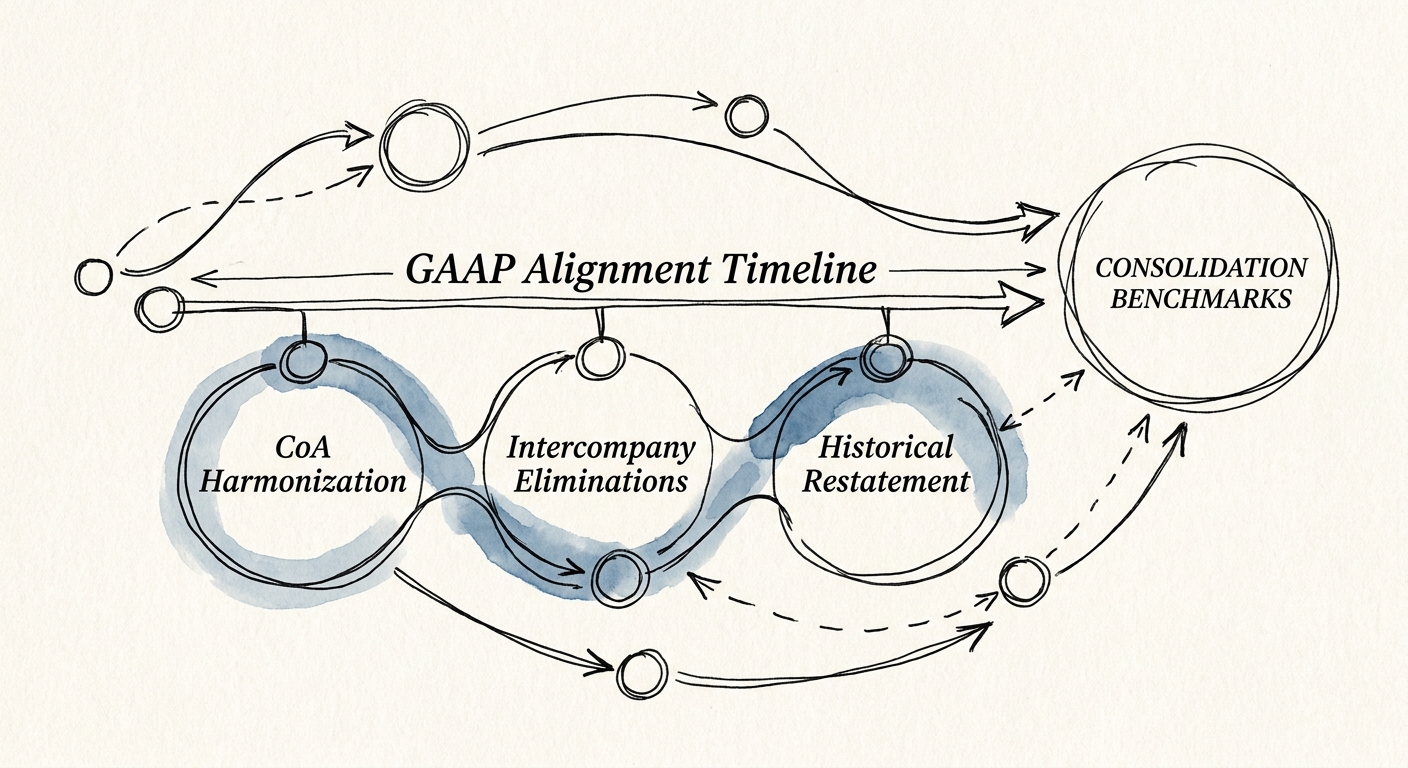
The benchmark is 184 days for a SaaS/IT-services roll-up that survives QofE without triggering material EBITDA adjustments. The reason it cannot be compressed is that each phase is the input to the next — and the FASB consolidation guidance (ASC 810) requires you to reflect controlling interests while eliminating every intercompany transaction before the consolidated statement means anything. You cannot eliminate intercompany revenue you have not yet defined consistently. So the sequence is fixed.
Days 1–45: harmonize the chart of accounts as a policy decision
The first 45 days never touch a system. They settle policy. In a SaaS roll-up the live arguments are predictable: one entity capitalizes internal software development, another expenses it; one recognizes a 12-month contract ratably, another books it at the milestone; one treats hosting cost as COGS, another buries it in opex and reports a flattering gross margin. You build one chart of accounts mapped to the platform's GAAP policy and force every entity onto it on paper first. Skip this and your close cycle goes from 7 days to 25-plus, because your controllers spend every month manually reconciling ledgers that were never speaking the same language.
Days 46–105: intercompany eliminations and transfer pricing
When one acquired MSP sells managed services to the platform, that revenue must vanish on consolidation — otherwise you are counting the same dollar twice and inflating top-line ARR. Sixty days here goes to building automated elimination rules inside the consolidation engine and structuring defensible transfer-pricing for the services flowing between entities. If your team is still hunting these transactions in Excel at the end of this window, your QofE is carrying material risk it does not know about. This is where mid-market finance teams stall, because intercompany services flows are messier than intercompany product transfers and most controllers have never structured them.
Days 106–184: restate the trailing twelve months
The last stretch is the one teams want to defer and cannot. You restate the trailing twelve months for each acquired entity onto the harmonized CoA and policies, so a future buyer gets comparable financials instead of a stitched-together story. Do it now, on your own clock, with your own team. Defer it and you will pay a Big Four firm a premium rate to do it under deal pressure — the worst possible time to discover that two of your entities never agreed on what revenue was.
The reason teams miss 184 days is org design, not accounting
Most sponsors miss the benchmark for a reason that has nothing to do with the standards and everything to do with who they put on it. The controller who ran a single-entity $20M services firm cleanly for a decade is excellent at that job and structurally unequipped to consolidate a $100M multi-entity roll-up — not because they are not smart, but because they have never built an elimination engine or restated TTM under a new policy set. Asking them to architect the consolidation while still running the daily close guarantees both jobs get done badly.
So separate the duties for the first six months. The legacy finance team keeps running standalone closes for the acquired entities. A dedicated integration group — usually a fractional technical CFO or a specialist revenue-recognition team — builds the consolidated environment with no operational distractions. APQC benchmarks show top performers close consolidated books in under five days, but that velocity only exists on top of a pre-mapped, automated ledger. You cannot build that ledger if the architects keep getting yanked into payroll fires.
The single thing to do Monday: pull the customer contracts from every acquired entity and lay the ASC 606 treatment side by side — when each recognizes implementation fees, how each handles multi-element arrangements, where each draws the line between license and service. If they disagree, your consolidated ARR is fiction until you fix it, and that one review will tell you whether your timeline is 184 days or two years. Fund the technical accounting resource now. A consolidation is a rebuild of how the combined company defines its own economics — not a software license and a weekend working session.