The practical answer
- Short answer
- While AWS and Azure markets saturate, Oracle Cloud Infrastructure (OCI) is growing at 52% YoY. Here is the diagnostic playbook for services firms to build a high-margin OCI practice.
- Best fit
- Industry: Cloud Services / System Integration. Function: Strategy & Revenue
- Operating path
- Revenue Architecture → Commercial Performance → Office of the CFO
- Key metric
- 52% Year-over-Year growth for OCI Infrastructure-as-a-Service (IaaS) revenue in Q4 FY25, outpacing competitors.
The AWS "Red Ocean" vs. The OCI "Blue Ocean"
If you are running a technology services firm between $10M and $50M in revenue, you are likely fighting a war on two fronts. On one side, you have the "Race to the Bottom" in AWS and Azure professional services. Every boutique consultancy and Global SI is fighting for the same migrations, compressing bill rates and forcing you to compete on price. On the other side, you have the growth plateau—the difficult moment when your pipeline coverage metrics stop predicting revenue because your differentiation has evaporated.
You don't have a sales problem; you have a supply-demand problem. You are selling water by the river. Meanwhile, there is a drought next door.
While the market obsesses over the "Big Two," Oracle Cloud Infrastructure (OCI) has quietly become the fastest-growing hyperscaler in the enterprise segment. In Q4 FY2025, while AWS and Azure managed respectable but maturing growth, OCI Infrastructure-as-a-Service (IaaS) revenue exploded by 52% year-over-year. Even more telling, Oracle leadership projects this acceleration to hit 70% in FY2026. This isn't just a blip; it is a correction of the market.
The "Uncool" Premium
In the services game, "cool" kills EBITDA. Everyone wants to build GenAI apps on AWS. Nobody wants to migrate a mission-critical Oracle ERP to the cloud. That is exactly why you should do it. Because the supply of qualified OCI architects is a fraction of the AWS ecosystem, rate cards for OCI specialists currently hold a 25-30% premium over generalist cloud architects.
When you build an OCI practice, you aren't just adding another logo to your slide deck. You are fixing your blended gross margin. You are moving from a commoditized service (generic cloud migration) to a specialized, high-barrier service (complex database migration).
In the services game, 'cool' kills EBITDA. Everyone wants to build GenAI apps on AWS. Nobody wants to migrate a mission-critical Oracle ERP. That is exactly why you should do it.
The Economics of the OCI Pivot
Why are enterprises suddenly moving to OCI? It isn't brand loyalty. It's cold, hard math. As a founder, you need to understand the economic triggers driving your customers so you can position your practice effectively.
1. The Data Egress Arbitrage
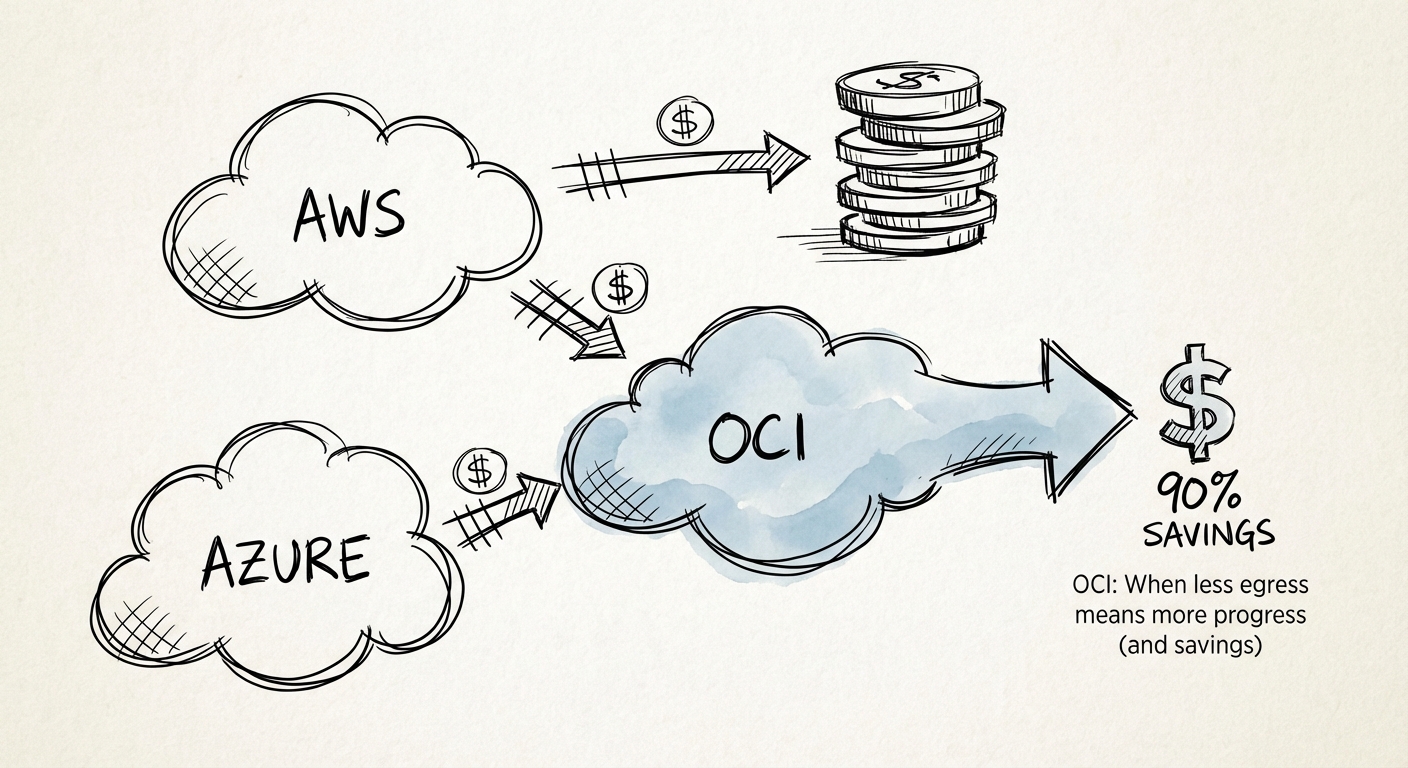
For AI and data-heavy workloads, the cloud tax is real. AWS and Azure charge significant fees to move data out of their networks. OCI has aggressively undercut this, offering outbound data transfer costs that are roughly 90% lower than AWS. For a client training Large Language Models (LLMs) or managing massive datasets, this single line item can save millions annually. Your pitch isn't "better technology"; it's "immediate EBITDA expansion" for your client.
2. The "Oracle on Oracle" Moat
This is the technical wedge. Oracle Real Application Clusters (RAC)—the gold standard for high-availability databases—is only supported natively on OCI. Running RAC on AWS or Azure requires complex workarounds or third-party hacks that introduce latency and risk. By offering zero-downtime migrations to OCI, you solve a technical debt problem that CIOs have been losing sleep over for a decade.
3. The Multi-Cloud Reality
The old days of "All-in on AWS" are dead. The future is multi-cloud. With the launch of Oracle Database@Azure and Oracle Database@Google Cloud, the walls have come down. Customers can now run OCI database services inside Azure data centers. This is your Trojan Horse. You don't need to convince a CIO to rip out Azure; you just need to convince them to place their database workloads on the optimal platform. This significantly lowers the barrier to entry for your sales team.
Execution: Building the Practice Without Breaking the Bank
Do not go out and hire five expensive OCI architects tomorrow. That is how you burn runway. Instead, follow a unit-economic efficient approach to platform expansion.
Step 1: The "Wedge" Offer
Define a specific, high-pain entry point. Do not sell "OCI Implementation." Sell "Oracle License Optimization & Cloud Migration Assessment." Many enterprises are paying for on-premise licenses they barely use. An assessment that promises to lower their Oracle licensing bill by moving to OCI (where Bring-Your-Own-License policies are favorable) pays for itself. It gets your team in the door and access to the infrastructure data.
Step 2: Leverage the Partner Ecosystem
Oracle is hungry for partners who can actually execute. Unlike the saturated AWS Partner Network, where you are one of 100,000, the OCI ecosystem is still porous. Register for the specific "Service Expertise" tracks in data management and migration. The incentives for partners driving Annual Recurring Revenue (ARR) consumption on OCI are currently aggressive—use them to subsidize your initial deal margins.
Step 3: Train, Don't Just Buy
It is faster to teach a senior AWS architect the nuances of OCI networking (VCNs vs. VPCs) than it is to find a culturally aligned OCI veteran in this market. Create a 60-day certification sprint for your top two engineers. Frame it as career development. You get the capability; they get the marketability. Win-win.
The Verdict: You can keep fighting for scraps in the Red Ocean, or you can take your existing cloud discipline and apply it to the fastest-growing infrastructure market in 2026. The 70% growth wave is coming. Build the capability before the market crowds.