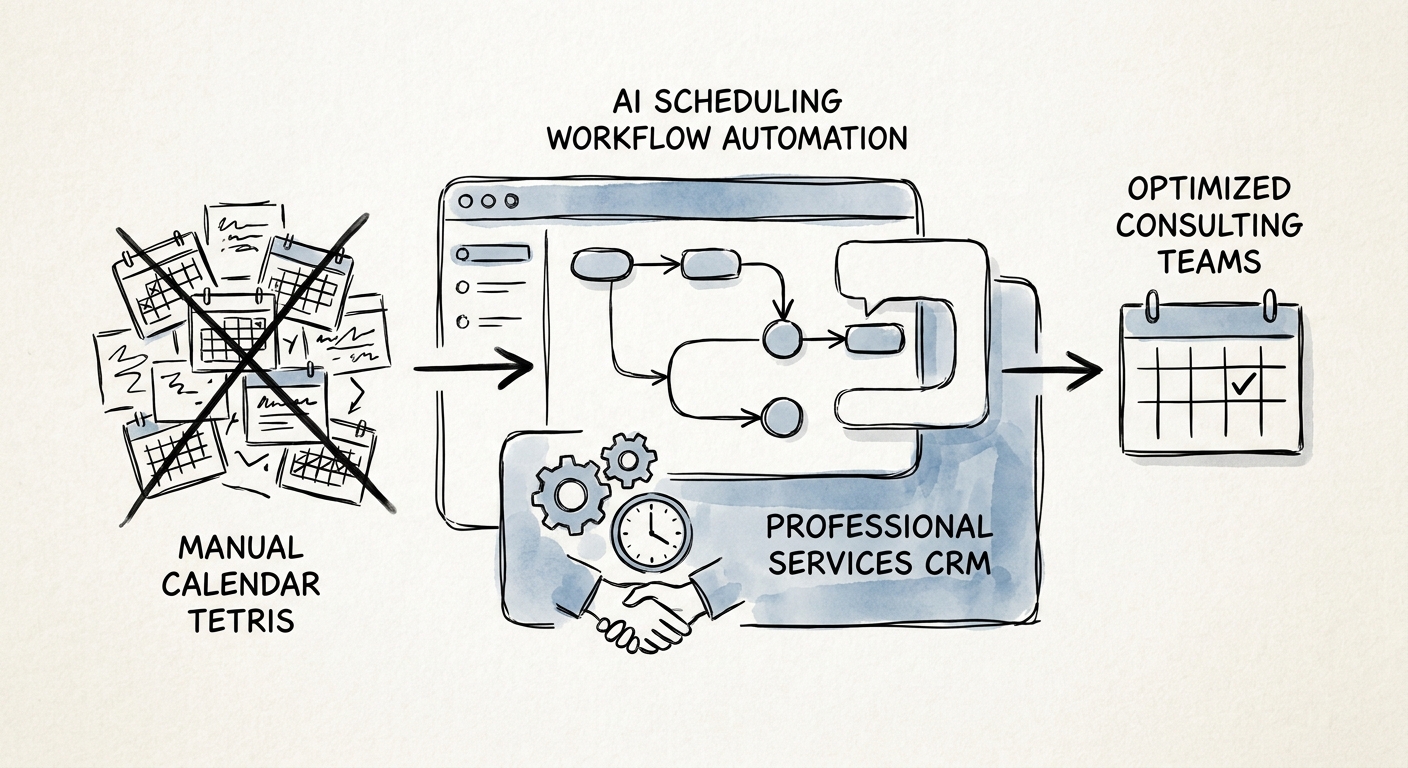
The double-booked consultant is a calendar problem, not a staffing one
Picture a 35-person implementation shop running eleven active deployments. Your most senior integration consultant is booked Thursday for a client go-live rehearsal — and the project coordinator, not knowing that, just dropped her into a kickoff for a deal that closed Tuesday. Nobody catches it until Wednesday night. Now you're either pulling her off the rehearsal (and risking a Friday go-live) or sending a junior to the kickoff and starting a new engagement on the wrong foot. That collision didn't happen because you're understaffed. It happened because the scheduling decision lived in three calendars, a Slack thread, and one coordinator's head.
This is exactly where scheduling AI is worth testing for software implementation partners, and exactly where it can quietly make things worse. The adoption pressure is real — Deloitte's State of AI in the Enterprise 2026 and the OECD SME AI adoption report both show smaller delivery firms reaching for automation while running thin on coordination capacity. But "the market is adopting" is not a workflow decision. The workflow decision is: which calendar, for which team, gets the AI first? Pick one project pod and one recurring pattern — say, the weekly cadence of kickoff, two configuration sprints, UAT, and go-live for mid-market clients — and let the delivery lead see every conflict the tool resolves before it touches a second pod.
The failure mode here is specific to your business. A generic assistant will happily reschedule a UAT session to free up a slot, not understanding that UAT sits on a critical path tied to a contractual go-live date. It will move a billable consultant onto an internal sync. It will auto-accept an invite that exposes one client's account name to another client's stakeholder list. Before you scale anything, watch the boring numbers: reschedule count per engagement, how often the lead has to override a consultant-allocation suggestion, milestone slip days, and client-facing calendar corrections you had to apologize for.
Measure whether the go-live held, not whether the calendar got faster
The trap in a delivery shop is measuring the wrong win. It's easy to point at "two hours of coordinator time saved per week" and call the pilot a success. But your coordinator's hours were never the constraint — your senior consultants' billable time and your contractual go-live dates were. So set the baseline on what actually breaks delivery: how many times a critical-path session got moved, how often a senior resource ended up double-allocated, how many days milestones slipped because of calendar churn, and how many engagements started late because a kickoff couldn't be assembled.
Run a weekly review that reads like a delivery standup, not a productivity report. Look at every schedule change the AI proposed and the lead accepted: did it respect the critical path? Did it keep utilization on the right consultants without burning them out? When it escalated a conflict, was the escalation the one a human would have flagged? You're testing whether the tool understands that not all meetings are equal — that a go-live rehearsal outranks an internal retro every time. Only once those behaviors hold across a few engagement cycles should you reach for the AI Opportunity Score or the AI ROI Calculator to put a number on it — and even then, tie that number to a named delivery owner who has to defend it.
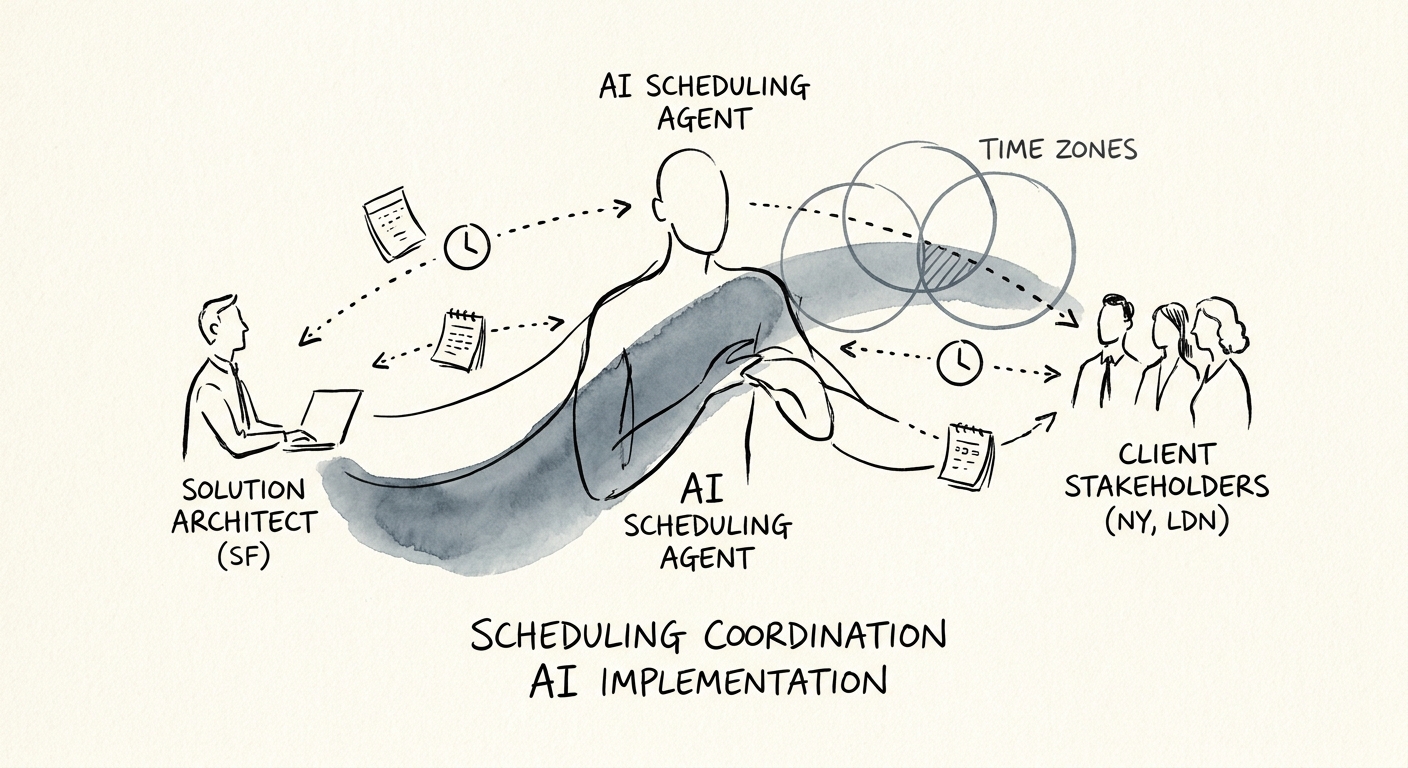
Lock down who sees which client, and who owns the override
Implementation firms carry a risk most calendar tools never consider: your invites are full of cross-client context. A go-live invite names the client, often names their systems, and sometimes names the deal. The moment scheduling AI starts auto-populating attendee lists and meeting titles across a multi-client book, you have a confidentiality surface you didn't have before. The NIST AI Risk Management Framework gives you a clean way to write down the intended use, the failure risks, the measures, and who is accountable — do that on one page before the pilot widens. CISA's AI data-security best practices should drive the unglamorous controls: role-based access so a consultant only sees the client books they're staffed on, scrubbed meeting metadata, and an immutable log of every schedule change the AI proposed, accepted, or rejected.
Two rules keep this safe in practice. First, the delivery lead — not the model — owns critical-path conflict escalation; the AI can flag, but a human decides whether to move a go-live-adjacent session. Second, nothing involving a client's calendar gets auto-sent without a human glancing at the attendee list. Expand the same way you'd expand a deployment: one pod, then one client tier, then your recurring milestone patterns across the book — and only after your delivery leads stop double-checking the calendar by hand because they've started trusting it.
