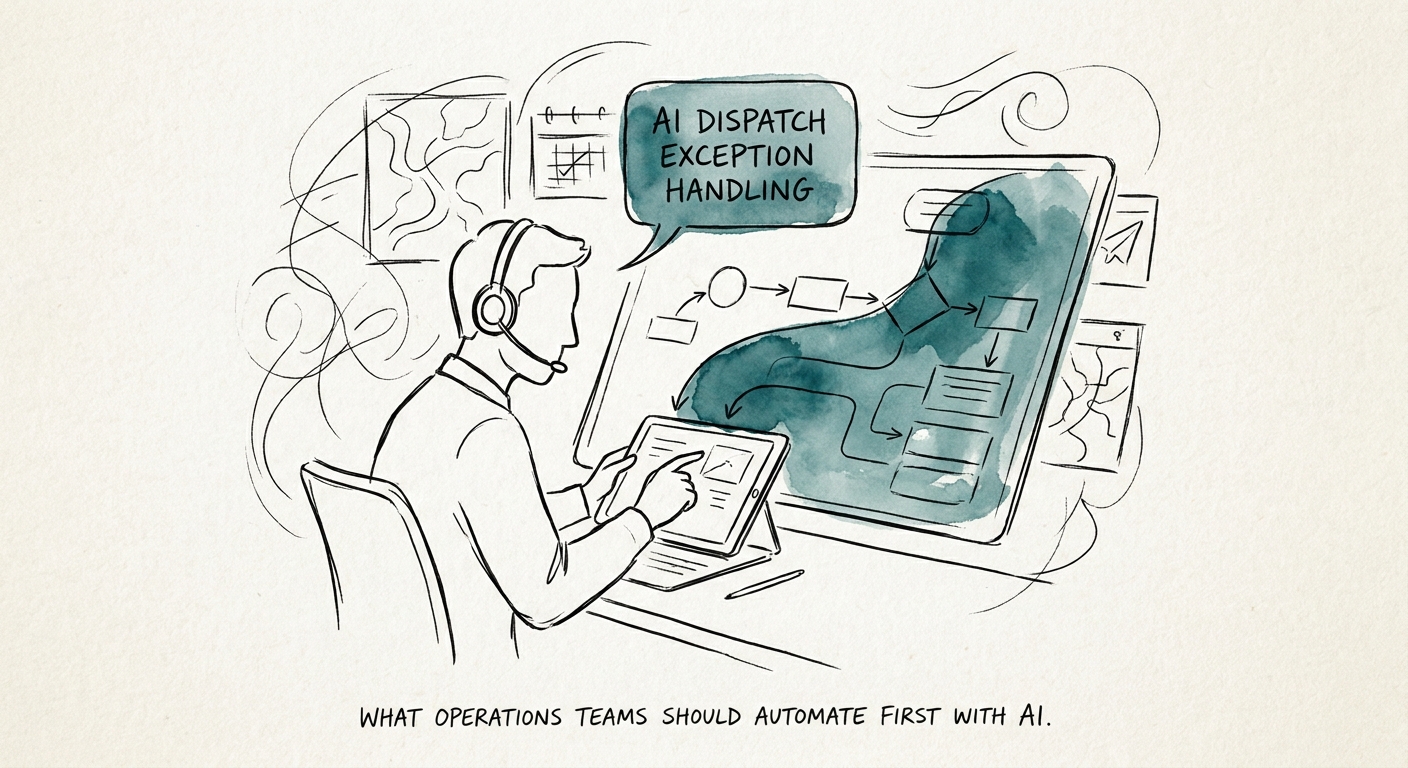
It's 9:40 a.m. and the board is bleeding amber
Three technicians are running late. A part that was supposed to be on the truck isn't. A platinum-contract customer's window closes at noon, and the only qualified tech for that job is 40 minutes away on a ticket that could slip to tomorrow without penalty. Your dispatcher is holding two phones and re-reading the same screen. This moment — not invoicing, not scheduling, not the chatbot everyone keeps pitching — is where AI earns its place in a field service operation first.
The reason is unglamorous and exactly why it works: the exception queue is structured, it repeats every single morning, and the cost of a wrong guess is measurable in SLA penalties and churned accounts. The broad Census reporting on business AI adoption shows where the market is heading, but the win here is narrow and concrete: surfacing which of 60 amber rows is the one about to break a contract, and what the realistic reroute options are — before the customer calls to complain.
The job of the assistant is to rank and explain, not to act. It does not silently reschedule a tech, override the dispatcher, or paper over the fact that the inventory feed is two hours stale. It says "this job is your highest service risk, here's why, here are three moves" — and leaves the call to the person who knows the customer.
The dispatcher already had the data. They didn't have time to fuse it.
A good exception ranking pulls from signals a dispatcher consults manually under pressure: live job status, technician location and skill match, whether the part is actually on the truck, the SLA clock, the customer's contract tier, prior visit history on that account, and the free-text notes from the last failed visit. Humans do this fusion well when they have ten minutes per ticket. At 9:40 with the board on fire, they triage by whoever yelled loudest. The model's only edge is that it reads all seven inputs for all 60 rows in the time it takes to refresh the screen.
That edge is worthless if nobody can tell whether the system is recommending or deciding. NIST's AI Risk Management Framework is useful precisely for drawing that line: in dispatch, the line sits at the moment a job gets reassigned or a customer gets a new ETA. Everything up to that line — ranking, evidence, reroute suggestions — is advisory. The reassignment itself stays a human action with a logged reason, so you can later tell whether the AI's ranking made service better or just made it faster.
Then there's the data you're feeding it. Technician GPS, customer addresses, contract terms, and service logs are sensitive, and they live in the field where access controls get sloppy. CISA's data-security guidance should govern who and what can read location and customer records. Practically: the system shows the evidence behind each ranking, flags when a signal is missing or stale ("location last updated 47 min ago"), keeps an override trail, and never routes a high-tier customer's job change without a dispatcher in the loop.
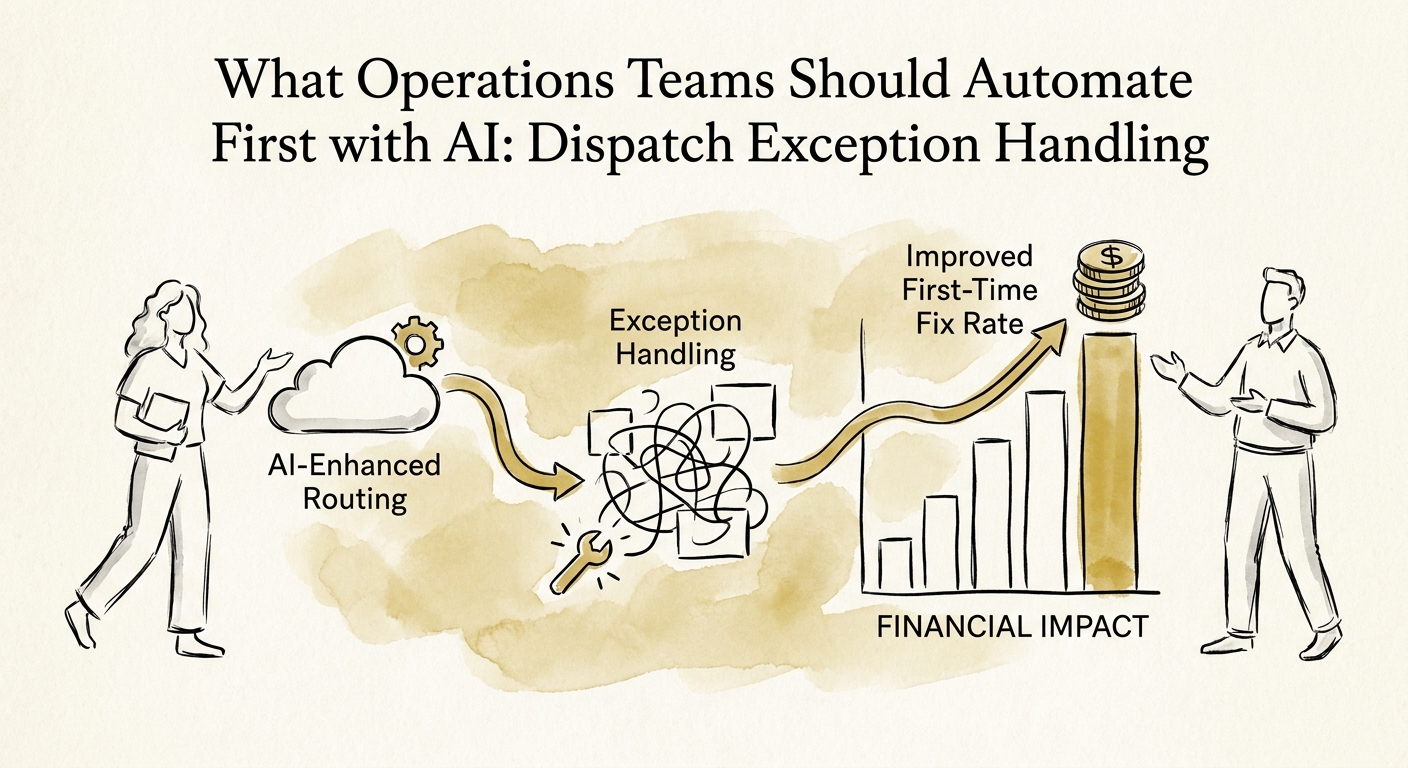
Pick one exception family, baseline it, and let the overrides teach you
Don't try to rank "exceptions." Pick one family: late arrival, missing part, technician skill mismatch, or SLA-at-risk. Each has a different data dependency and a different person who owns the fix — the parts shortage routes to the warehouse lead, the skill mismatch routes to the scheduler. Picking one keeps the logic small enough that a dispatcher can look at any ranking and say "yes, that's right" or "no, you're missing that this customer waived the window last time." Say a 50-tech HVAC operation starts with missing-part exceptions only: now the recommendation logic is inspectable, and you can A/B the AI's ranked list against the dispatcher's gut for two weeks before trusting it.
Baseline first, then measure what actually moved: response time to each exception, prevented SLA misses, repeat visits, customer escalations, and how many dispatcher touches the workflow saved. Track override reasons obsessively — they are not failures. When a dispatcher overrides because "the parts feed didn't show the emergency restock," you've just found a broken data source the model couldn't have known about. Overrides are your map of where the source systems are still lying to you.
Scale when dispatchers trust the rankings enough to override fast and rarely — and stall when the location feed, inventory records, or SLA rules can't be relied on, because no model fixes a bad address. Resource-constrained teams have the most to gain here, a pattern the Federal Reserve Bank of San Francisco notes for smaller operators, and one echoed in the OECD's work on SME adoption and Deloitte's 2026 State of AI report. Monday move: pull last month's exception log, sort by which ones caused an SLA miss or escalation, and you'll see your starting family in about ten minutes. If you want a structured read on sequencing, run an AI opportunity score and frame the rollout against a 90-day implementation plan.
