
The practical answer
- Short answer
- Learn how to triage distressed accounts, escalate contract-governed payment issues, and recover cash when customers cannot pay on time.
- Best fit
- Industry: B2B Software & Services. Function: Finance & Operations
- Operating path
- Project Recovery → Turnaround & Restructuring → Transaction Execution Services
- Key metric
- 3 Practical segments for delinquent accounts: insolvent, distressed but viable, and deliberately stretching terms.
A meaningful share of mid-market B2B tech receivables are now aged past 90 days, effectively acting as zero-interest loans to customers under liquidity pressure, according to S&P Global's Q1 2026 Corporate Default Tracker. We are living through a silent liquidity problem masquerading as a temporary billing glitch. While sales teams celebrate top-line bookings, finance teams may be carrying revenue that has not converted to cash. The fundamental mistake scaling companies make is treating delinquent accounts as an administrative issue rather than a strategic project recovery effort. When a customer stops paying, it is not a clerical error; it is an active operational failure that requires immediate executive intervention.
The Zero-Interest Loan Problem
In private equity-backed software and services companies, the pattern is often the same: the executive team watches booked revenue while treasury waits for cash. Sales reps do not want to pressure champions, account managers assume the invoice is stuck in a portal, and finance keeps sending reminders to a generic inbox. That passive approach lets the customer decide your working-capital policy for you. The reality is that customers under pressure manage cash aggressively, and vendor payment timing becomes part of their runway planning. The data confirms this systemic delay. Deloitte's 2026 Working Capital Optimization Study reveals that the average Days Sales Outstanding (DSO) in the B2B software sector has expanded by a devastating 18 days over the trailing twelve months.
This is where standard collections playbooks fail. You cannot rely on automated reminders when the client's controller has explicit orders to freeze all non-payroll disbursements. You have to treat aged accounts receivable exactly like a failing software implementation: you halt normal operations, you escalate past the daily contacts, and you force an executive steering committee decision. This requires a profound shift in mindset. You must stop viewing yourself as a passive vendor and start operating like a senior commercial partner. If you do not actively defend your Working Capital Optimization in PE Portfolios, your customers will cheerfully drag your firm down with theirs.
If a customer is 120 days past due, the account needs executive recovery review, not another automated reminder.
Triage and the 'Runway Segmenting' Playbook
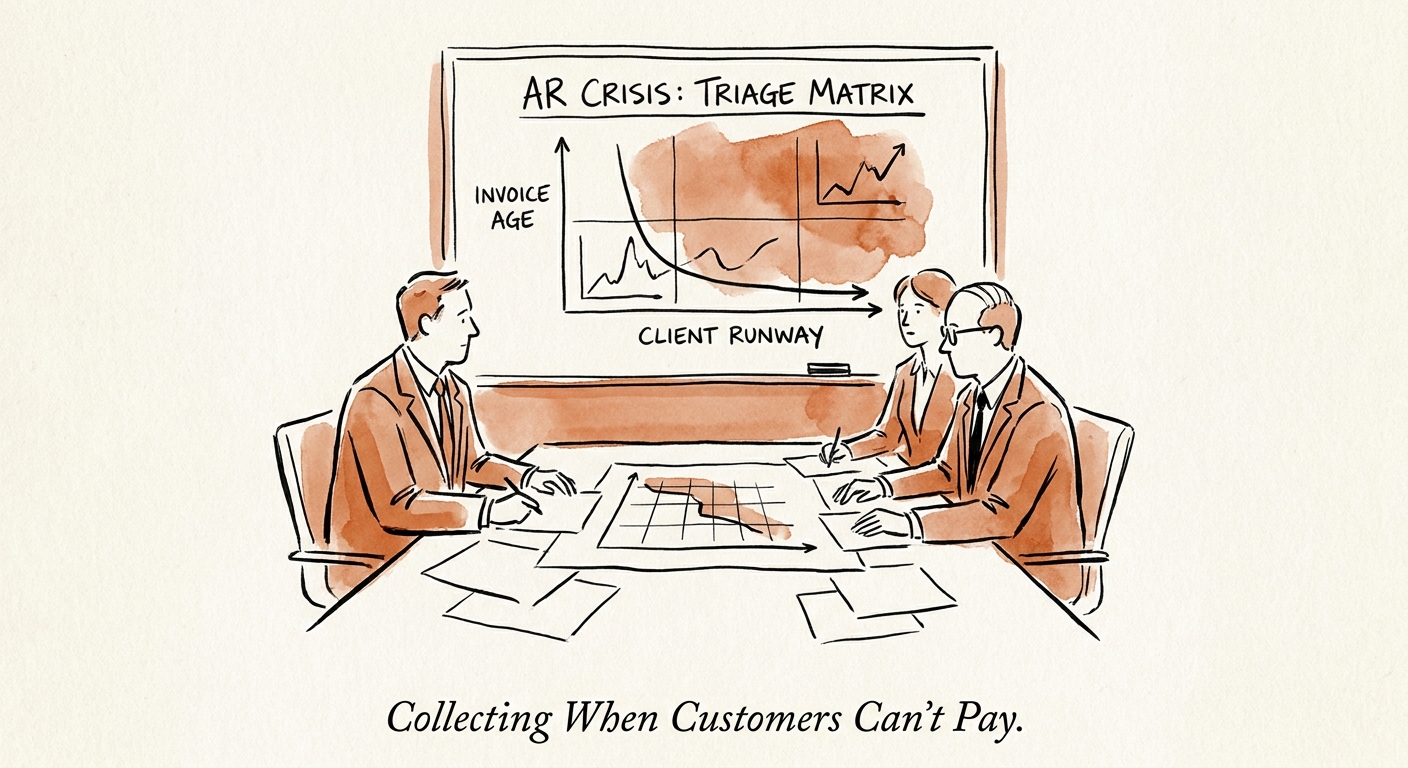
The first step in recovering distressed accounts receivable is diagnostic. You must segment your delinquent customers not by the age of their invoice, but by their actual operational cash runway. Traditional 30/60/90-day aging buckets can be incomplete when the entire market is delaying payments. Instead, you need a structured triage methodology. McKinsey's 2026 B2B Payment Dynamics Analysis proves that firms segmenting their AR aging by client operational runway rather than standard chronological buckets recover materially more cash within the fiscal quarter.
Our recovery framework divides delinquent accounts into three categories. Tier 1: companies that cannot pay and may face insolvency. Tier 2: distressed but viable companies that want to pay but lack current liquidity. Tier 3: customers with cash who are deliberately extending vendor payment terms. Each tier demands a different recovery tactic. For Tier 3, enforce the escalation rights in the contract. But for Tier 2, demanding immediate full payment simply forces them to default. You have to engineer a structured exit or a phased recovery. PwC's 2026 Restructuring and Liquidity Trends Report found that 42% of successful mid-market technology turnarounds now mandate accepting structured payment plans over pursuing costly, protracted legal write-offs.
When you encounter a Tier 2 client, you must transition from a vendor into a restructuring partner. This means picking up the phone, bypassing the procurement portal, and having a direct conversation with their CFO. Offer to restructure their payment terms, discount for immediate partial cash, or swap debt for extended contract commitments. The goal is to get cash in the door today, even if it means taking a slight haircut on the recognized revenue. Be acutely aware of The ARR-to-Cash Illusion; a signed contract is worthless if the counterparty cannot fund the wire transfer.
Contract-Governed Escalation for Cash Recovery
When restructuring conversations fail, escalation needs to follow the contract, the customer relationship, and legal review. If you provide a mission-critical SaaS platform, essential managed service, or foundational infrastructure layer, do not improvise service disruption. Review the agreement, confirm notice periods, involve counsel, align finance and customer success, and document the customer's payment history before changing service levels.
The escalation path should be explicit. Send a formal notice to the customer's executive sponsor, CFO, and legal contact. State the delinquency, the contract provision, the cure period, the proposed payment path, and the operational consequence if the customer does not respond. For software companies, any access change should be permitted by contract, proportional to the delinquency, and designed to preserve data integrity. For professional services firms, it may mean pausing non-critical work, freezing new scope, or moving the account to executive review until payment terms are reset.
Many founders and sales leaders resist escalation because they fear damaging the long-term customer relationship. The better framing is commercial clarity. If a customer is 120 days past due, the relationship already requires executive-level repair. Every day you continue to provide uncompensated value, you are increasing working-capital risk inside your own company. A disciplined accounts receivable recovery project enforces contract terms, protects service teams from informal exceptions, and gives viable customers a clear path to become current.