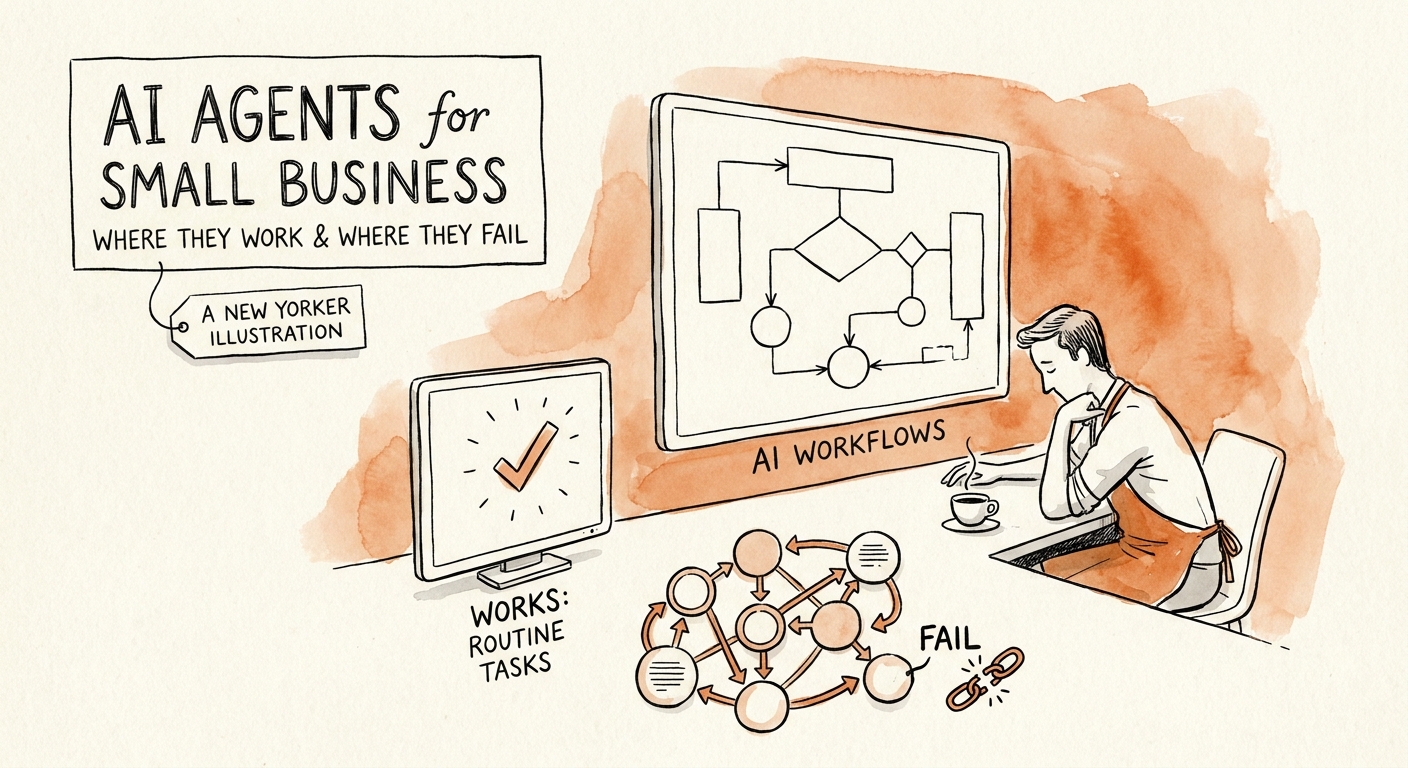
A chatbot answers. An agent acts — and that changes everything
Here is the line that matters. A chat window hands you a draft and waits. An agent takes steps on its own: it pulls a record, updates a field, routes a ticket, or queues a change inside a live workflow. The moment software stops answering and starts doing, the question is no longer "is the output good?" It is "what did it just do to my business, and can I see it?"
That distinction is why the same demo that wowed you in a 20-minute sales call falls apart three weeks in. The demo ran on a clean ticket with a complete record and an obvious answer. Your Tuesday queue has a customer who changed their email twice, an attachment that never uploaded, and a note that contradicts the CRM. The RSM middle-market AI survey shows the adoption pressure is real — and that pressure is exactly what pushes owners to grant an agent broad authority before anyone has watched it handle a single messy case.
So before you compare models or pricing, answer five questions in plain language: what can this agent read, what can it write, what can it merely suggest, what is it allowed to execute without a human, and who reviews the calls it is unsure about? If you can't answer all five in one sentence each, you haven't bought an operating asset. You've bought a risk surface with a friendly interface.
The agents that work share one trait: a small blast radius
The agents that survive in a 50-to-300-person company are boring on purpose. One source system. One task family. One named owner. One review path. Picture a 40-person agency: instead of "an AI that handles support," you start with an agent that reads incoming tickets, applies a label, and suggests an escalation tier — and never sends a customer a word. A sales manager sees proposed CRM field updates in a queue and accepts or rejects them; nothing changes in the record until a human clicks. A research assistant drafts a market summary from approved files and stops there.
Contrast that with the version that quietly ruins a quarter: it has logins to four systems, edits customer and billing records directly, writes nothing to a log, and leaves no trail you could follow to reconstruct why it did what it did. The OECD SME AI adoption report draws a sharp line between casual generative AI use and AI woven into core operations — and direct-action agents land squarely in the second category, where your controls have to be grown-up before you turn anything on.
Run every candidate agent through five scores before spend: permission scope, source quality, the cost of a single bad exception, the review burden it adds to a human, and reversibility. Weak on any one? Keep it in suggestion mode. The counterintuitive part is that the narrower authority boundary is usually what lets a small team move faster — because you're not spending Fridays cleaning up actions you can't undo.
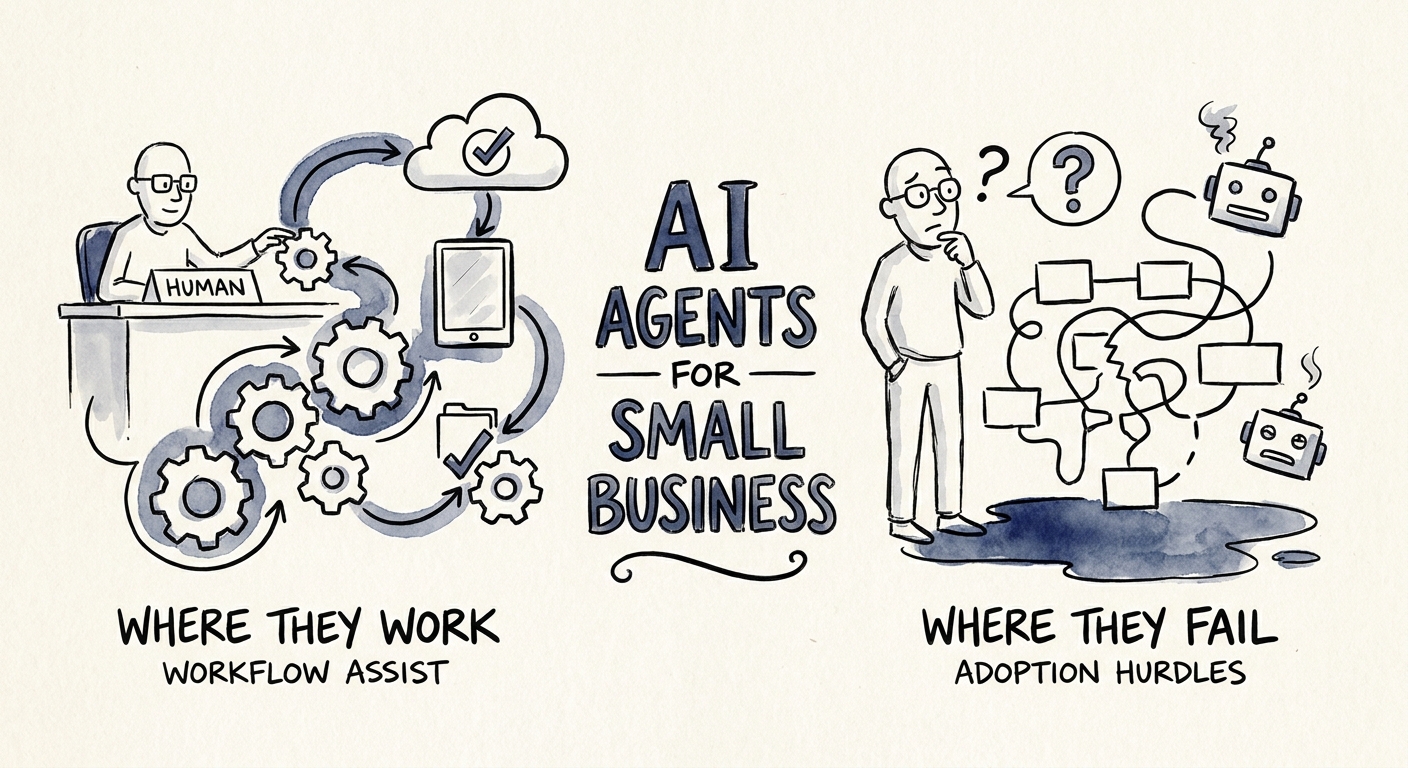
The production gap, and the checklist that closes it
An agent project exposes the gap between "we're using AI" and "AI changed how the work runs" faster than any other use case — because the agent is expected to act, not just talk, so the first wrong action is visible immediately. The Deloitte State of AI report keeps surfacing that same gap between AI activity and actual process change, and it's not a model problem. It's an operations problem wearing a model costume. It's also why Gartner expects more than 40% of agentic AI projects to be canceled by the end of 2027 — not because the tech can't work, but because the demo never met the real queue.
Treat the rollout like onboarding a new hire who is fast, literal, and tireless. Before go-live you need: an evaluation set built from your actual ugly cases, defined source boundaries, explicit action permissions, approval states, logging, a rollback path, a human who owns support, and a standing weekly exception review. Then measure the thing that actually predicts trust. If it proposes CRM updates, track accepted versus rejected changes week over week. If it routes tickets, sample the labels. If it drafts follow-up, watch how heavily people edit before sending — a draft that always gets rewritten isn't saving anyone time.
Monday move: pick one task with the smallest blast radius you have, put an agent in suggestion-only mode, and log every call for two weeks before you let it touch a single record. When the question shifts from "can it respond?" to "can it operate safely inside the business?", the next step is AI Agents and Internal Copilots. The same discipline that unblocked a $3M stalled initiative in 30 days — clear ownership, hard controls, a real recovery path — is what separates an agent that ships from one that gets canceled. Design a safe agent workflow when you're ready to scope it for real.
