The owner is the bottleneck — start there
Walk into a 30-person business where the owner still signs off on quotes, and you'll find the same scene every week: a stack of half-drafted proposals waiting on her, a sales rep sitting on a hot lead because nobody wrote the follow-up, and an inbox where the only record of what a customer asked for last March lives in one person's head. That's not a technology gap. It's a single human approval queue with too many lanes feeding into it.
This is what makes owner-led different from enterprise AI planning. A 2,000-person company has a department to absorb a new tool. You have the owner, a bookkeeper, and a sales lead who already wear four hats each. The RSM middle-market AI survey shows usage is now broad — but broad usage in a small shop turns into one curious employee building something nobody else can run or maintain when they're out for a week.
So the first filter isn't "what could AI do." It's "what already lands on the owner's desk that didn't need her judgment in the first place." Quote drafting, follow-up writing, ticket triage, invoice nudges — these are tasks where a person reviews and approves, but doesn't need to originate. Those are the lanes you widen first. Everything else waits.
Ten candidates — and the four columns that rank them
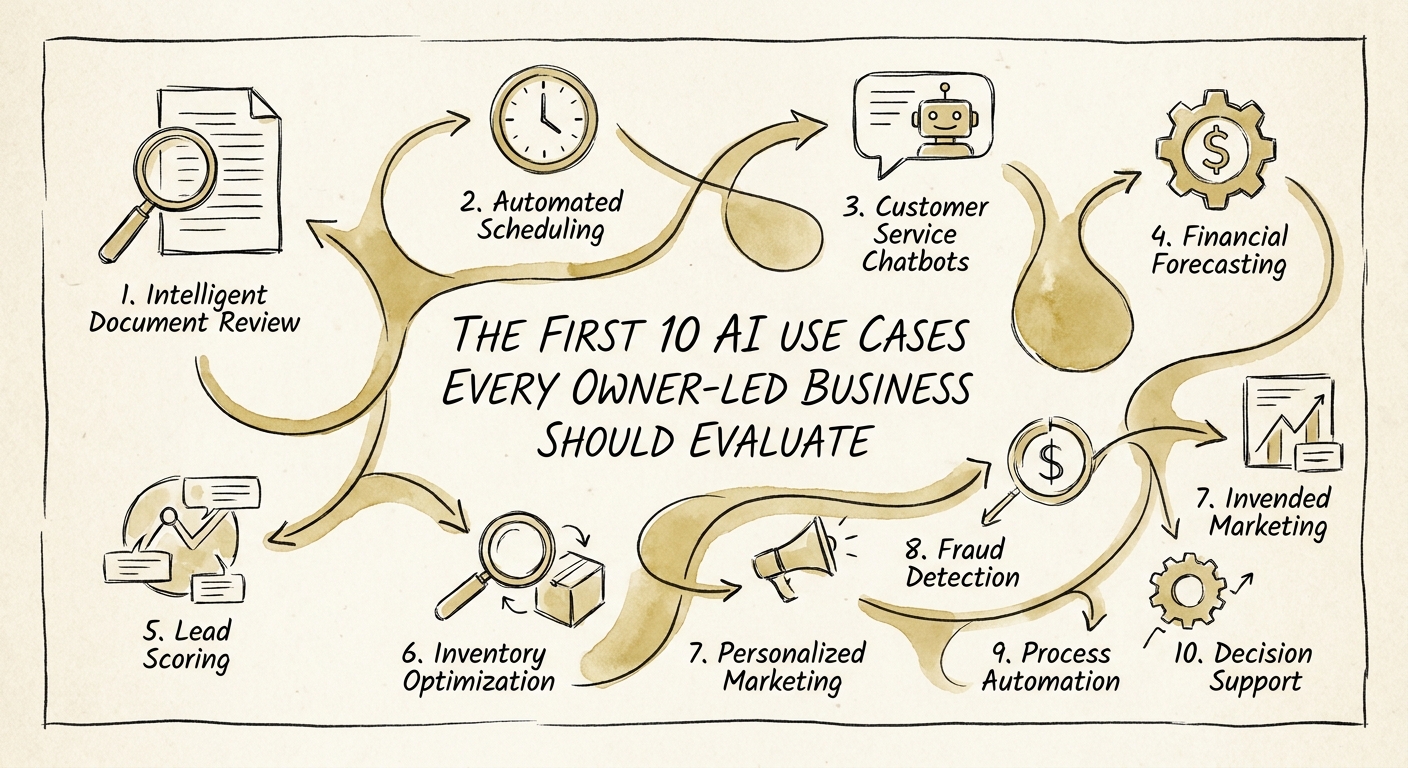
Here's the list worth scoring. Sales follow-up: draft the next-touch email from CRM history and call notes, owner approves with a glance. Proposal assembly: build a first-draft outline from your approved service descriptions. CRM hygiene: flag duplicate records and deals stuck 60 days in the same stage. Support triage: label incoming tickets and surface the customer's prior context. Internal knowledge search: answer "how do we handle X" from your own documents instead of interrupting the one person who knows. Invoice follow-up: prep the reminder, finance checks the tone and the balance before it goes. Scheduling: offer real time slots without promising availability you don't have. Weekly operating summary: roll up the numbers managers keep asking for by hand. SOP drafting: turn a recorded walkthrough into a written procedure. Review mining: pull recurring themes out of customer feedback.
Don't pick by excitement. Score each one against four columns: Does a named person own the output? Does the input data already exist and stay reasonably clean? Can a human review the result in seconds before it's used? And is there a number the owner already trusts — response time, days-to-quote, percent of invoices over 30 days? A use case that scores yes on all four is a pilot. A use case missing two of them is a process problem wearing an AI costume; fix the process first. The OECD SME AI adoption report lands on the same lesson: adoption sticks when AI is bolted to a specific activity, not turned loose as general experimentation.
Pick one. Make it boring. Measure it.
The instinct in an owner-led shop is to start with the messiest, most painful workflow — the one that's been bleeding money for a year. Resist it. Your first pilot should be the contained one: clear input, reviewable output, low blast radius if it's wrong. Say a 40-person services firm picks invoice follow-up. Finance still approves every reminder before it sends, so a bad draft costs ten seconds, not a client relationship. Compare days-to-payment for the month before and the month after. If it moves, you've earned the right to a second workflow. If it doesn't, you stop, and you've lost almost nothing.
What you're explicitly not doing first: customer-facing communications that can't be reviewed in time, anything touching HR or credit decisions, and data-heavy automations with no clear owner. The Deloitte State of AI report documents how wide the gap is between teams experimenting and teams running AI in production — and small companies close that gap not with bigger ambition but with one workflow, trained users, reviewed exceptions, and a decision made only after the evidence shows up.
If your candidate list is already longer than your team can build, that's the signal to narrow before you buy a single tool. The QuickStart AI Audit runs exactly this scoring exercise: define the operating problem, assign an owner, set the measure, and keep the risk visible — the same discipline we bring to turnaround and stalled-project recovery. Find your first AI win and pick the one workflow that gives the owner a Tuesday back.