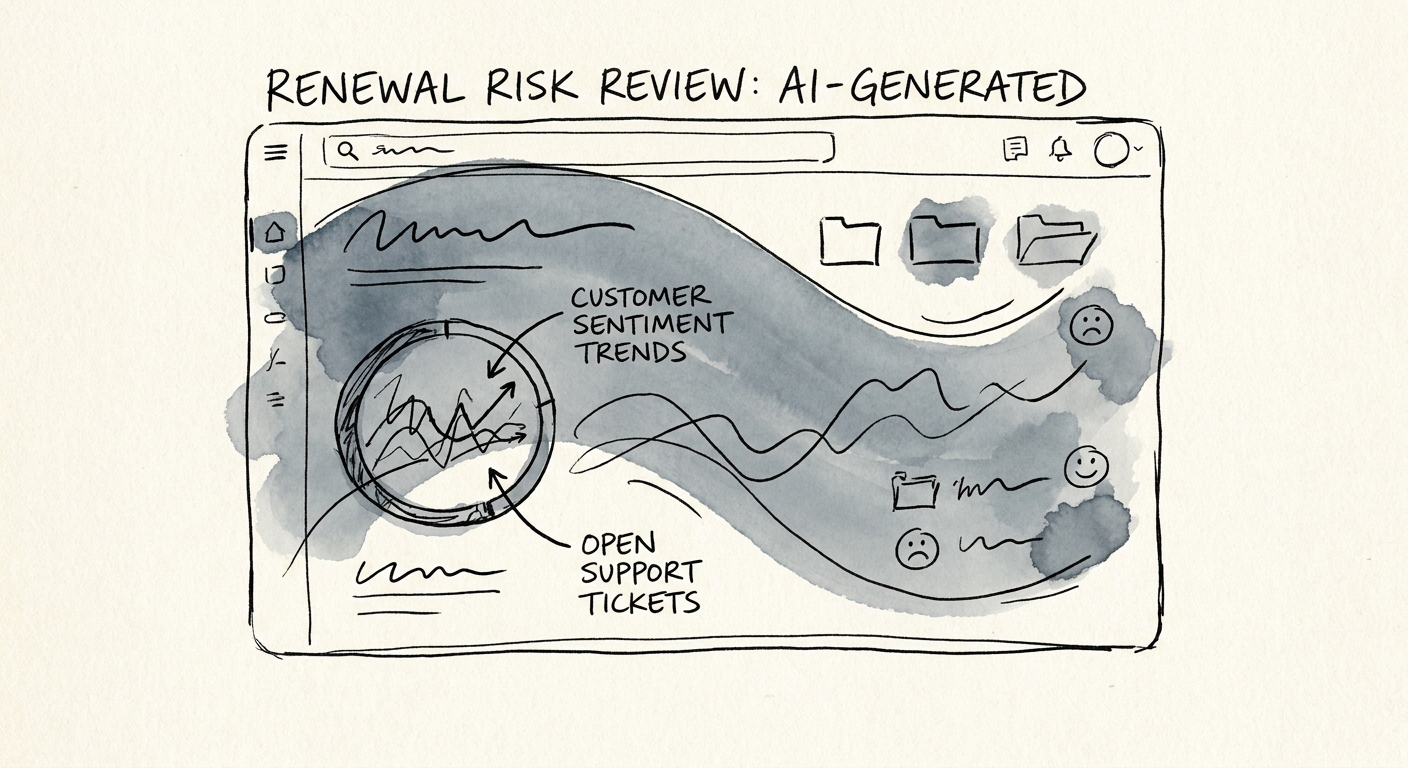
The signals were always there. Nobody read them in one place.
A 60-seat SaaS account churns at renewal and the post-mortem always sounds the same: "We didn't see it coming." But you did. The support queue showed three reopened tickets in Q4. Product usage on the feature they bought for had quietly dropped 40% after their champion left. The salesperson promised an integration in the kickoff deck that never shipped. The CS notes from February said "exploring alternatives" in a field nobody reads before a renewal call. Five true signals, five different systems, zero people who saw all five at once.
That is exactly why renewal risk review is the right first AI workflow for a B2B SaaS or managed-services team to automate — not ticket deflection, not a chatbot. The evidence already exists; it's just scattered across your helpdesk, your product analytics, your CRM, and your CS team's heads. The Salesforce State of Service 2025 report tracks service teams taking on more complex, revenue-adjacent work — and renewals are where service history and commercial reality collide. Because that work crosses sales and service, the Salesforce State of Sales view matters too: the AI's job is to reconcile what was sold against what was delivered, and surface the gap, before a human walks into the room.
What most teams get wrong: they automate the verdict instead of the brief
The failure mode is predictable. A team buys a "churn prediction" score, gets a number — 73% risk — and has no idea what to do with it. Nobody trusts a black-box number they can't trace, so it gets ignored, and you're back to "we didn't see it coming."
Build the opposite. Every risk flag must cite its source: the specific ticket, the specific usage drop, the specific line in the kickoff deck, the specific CS note. A useful brief reads like "Renewal risk elevated: champion departed (CRM contact deactivated Feb 3), reopened billing ticket #4821, advanced-reporting usage down 40% since January, integration committed in onboarding never delivered." Now a human can act in two minutes instead of spending an hour reconstructing the account. The NIST AI Risk Management Framework is the right discipline here precisely because these summaries shape how you treat a customer and where revenue attention goes — you want the system mapped, measured, and governed, not improvising verdicts. And the McKinsey State of AI 2025 finding holds: value comes from redesigning the workflow, not bolting a model onto chaos. A risk summary that doesn't feed a fixed account-review cadence — say, 90 days before every renewal over a revenue threshold — is just another report nobody opens.
Measure the save, not the summary
The vanity metric is "we generated 200 risk briefs this month." That tells you nothing. Track what actually moves renewals: source completeness (did the brief pull from all five systems, or miss the product-usage feed?), false-positive rate (how many healthy accounts got flagged — kill trust fast if this runs high), save-plan acceptance (did the CS owner act on the brief?), and prep time saved per account review. The goal is a sharper human decision inside the renewal window — escalate, save, expand, or let it lapse cleanly — not an automated account verdict the team learns to distrust.
The line that doesn't move: a person owns the save plan. AI assembles the picture; your CS lead decides what earns the renewal. If you're a B2B SaaS or managed-services team weighing where to start, work through the operating model in customer-service AI workflow design, then run the AI Opportunity Score to confirm renewal risk belongs ahead of ticket triage or reporting in your queue. For most subscription businesses with a real renewal book, it does — because nothing else you automate protects revenue this directly.