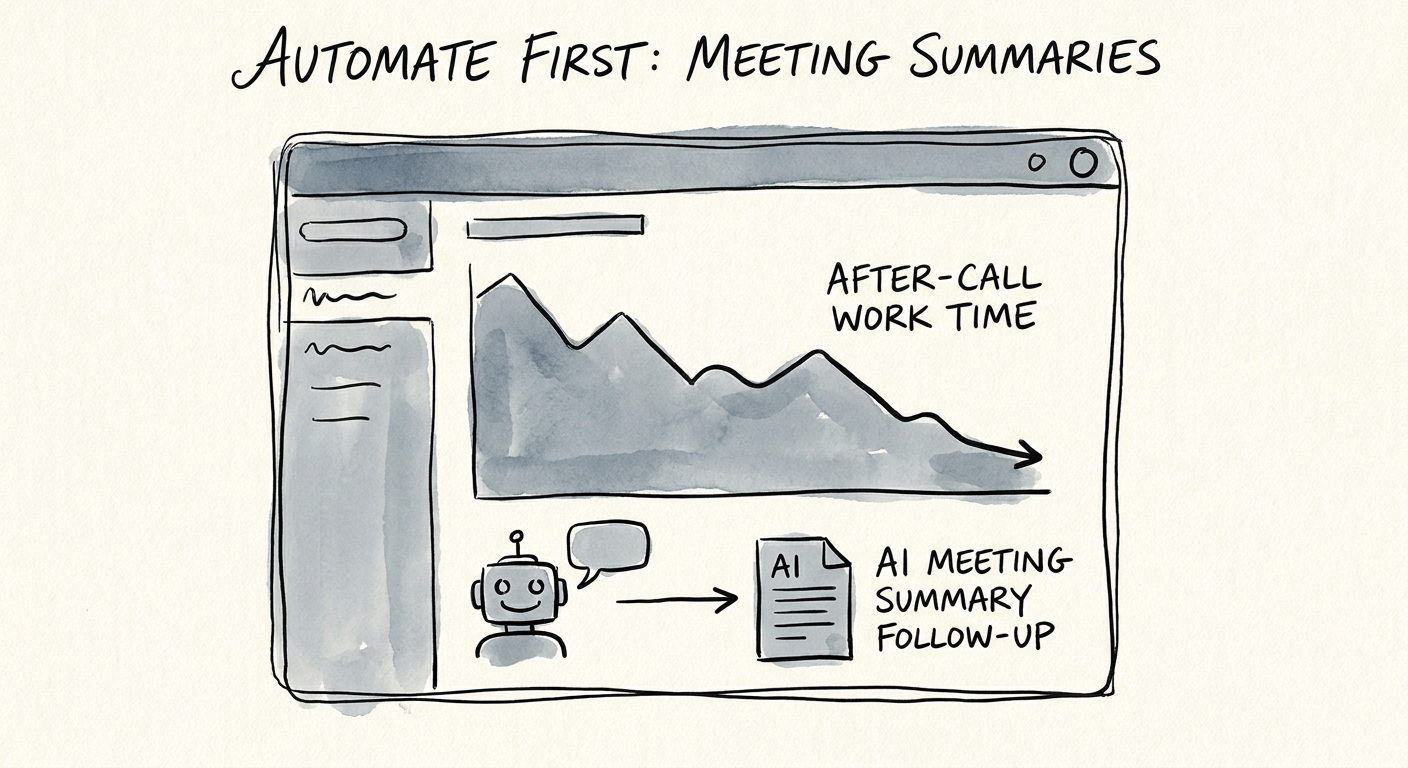
The credit you promised at minute 34
Picture a customer success manager on a renewal call with an account that's quietly unhappy. Thirty-four minutes in, she says: "I'll get you a one-month credit and loop in our integrations lead by Friday." The call ends, three more start, and by Friday the credit hasn't moved and the integrations lead has never heard of this account. The customer didn't churn over the original problem. They churned because you proved, in the most visible way possible, that your word has a shelf life of one afternoon.
That gap is exactly where customer service and success teams reach for an AI meeting assistant — and exactly where most of them set it up wrong. The tool spits out a fluent recap, everyone nods, and the recap goes into a channel nobody reads. The summary was never the bottleneck. The bottleneck is that a spoken commitment, a CRM account record, a consent status, and a named owner all live in different places and never get stitched together before the meeting fades from memory.
The adoption research bears out the pattern. The RSM middle-market AI survey and the San Francisco Fed small-business AI analysis both show plenty of teams trying these tools; the OECD SME AI adoption report shows how few turn that into a repeatable result. The teams that get value don't ask "can it summarize?" They ask "does this turn a spoken promise into an owned, dated, customer-linked action — without firing off a message I never approved?"
Where it goes wrong: the consent flag and the missing owner
Two failure modes will sink this faster than any model quality issue, and both are specific to customer-facing calls.
The first is consent. A sales or support recording often carries a recording-consent status that travels with the account — and a meeting assistant that ingests every transcript indiscriminately will happily summarize a call the customer never agreed to have recorded. The second is the orphaned commitment: the AI captures "we'll send a credit" but attaches it to no one, so it dies in a draft. A summary with five action items and zero owners is worse than no summary, because it creates the feeling that follow-up is handled when nothing is.
Treat this as an operating design, not a prompt. Use the NIST AI Risk Management Framework to name who is accountable for each follow-up and what "acceptable error" means here — a missed credit is not the same risk as a misspelled name. Use CISA AI Data Security Best Practices to decide which fields the assistant may touch: transcript, consent flag, CRM account record, open commitments, support history, and next-action owner each get explicit rules for what's logged, retained, or excluded.
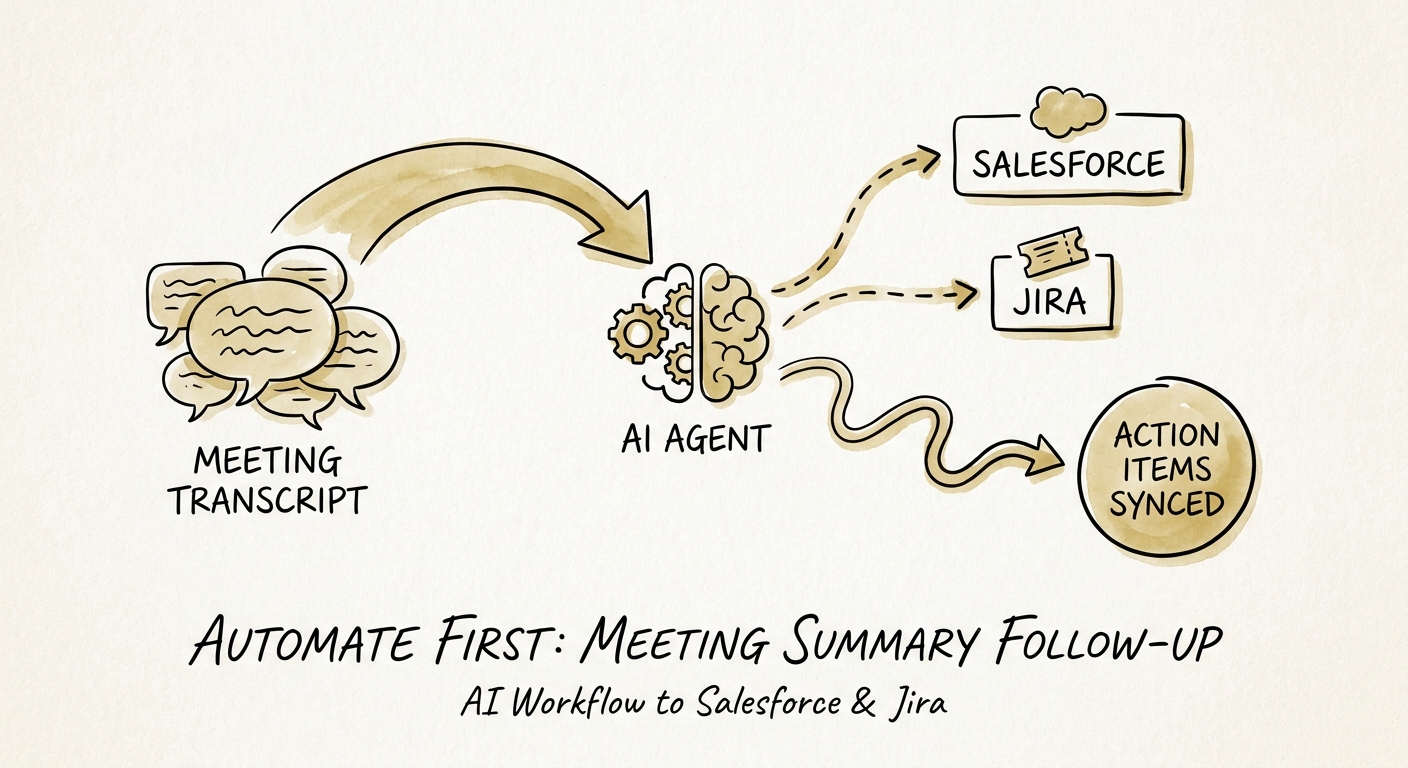
The concrete output isn't a paragraph — it's a structured row per commitment: what was promised, which account, consent confirmed yes/no, who owns it, the due date, who it gets sent to, the reviewer signoff, and a hard no-auto-send rule. The manager skims the row, fixes the owner if it's wrong, approves, and the message goes out under a human name. The model drafts; it never presses send to a customer on its own.
Count promises kept, not summaries generated
The trap is measuring activity — "we summarized 200 calls this month." That number tells you nothing about whether the unhappy renewal account got its credit. Deloitte's State of AI in the Enterprise 2026 makes the same point at scale: the teams seeing real return moved past pilot vanity counts to production outcomes. For meeting follow-up, the production outcome is a kept promise.
So track four things and ignore the rest: percent of spoken commitments that ended up with a named owner and a date; median hours from call end to a reviewed, approved follow-up; the correction rate (how often the manager has to rewrite the owner, date, or commitment); and overdue-action reduction against your pre-AI baseline. Watch the correction rate especially — if managers keep fixing the same field, the problem isn't the model, it's that your CRM doesn't reliably tell anyone who owns the account. Fix the source before you bolt on more AI.
Start narrow. Pick one meeting type — routine account check-ins, not your hardest calls — and run it for a few weeks against the manual baseline. Renewal negotiations, billing disputes, and executive escalations stay out of scope at first; they carry tighter consent and approval needs, and a misfired auto-draft on a dispute call can do real damage. Before you build anything, confirm the work is even worth automating with the manual-work scoring guide, then sequence source cleanup, prototype, reviewer training, and launch using the 90-day AI implementation plan. Expand only once the credit you promise at minute 34 reliably reaches the customer by Friday.
