The practical answer
- Short answer
- IT services firms lose 25% of engineering capacity to manual QA rework. Learn how to implement AI QA reviews to protect margins and eliminate defect leakage.
- Best fit
- Industry: IT Services. Function: Quality Assurance
- Operating path
- AI Measurement and ROI → AI Transformation
- Key metric
- 37% Gain in QA productivity for early AI adopters
The Real Cost of Manual Quality Assurance
IT services firms currently burn up to 25% of their engineering capacity on manual quality assurance rework that ultimately fails to catch production-breaking errors. We see this margin leak every day, and the data backs it up. According to DORA's 2024 State of DevOps Report, average organizations lose a quarter of their total development time to rework and manual bug hunting. That is not a necessary cost of doing business; it is a structural failure in how mid-market IT service firms deploy talent. You are paying your most expensive engineers to proofread configurations, scripts, and deployment packages instead of building new billable solutions for your clients. This manual tax cripples your EBITDA, inflates your project timelines, and severely caps your ability to take on new enterprise clients without linearly scaling your headcount.
For years, IT service providers have treated quality assurance as an afterthought or a junior-level function. They build complex environments, write custom integrations, and then hand the final product over to a manual QA team equipped with outdated scripts and spreadsheets. This approach guarantees bottlenecks. The modern IT services landscape demands speed, but speed without governed quality results in catastrophic client outcomes. When you rely on human eyes to catch minute syntactical errors or misconfigured environment variables across multi-cloud deployments, you are playing Russian roulette with your margins. If you want to understand the true cost of this operational blind spot, read our breakdown on What Operations Teams Should Automate First with AI: Quality Assurance Review.
The reality is that traditional QA cannot scale alongside the complexity of modern IT environments. Every new client onboarded adds exponential variables to your testing matrix. Manual testers simply cannot keep up with the permutations required to validate an enterprise-grade deployment. As a result, testing cycles are artificially compressed, critical test cases are skipped to meet deadlines, and defective code is pushed into production.
Replacing human fatigue with AI consistency is the only way to break the firefighting loop in IT services delivery.
The Illusion of Manual Test Coverage
In our last engagement with a mid-market IT services provider, we found that despite claiming 90% test coverage, their manual QA processes were missing critical edge cases that resulted in three major client outages per quarter. I have rebuilt this QA function three times for IT service providers, and the pattern is always the exact same: firms throw more junior testers at the problem, assuming sheer volume of human effort solves for quality. It doesn't. Human fatigue, context switching, and the inability to instantly process thousands of lines of code mean that defects will always slip through a manual net.
When a defect escapes into your client's production environment, the financial penalty is brutal and immediate. IBM's Cost of a Data Breach 2024 report indicates that critical enterprise defects and resulting data breaches average $4.88 million globally. While not every bug leads to a breach, even non-security defects carry a massive financial weight. Furthermore, Gartner's IT Downtime Cost Benchmark calculates that application downtime costs businesses approximately $300,000 per hour. When you are the managed service provider or implementation partner responsible for that outage, your margins evaporate into SLA penalties, emergency war rooms, and destroyed client trust.
The operational friction caused by defective deployments extends beyond immediate financial penalties. Your senior engineers are pulled off new revenue-generating projects to perform emergency root-cause analysis and remediation. This creates a cascading delay across your entire project portfolio. You end up in a reactive cycle of firefighting, which destroys employee morale and drives up your engineering turnover rate. To stop this cycle, you must focus on Implementation QA: The AI Solution to the Professional Services Margin Squeeze. Replacing human fatigue with AI consistency is the only way to break the firefighting loop.
Measuring QA AI ROI Without Fake Math
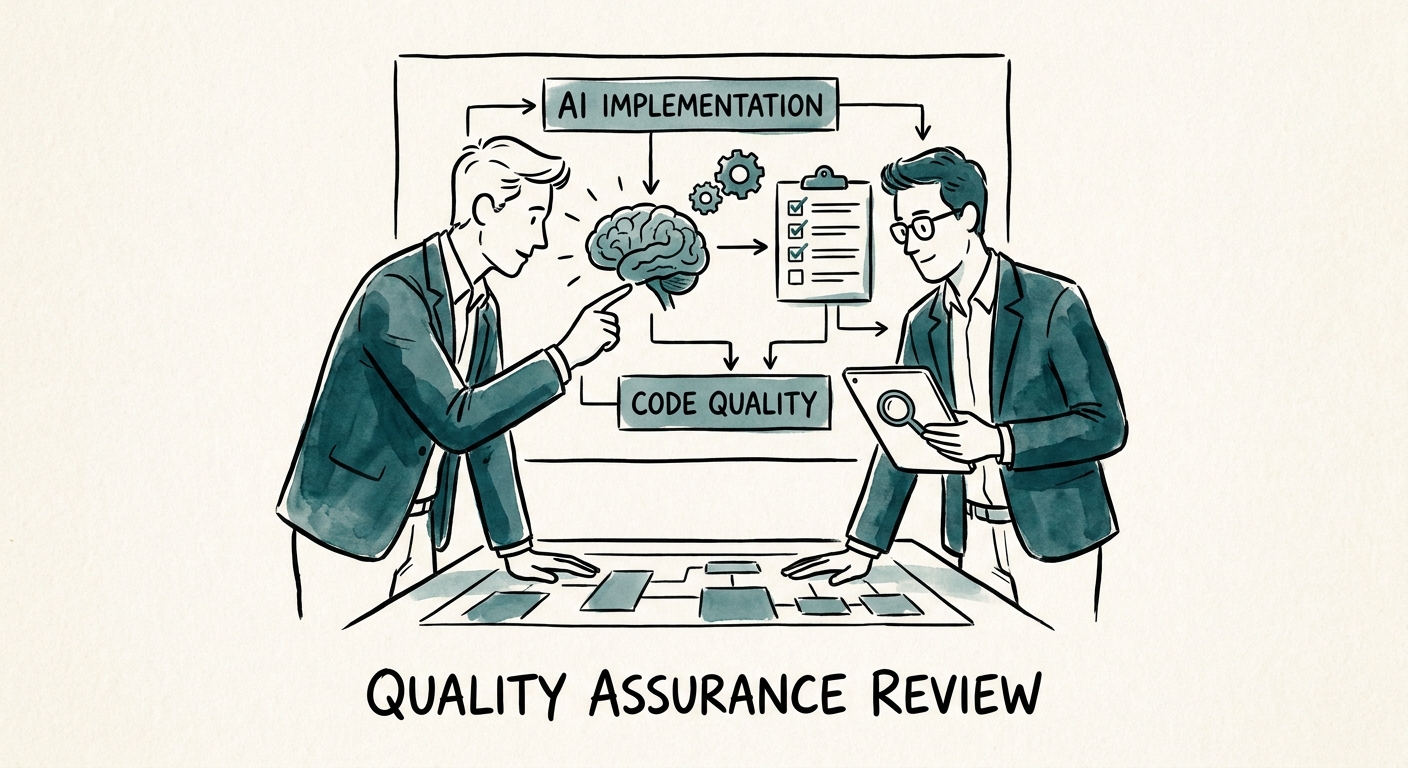
You cannot scale an IT services firm linearly by hiring more manual QA testers. Implementing an AI-augmented QA review workflow fundamentally alters your unit economics and protects your operating margins. By deploying AI to automatically generate test cases, analyze code commits for historical defect patterns, and perform initial code reviews, your engineers are freed to focus on high-complexity problem-solving. This isn't about replacing your QA department; it is about giving them a machine-speed exoskeleton that eliminates the mundane and surfaces the critical.
The data proving this transformation is definitive. McKinsey's 2024 Generative AI Productivity Study found that early adopters of AI-powered testing achieve a 37% gain in QA productivity. This means faster release cycles, fewer escaped defects, and a drastic reduction in unbillable rework hours. Moreover, Forrester's Test Automation Productivity Analysis demonstrates that organizations leveraging advanced automated testing report 4x faster productivity gains compared to traditional script-based manual approaches. When your competitors are moving four times faster with higher precision, clinging to manual QA is a deliberate decision to lose market share.
To capitalize on these gains without falling into pilot purgatory or buying into vendor hype, operations leaders must ruthlessly measure their baseline metrics before writing a single line of AI prompt. You must know your current defect leakage rate, your average cost per rework hour, and your incident resolution times. For a deep dive into establishing these metrics, review How to Measure AI ROI Without Fake Savings.
Stop funding the manual rework tax. The path forward requires decisive action, not endless evaluation. Start with a structured 90-Day AI Implementation Sprint to build a governed, secure AI QA workflow. By isolating a specific, measurable segment of your deployment pipeline and implementing an AI QA agent to review it, you prove the ROI and build internal momentum. This structured approach forces alignment, mitigates deployment risks, and ensures that your AI transformation actually drives EBITDA rather than just burning budget.