
The practical answer
- Short answer
- Discover how Managed Service Providers (MSPs) use AI to automate onboarding checklists, eliminate the 60-day setup tax, and protect year-one margins.
- Best fit
- Industry: Technology Services & MSPs. Function: Service Delivery & Operations
- Operating path
- AI Measurement and ROI → AI Transformation
- Key metric
- 45% Reduction in manual infrastructure setup errors through workflow automation.
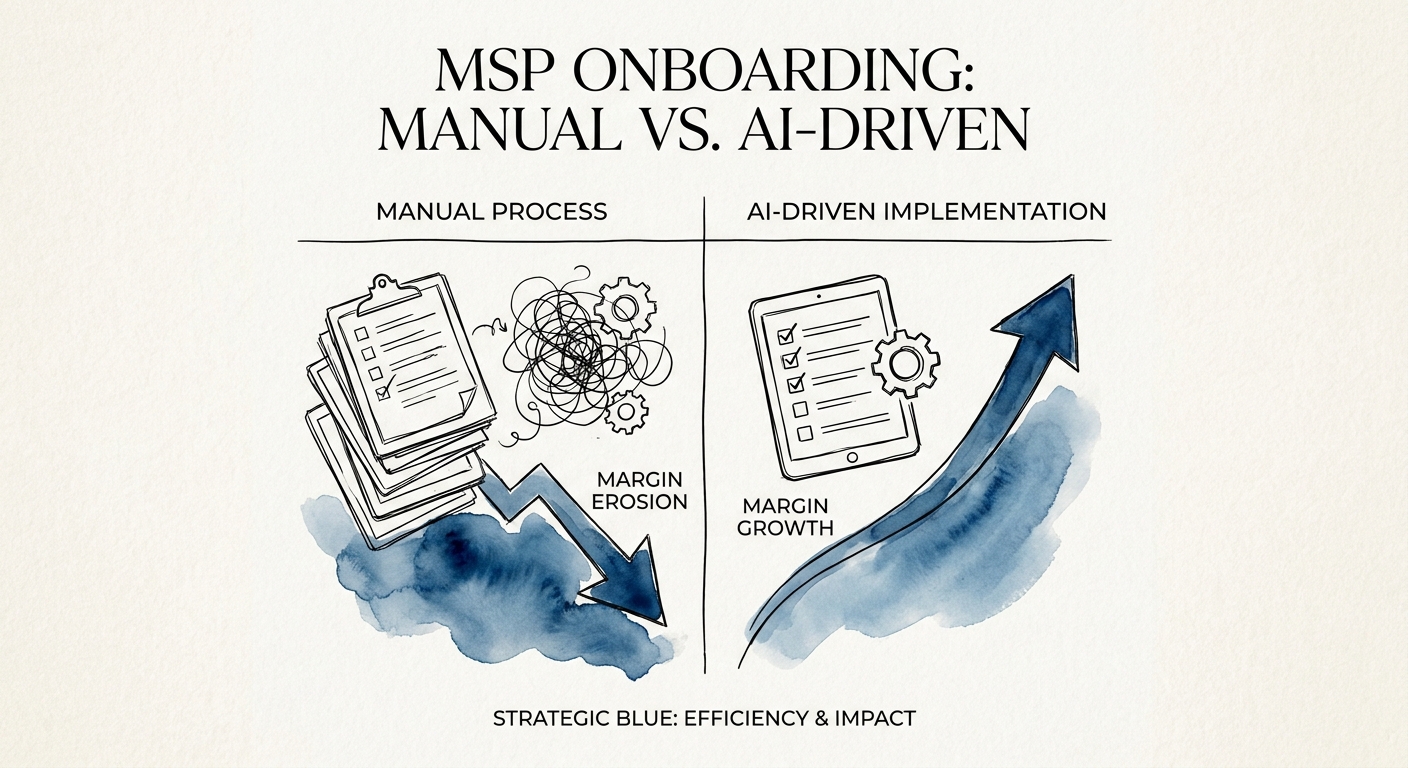
The most expensive phase of any managed service contract isn't the ongoing support or the inevitable security escalations—it is the unbillable onboarding purgatory that quietly consumes your entire year-one margin. For Managed Service Providers (MSPs), the transition from a signed MSA to a fully managed environment is a logistical nightmare of static spreadsheets, scattered credentials, and manual tenant configurations. When your highest-paid engineers are functioning as human APIs to copy and paste data from a sales CRM into Active Directory, your delivery economics are fundamentally broken from day one. This manual friction prevents you from scaling your recurring revenue engine.
In our last engagement with a $25M MSP, we uncovered that they were bleeding roughly $4,200 in unbillable labor per new client setup. Their Level 3 architects were spending countless hours hunting down client network topologies, deciphering fragmented onboarding questionnaires, and manually provisioning cloud environments. This isn't an isolated problem; the structural delay in translating a closed deal into a billable, managed environment is devastating to profitability. According to TSIA's 2025 State of Managed Services, managed cloud and security services typically require 60 to 120 days for tooling integration, runbooks, and stabilization. During this massive gap, your firm is absorbing heavy operational costs without recognizing the full recurring revenue.
The financial bleed doesn't stop at direct labor costs. When onboarding relies exclusively on manual checklists, the inevitable outcome is a margin-crushing delay in time-to-value for the client. Research from PwC's 2025 Technology Services Margin Analysis reveals that MSPs routinely lose up to 18% of their year-one contract value to unbillable setup and configuration time. Every single manual step—from deploying Remote Monitoring and Management (RMM) agents to setting up backup schedules and firewall rules—introduces severe human latency. To protect your enterprise valuation and maintain healthy cash flow, automating this checklist process is the most urgent operational imperative you face today.
You cannot scale a managed services business to $50M ARR if every new client requires a bespoke, manual deployment sprint by your most expensive technical talent.
Transitioning from Static Checklists to Intelligent Workflows
Most MSPs attempt to solve the onboarding bottleneck by buying more software tools or throwing more project managers at the problem. However, the root cause isn't a lack of tools; it is the complete lack of intelligent orchestration between them. A static checklist residing in an IT documentation platform requires a human to read it, interpret the client's specific licensing needs, and physically execute the provisioning steps. AI workflow automation changes this dynamic entirely. Instead of a human executing the checklist, a custom AI workflow parses the signed contract, extracts the necessary technical requirements, and triggers the API calls to provision the required SaaS tenants and security policies autonomously.
Despite the obvious financial incentives to modernize, the MSP industry is severely lagging in the actual operational deployment of these intelligent technologies. As highlighted in McKinsey's 2025 State of AI Report, only 13% of organizations report implementing intelligent automation at scale in IT operations. The remaining 87% are stuck in pilot purgatory or treating AI merely as a glorified chatbot for their helpdesk teams. True transformation requires integrating AI directly into the provisioning pipeline. When a new client signs an agreement, the AI workflow should instantly generate the specific onboarding runbook, audit the client's current environment credentials for completeness, and push the initial configurations directly to your PSA (Professional Services Automation) tool without manual intervention.
We consistently tell private equity operating partners and MSP founders that they must fix their foundational data before they try to automate the entire service delivery lifecycle. If you want to understand the exact sequence for deploying this architecture successfully, I highly recommend reviewing our detailed guide on Microsoft 365 Copilot vs. a Custom AI Workflow for Onboarding Checklists. You simply cannot scale a managed services business to $50M ARR if every new client requires a bespoke, manual deployment sprint by your most expensive technical talent.
Measuring the ROI of Automated Client Provisioning
The return on investment for AI-driven onboarding is not measured in abstract "hours saved" or vague productivity metrics. It is measured in accelerated revenue recognition, drastically reduced initial ticket volume, and the complete elimination of day-one churn. When manual checklists drive the setup process, misconfigurations are statistically unavoidable. A missed security policy, a misconfigured firewall rule, or a forgotten email alias inevitably generates a flood of critical support tickets during the client's first week. This initial friction destroys client trust immediately. According to Gartner's 2026 IT Services Efficiency Benchmark, the automation of routine provisioning reduces manual infrastructure setup errors by exactly 45%. That massive reduction translates directly to a quieter helpdesk and significantly higher gross margins.
Furthermore, the long-term enterprise value of your MSP is inextricably linked to your customer retention metrics. If your onboarding process is chaotic and disjointed, you are actively setting the stage for future contract cancellations. Actionable data from Bain & Company's 2025 B2B Customer Retention Study confirms that 65% of early customer churn in technology services originates directly from Day One onboarding failures. When an AI workflow ensures that every user, device, network, and security policy is configured flawlessly before the scheduled cutover date, you entirely eliminate the primary driver of early-stage customer churn.
To capture this multi-million dollar value, you must stop treating AI as an experimental side project and start treating it as the core component of your future service delivery architecture. We guide operators through this exact transformation using a highly structured, risk-mitigated approach. If you are finally ready to eliminate the unbillable onboarding tax from your P&L, start by reviewing the AI Readiness Assessment for a 100-Person MSP: Escaping the Escalation Tax. From there, your leadership team can execute a disciplined 90-Day AI Implementation Plan to fully automate your client setups. The MSPs that successfully weaponize AI for onboarding will effortlessly absorb market share, while those clinging to manual checklists will be crushed by their own spiraling delivery costs.