
The practical answer
- Short answer
- Stop bleeding 19% of billable capacity to documentation searches. Learn how IT services firms deploy internal knowledge search AI to reduce escalations and protect margins.
- Best fit
- Industry: IT Services. Function: Service Delivery & Operations
- Operating path
- AI Measurement and ROI → AI Transformation
- Key metric
- 28% L2 escalations deflected by deploying an effective RAG AI search architecture.
The Hidden Unbillable Tax in IT Services
IT services firms are currently writing off a staggering 19% of their engineers' weekly capacity just searching for legacy runbooks, past incident post-mortems, and fragmented client architectural diagrams, according to Gartner's 2024 IT Service Desk Efficiency Benchmark. This is the silent margin killer of the managed services world. When a critical server goes down for a top-tier client, your response time isn't dictated by how fast your Level 3 engineers can fix the issue; it is dictated by how fast they can find the root password and the network topology map buried in a chaotic SharePoint instance. Every minute spent hunting through Confluence pages, outdated Jira tickets, or endless Slack threads is unbillable time that erodes your profitability. When I rebuilt the delivery operations for a 150-person managed service provider last year, we discovered a $1.2 million margin leak hiding in plain sight. It wasn't an over-staffing problem; it was an information retrieval crisis. We found that 22% of escalated tickets weren't actually complex engineering problems—they simply required documentation that was invisible to the Level 1 service desk. IDC's 2025 State of Knowledge Management in IT Services quantifies this exact dynamic, revealing that poor knowledge discoverability costs mid-market IT firms an average of $1.5 million annually in lost billable realization. By deploying an internal knowledge search AI, you stop paying highly compensated engineers to play digital archaeologist. Instead of relying on tribal knowledge where only two veteran engineers know how a legacy client's environment is configured, AI democratizes that intelligence across the entire delivery team. This isn't just about making searches faster; it is about fundamentally restructuring how an IT services firm captures and monetizes its historical intellectual property. For more context on why this matters, see our guide on AI Workflow Automation for Internal Knowledge Search.
When I rebuilt the delivery operations for a 150-person managed service provider last year, we discovered a $1.2 million margin leak hiding in plain sight. It wasn't an over-staffing problem; it was an information retrieval crisis.
Measuring the ROI Without the Time Savings Trap
The biggest mistake operators make when measuring the ROI of internal knowledge search AI is falling into the time savings trap. If your AI vendor tells you that saving five minutes per search equals a million dollars in ROI, they are using fake math. You do not actually realize financial returns unless those saved minutes are converted into higher billable utilization or a delayed headcount requirement. True ROI in IT services comes from accelerating ticket velocity and reducing expensive escalations. According to Forrester's 2025 Total Economic Impact of Enterprise Search, implementing a properly tuned Retrieval-Augmented Generation (RAG) architecture can deflect 28% of Level 2 escalations by empowering Level 1 technicians with the exact troubleshooting steps they need, right when they need them. This is where the unit economics of your firm begin to shift dramatically. By flattening the escalation tier, you improve your mean time to resolution (MTTR) while simultaneously lowering your blended cost of delivery. We measure this transformation rigorously. We track the ratio of tickets resolved by the initial assignee, the reduction in Slack pings to subject matter experts, and the compression of new engineer onboarding times. As noted in Bain & Company's 2025 IT Services Margin Analysis, IT services firms that successfully utilize AI for internal knowledge retrieval improve their gross margins by a massive 4.2%. When your AI assistant can instantly synthesize a client's specific firewall configuration history alongside the vendor's official patching documentation, your team moves from reactive hunting to proactive resolution. If you want to dive deeper into the exact KPIs we use to track this financial impact, review our framework on How to Measure AI ROI for Internal Knowledge Search. It is critical to align your AI implementation with metrics that actually show up on your profit and loss statement.
The Governance and Deployment Sprint
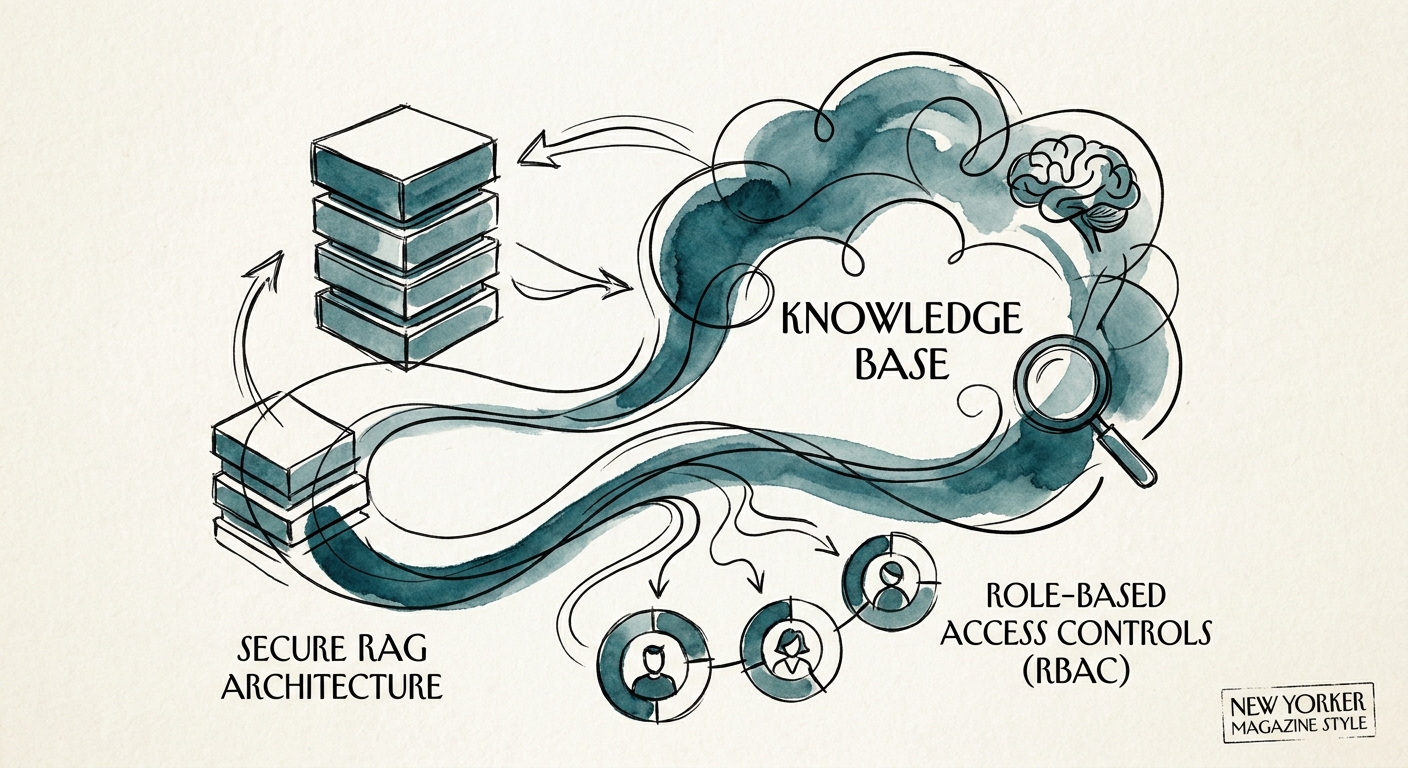
However, deploying an AI knowledge assistant across an IT services firm carries significant governance risks if executed poorly. You cannot simply point a Large Language Model at your entire Microsoft Teams and SharePoint environment and hope for the best. If you do, your Level 1 technicians might suddenly gain conversational access to executive M&A plans, sensitive HR complaints, or worse, cross-client security credentials. Data hygiene and strict Role-Based Access Control (RBAC) are non-negotiable prerequisites. Deloitte's 2024 AI and Data Governance Report warns that 61% of enterprise AI search deployments fail their initial security audits due to improper access controls and permissions sprawl. In our practice, we never deploy an AI search tool without first executing a rigorous data classification sprint. We map out exactly which repositories contain public knowledge, which house proprietary operational procedures, and which hold restricted client data. This ensures the RAG architecture respects your existing permissions matrix, pulling context only from documents the requesting user is explicitly authorized to view. For mid-market operators, this transformation should not be a multi-year consulting boondoggle. We structure this as a focused 90-Day AI Implementation Sprint. In month one, we audit the knowledge repositories and enforce data hygiene. In month two, we configure the RAG pipelines and integrate the AI assistant directly into your PSA or ITSM tools, meeting the engineers where they already work. In month three, we train the team and optimize the retrieval accuracy based on real-world queries. If you are unsure where your firm stands on this journey, I strongly recommend starting with an AI Readiness Assessment for a 150-Person IT Services Firm. Stop letting your firm's hard-earned technical knowledge decay in forgotten folders, and start turning it into a scalable margin driver.