
The practical answer
- Short answer
- Learn why AI operations reporting fails when measured by time saved, and how to execute a 90-day implementation sprint to recover billable capacity.
- Best fit
- Industry: Professional Services. Function: Operations
- Operating path
- AI Measurement and ROI → AI Transformation
- Key metric
- 70% of modernization initiatives fail due to poor data alignment.
The Administrative Tax and the Cost of Decision Latency
Every week, McKinsey's research on knowledge-worker productivity shows that close to a full day per week—nearly a fifth of business time—evaporates into the administrative void of hunting for data. For professional services firms, this is not just an operational annoyance; it is a direct tax on billable capacity. In our last engagement with a mid-market consultancy, we found managing directors burning their weekends manually exporting CSVs from resource management tools just to figure out who was available on Monday. They were paying premium salaries for strategic advice, but forcing their smartest people to act as human middleware for weekly operations reporting. The firms that survive the coming margin compression will be those that ruthlessly automate their internal overhead to maximize client-facing time.
The problem isn't simply the labor cost of compiling the data—it is the resulting decision latency. When operations reports take five days to build, you are managing your firm by looking in the rearview mirror. By the time you realize a key project is running over budget or a practice area is underutilized, the margin has already leaked. PwC's 2025 Global Business Services Index confirms that professional services margins are remaining flat despite top-line growth, entirely due to wage inflation and operational friction. You can no longer out-hire your inefficiencies. Furthermore, McKinsey's state of enterprise decision-making reveals that only 37% of executives believe their organizations consistently make decisions quickly and well. When your weekly reporting cycle is broken, your capacity allocation is broken, and your EBITDA suffers. Automating this workflow is the single highest-leverage AI implementation a services firm can execute today.
If you save a project manager two hours on a Friday afternoon, they do not magically bill two more hours to a client. They just start their weekend early. The true ROI of AI in operations is measured by the speed at which you can redeploy benched talent.
The Hallucination of Time Saved vs. True ROI
Before you deploy a generative AI tool to summarize your operations data, we need to address the hallucination of time saved. I have rebuilt this team three times, and the most common trap operations leaders fall into is measuring AI ROI through a lens of theoretical hours recovered. The math looks great on a vendor's spreadsheet: save every project manager two hours a week, multiply by 50 managers, multiply by their blended rate, and suddenly you have a million-dollar business case. It is entirely fake math. If you save a project manager two hours on a Friday afternoon, they do not magically bill two more hours to a client. They just start their weekend early. When you eliminate the manual friction of assembling reports, you unlock the operational agility needed to pivot resources mid-week before margins collapse entirely.
This enablement illusion is a documented crisis. According to Gartner's research on people-centric AI strategy, by 2027 half of enterprises that hand staff new tools without restructuring the underlying workflow will lose their top AI talent. Real financial return in professional services comes from collapsing the latency between data generation and leadership action. We outline this exact metric trap in our guide on How to Measure AI ROI for Weekly Operations Reporting. The true ROI of AI in operations is measured by the speed at which you can redeploy benched talent and the reduction in project overruns. Bain & Company's research on decision effectiveness tracked nearly 800 companies and found a 95% correlation between decision effectiveness and financial performance. AI should not just compile the report faster; it should eliminate the cognitive load required to understand what the report means.
Executing the 90-Day AI Implementation Sprint
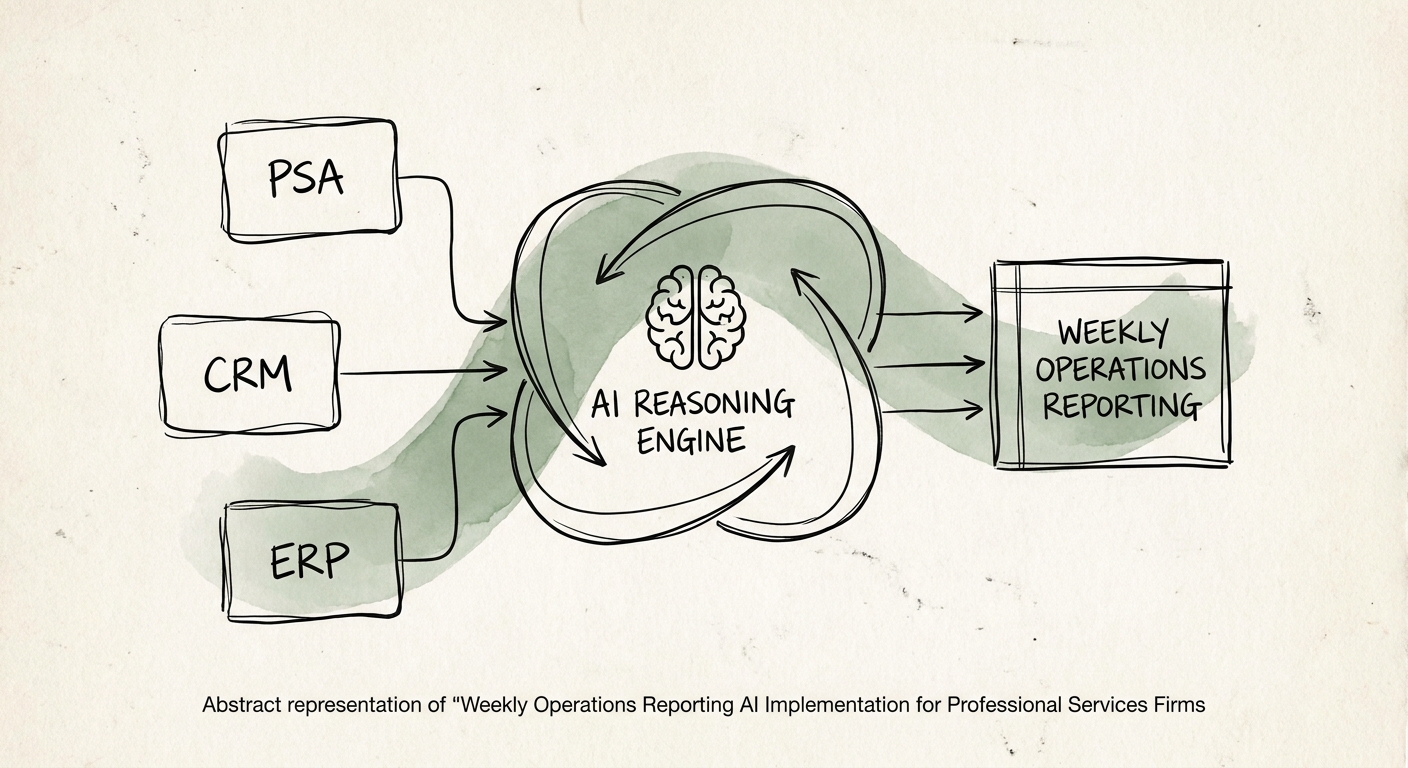
So, how do you safely deploy AI into your weekly reporting cadence without exposing confidential client data or creating entirely new administrative bottlenecks? You must treat operations reporting not as a document generation task, but as a structured data pipeline. The workflow risks are severe: if you allow a generative model to hallucinate utilization metrics, or misinterpret the utilization thresholds in your professional services automation (PSA) software, you will inevitably make catastrophic staffing decisions. Gartner's analysis of technology implementation risks warns that over 70% of modernization initiatives fail to meet their original business goals precisely because they lack strategic data alignment. A successful implementation requires strict data governance. You must connect your systems of record—your CRM pipeline, your time-tracking tools, and your financial ledgers—through a secure, automated extraction layer long before the AI ever attempts to synthesize the narrative. By integrating your data layer properly, you turn your weekly operations report from a historical artifact into a forward-looking predictive asset.
This is exactly why we aggressively route our clients away from open-ended, undefined pilot programs. If you want to understand your firm's operational baseline before touching a single piece of code, I highly recommend executing an AI Readiness Assessment for a 100-Person Professional Services Firm. The objective is to transition from manual data extraction to an AI-driven reasoning engine within a tightly controlled window. Stop paying for infinite consulting engagements that deliver slide decks but never reach production environments. Instead, operations leaders must adopt a structured 90-Day AI Implementation Sprint. This framework standardizes your data inputs, establishes a compliant security perimeter, and automates the specific weekly flash reports that dictate your resource allocation. As detailed in our analysis of The True Cost of AI Consulting: Escaping Pilot Purgatory, targeted sprints prevent scope creep and guarantee that the system delivers actionable executive insights rather than just faster typing. It is time to stop acting as the human API for your own business operations.