
The practical answer
- Short answer
- Why 87% of AI projects fail in professional services. A readiness assessment guide for 100-person firms focusing on data governance and the billable hour trap.
- Best fit
- Industry: Professional Services. Function: Operations
- Operating path
- AI Transformation Strategy → AI Transformation
- Key metric
- 6-8% Margin expansion for firms deploying AI strategically for predictive planning, compared to <2% for task automation alone.
Eighty-seven percent of AI initiatives never make it past the pilot stage to full production deployment, not because the underlying technology is flawed, but because the business operating model actively rejects it. When operators of 100-person professional services firms approach me about buying AI, they treat it as a software procurement exercise rather than an operational transformation. They want the efficiency gains they read about, but they are terrified of what those efficiencies will do to their billable hours. You cannot bolt a highly efficient, automated intelligence layer onto a business model that penalizes you for working faster.
The Billable Hour Margin Collapse
For a mid-market professional services firm, an AI readiness assessment must begin by examining the pricing architecture. If your firm bills strictly for time and materials, making your associates 30% faster with generative AI will literally erode your top-line revenue by 30%. I have rebuilt this team three times across different service organizations, and the pattern is brutally consistent. In our last engagement with a 110-person regional consulting group, the partners rolled out a suite of AI drafting tools without altering their contracts. The associates finished their research and report drafting in record time, utilization rates plummeted, and the firm suffered an immediate cash flow crunch because they billed fewer hours for the exact same deliverables.
This is an industry-wide reckoning. McKinsey's 2025 operating model analysis reveals that leading professional-services firms increasingly earn a meaningful share of their fees from outcome-based arrangements rather than traditional billable hours. The strategic value of AI does not lie in simply typing faster; it lies in severing the linear relationship between human time and firm revenue. Furthermore, SPI Research's professional-services benchmarking shows that firms focusing narrowly on task automation see only marginal profitability gains, whereas firms that deploy AI strategically to improve predictive planning capture materially stronger margin expansion. If your AI readiness assessment does not include an immediate roadmap for transitioning to value-based pricing, you are preparing your firm for a highly efficient bankruptcy.
You cannot bolt a highly efficient, automated intelligence layer onto a business model that penalizes you for working faster.
Evaluating the Unstructured Data Foundation
Once you align the commercial model, an AI readiness assessment must aggressively interrogate your data environment. For a 100-person firm, the reality of data is rarely a pristine warehouse. It is usually a chaotic sprawl of localized SharePoint folders, overlapping OneDrive accounts, inconsistent naming conventions, and highly subjective CRM hygiene. You will never automate your way past a mess. An AI agent designed to retrieve historical project precedents or draft new proposals based on past successes will confidently hallucinate if it is fed garbage. Data governance is no longer a theoretical enterprise exercise; it is the absolute prerequisite for deploying AI effectively.
When we evaluate professional services organizations, we look directly at their knowledge management practices. I regularly tell CEOs that their most valuable asset is the localized, tribal knowledge locked inside the heads of their senior partners. However, capturing that knowledge and formatting it so an AI can utilize it is a massive operational hurdle. According to PwC's 2025 Global AI Jobs Barometer, 53% of senior leaders report significant efficiency gains from AI adoption, but those gains are heavily concentrated in knowledge-work environments that have successfully structured their internal text generation and data pipelines. If your firm has not standardized how proposals are written, how project debriefs are logged, and how deliverables are archived, your AI readiness score is essentially zero.
In practice, we force firms to conduct a process inventory before they ever license an enterprise agent. We saw this pattern at a mid-sized IT services firm last year: they purchased expensive enterprise AI licenses for all 95 employees, but because their internal documentation was entirely fragmented, the AI returned conflicting policy answers and irrelevant project templates. The resulting employee frustration led to total tool abandonment within sixty days. A true readiness diagnostic exposes these infrastructure cracks so you can fix your taxonomy before you pay for the automation.
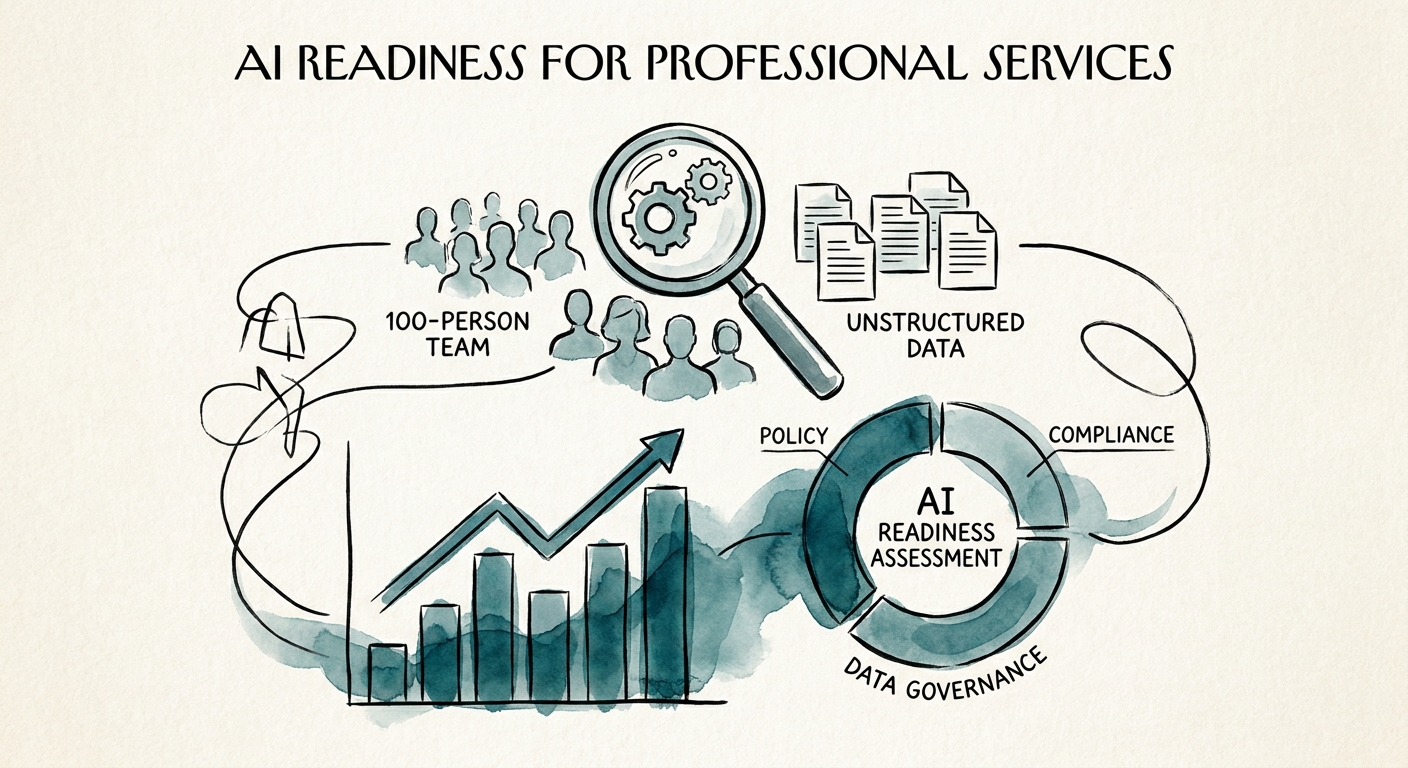
Executing the 30-Day Readiness Roadmap
Transitioning from intent to impact requires a highly disciplined operational sequence. A 100-person professional services firm cannot afford the multi-million dollar digital transformation budgets of the Fortune 500. You need a 30-day readiness roadmap that targets specific, high-friction workflows where the data is already relatively clean and the outcome is highly measurable. We typically start by targeting the proposal generation desk, internal knowledge search, or routine onboarding documentation. These are areas where the firm burns hundreds of non-billable hours, making them perfect proving grounds for early AI adoption without risking client-facing deliverables.
You also have to prepare your workforce for the psychological shift of AI integration. The technology is advancing faster than human adaptability, and your mid-level managers will resist workflows that obscure their oversight. Thomson Reuters' 2026 AI in Professional Services Report indicates that while most professionals believe GenAI will be central to their workflow by 2030, a significant portion remain anxious about the operational transition. Your assessment must include a formal change management plan that redesigns the definition of done for your associates. When AI generates the first draft of a client audit in three seconds, your associates must transition from being primary authors to being expert editors.
To capture this value, operators must embrace rigorous AI transformation services that prioritize governance and measurable ROI over vendor hype. JPMorganChase's 2026 Small Business AI Adoption Report confirms that knowledge-intensive industries like professional services are adopting these tools at nearly twice the rate of non-employer firms. Your competitors are already moving. Your mandate as an operator is to map your workflows, structure your proprietary data, adjust your pricing model, and train your 100-person team to orchestrate the machine. Firms that score highly on these readiness dimensions will achieve software-like margins; the rest will be commoditized out of existence.