
The practical answer
- Short answer
- Learn how to assess AI readiness for a 200-person professional services firm. We cover data hygiene, workflow standardization, and governance.
- Best fit
- Industry: Professional Services. Function: Operations
- Operating path
- AI Transformation Strategy → AI Transformation
- Key metric
- 80% of AI initiatives fail to deliver intended outcomes due to broken underlying processes.
The Reality of the Data Swamp
According to SPI Research's 2026 Professional Services Maturity Benchmark, billable utilization has collapsed to a staggering 68.9%, meaning 31.1% of your firm's total capacity is currently bleeding into unstructured, undocumented administrative friction. When owners of 200-person professional services firms approach us for an AI readiness assessment, they typically want to talk about large language models, enterprise copilots, and chatbot adoption. I tell them to stop. You do not have a technology problem; you have a process documentation problem. You simply cannot automate a workflow that only exists in a senior partner's head or lives inside bespoke spreadsheets.
In our last engagement with a 215-person specialized consultancy, the executive team wanted to deploy generative AI to automate their proposal drafting and account research. We ran our standard readiness diagnostic and discovered a harsh reality: their win-loss data, pricing templates, and historical deliverables were scattered across personal OneDrive folders, isolated Slack channels, and buried in individual email threads. The foundational data required to train any intelligent agent was a toxic swamp of contradictory information. We see this exact pattern every time we audit a mid-market firm. It is entirely predictable that McKinsey's 2025 AI in Professional Services report found that 63% of firms lack a written AI strategy despite managing partner enthusiasm. Enthusiasm does not structure data.
Before you spend a single dollar on an AI platform, your readiness assessment must ruthlessly audit your knowledge management systems. We had to enforce severe data hygiene, migrate legacy files to a centralized repository, and establish a single source of truth before a single line of AI code could be written. This is what actual AI readiness looks like in the real world. It is not about buying the trendiest software; it is about building a scalable digital foundation that supports algorithmic automation.
You do not have a technology problem; you have a process documentation problem. You simply cannot automate a workflow that only exists in a senior partner's head.
Assessing Your Operating Rhythms
Once your data architecture is centralized, you must critically assess how work actually gets done inside your firm. At the 200-employee mark, the heroics of a few top performers often mask systemic operational failures. Middle managers become highly paid traffic cops, spending their days routing exceptions, clarifying vague instructions, and patching broken workflows manually. When you introduce AI into this environment without standardizing the underlying process, you do not achieve efficiency. You simply accelerate the rate at which your firm produces errors.
We measure process maturity by looking for the explicit definition of standard operating procedures. Every time I have rebuilt this team structure, the pattern is identical: the firm assumes their delivery methodology is standardized, but the reality is rampant "shadow IT" and bespoke workarounds deployed by disparate practice groups. This operational chaos explains why BCG and MIT Sloan's 2024 AI Implementation Study revealed that 80% of AI initiatives fail to deliver their intended business outcomes. Firms try to automate chaos instead of re-architecting the workflow for machine execution.
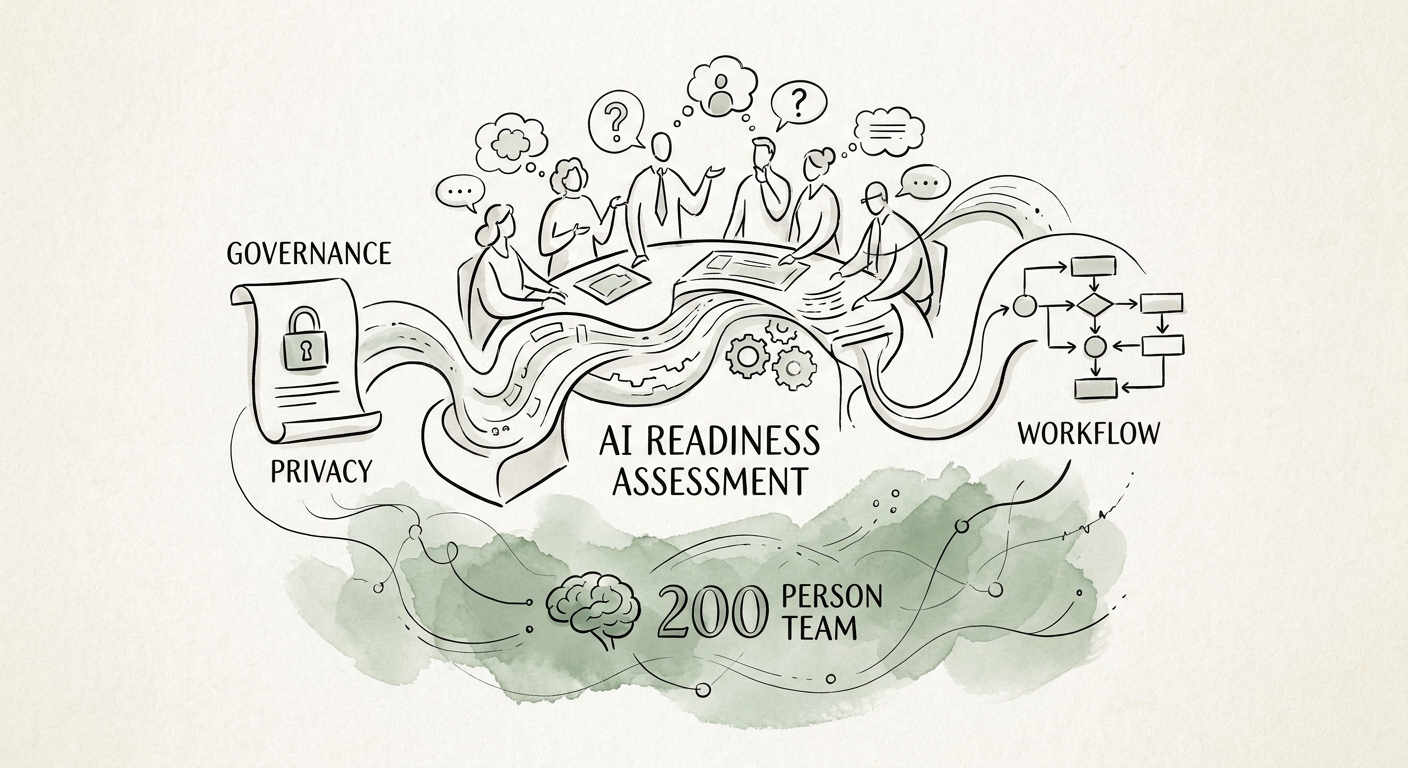
Your AI readiness assessment must force your leadership team to map the exact sequence of steps for your highest-volume tasks. If you cannot produce a visual flowchart of your client onboarding process, your contract review preparation, or your weekly status reporting, you are not ready for AI. We force our clients to track the exact baseline time these manual processes consume. If a junior analyst spends four hours extracting clauses from legacy contracts, that is a highly measurable manual tax. By documenting that baseline, we establish the financial justification for AI transformation services for consulting firms that will definitively impact your EBITDA, rather than just generating novelty. You must map the workflow, calculate the exact cost of human execution, and then—and only then—select the automation tool.
The Talent and Tooling Gap
The final phase of a rigorous AI readiness assessment evaluates your talent, governance, and organizational culture. You are not ready for an AI transformation if you have not explicitly defined how your team's roles will evolve once the bots take over the repetitive administrative work. At a 200-person firm, you are likely carrying a layer of junior staff and middle managers whose entire perceived value proposition is coordinating manual tasks. If AI reduces a ten-hour compliance reporting task to twelve seconds, what do those employees do with the remaining nine hours and fifty-nine minutes? You must have a redeployment strategy focused on higher-margin advisory work.
Without proper governance, unauthorized AI usage will create catastrophic liability. We consistently find employees feeding sensitive client financials and proprietary intellectual property into public, consumer-grade language models just to save a few hours of formatting. The risk is not hypothetical; Baker McKenzie's 2025 AI and Legal Privilege Survey documented that 34% of professional services firms have already experienced at least one potential privilege breach related to unmanaged AI tool usage. Your readiness assessment must verify that you have zero-trust data boundaries, enterprise licensing, and clear acceptable-use policies deployed across every endpoint.
Furthermore, you must evaluate your internal technical capability. You do not need to hire a massive team of costly machine learning engineers—especially since IDC's 2026 AI Skills Gap Research indicates AI skills now command a massive 67% salary premium over traditional software roles. Instead, you need a fractional governance leader and a focused 90-day AI implementation plan to train your existing domain experts on secure, enterprise-grade tools. Stop letting vendor hype dictate your strategic roadmap. I strongly recommend routing your leadership team through our AI Opportunity Score diagnostic to pinpoint exactly which 10% of your workflows contain 90% of your margin leakage. That is how you build an actionable, ROI-positive path forward.