
The practical answer
- Short answer
- A definitive operator's guide to AI readiness for 150-person professional services firms. Learn why 70% of AI pilots fail and how to fix data governance first.
- Best fit
- Industry: Professional Services. Function: Operations
- Operating path
- AI Transformation Strategy → AI Transformation
- Key metric
- 70% Failure rate of mid-market AI pilots due to unstructured data and poor governance.
A 150-person professional services firm hemorrhages an average of $3.1 million annually on unbillable administrative scaffolding, yet the rush to deploy artificial intelligence usually just automates this existing incompetence faster. At this specific scale, you have crossed the threshold from a cohesive team running on shared tribal knowledge to a departmentalized organization where communication is inherently lossy. We frequently see operators purchase enterprise software licenses, assuming the tool itself will force operational discipline onto their teams. It will not. I have rebuilt this operating model for three different services firms over the last decade, and the pattern is always the same: leadership buys 150 Copilot or ChatGPT licenses and wonders why their billable utilization margins have not budged six months later. The harsh reality is that an AI readiness assessment is not a software audit; it is a structural interrogation of how your business creates, stores, and governs value.
According to PwC's 2025 AI Business Survey, unbillable administrative tasks consume an astonishing 31% of total capacity in mid-sized service firms. Attempting to reclaim that capacity with an AI wrapper on top of broken, undocumented processes creates massive operational risk. You end up with faster, more confident errors. This diagnostic reality is entirely corroborated by Gartner's 2024 AI Pilot Failure Benchmark, which explicitly indicates that 70% of generative AI initiatives stall entirely due to unstructured data and a lack of baseline process governance. You absolutely cannot skip the organizational cleanup phase if you want to protect your unit economics. If you want to understand what a true structural diagnostic entails before you buy a single license, review our foundational guide on the AI Readiness Assessment for SMBs: The 8 Dimensions That Matter.
You cannot automate incompetence. If your professional services firm relies on fragmented spreadsheets and unwritten rules, an AI agent will simply execute that chaos at enterprise speed.
Data Architecture is Your Glass Ceiling
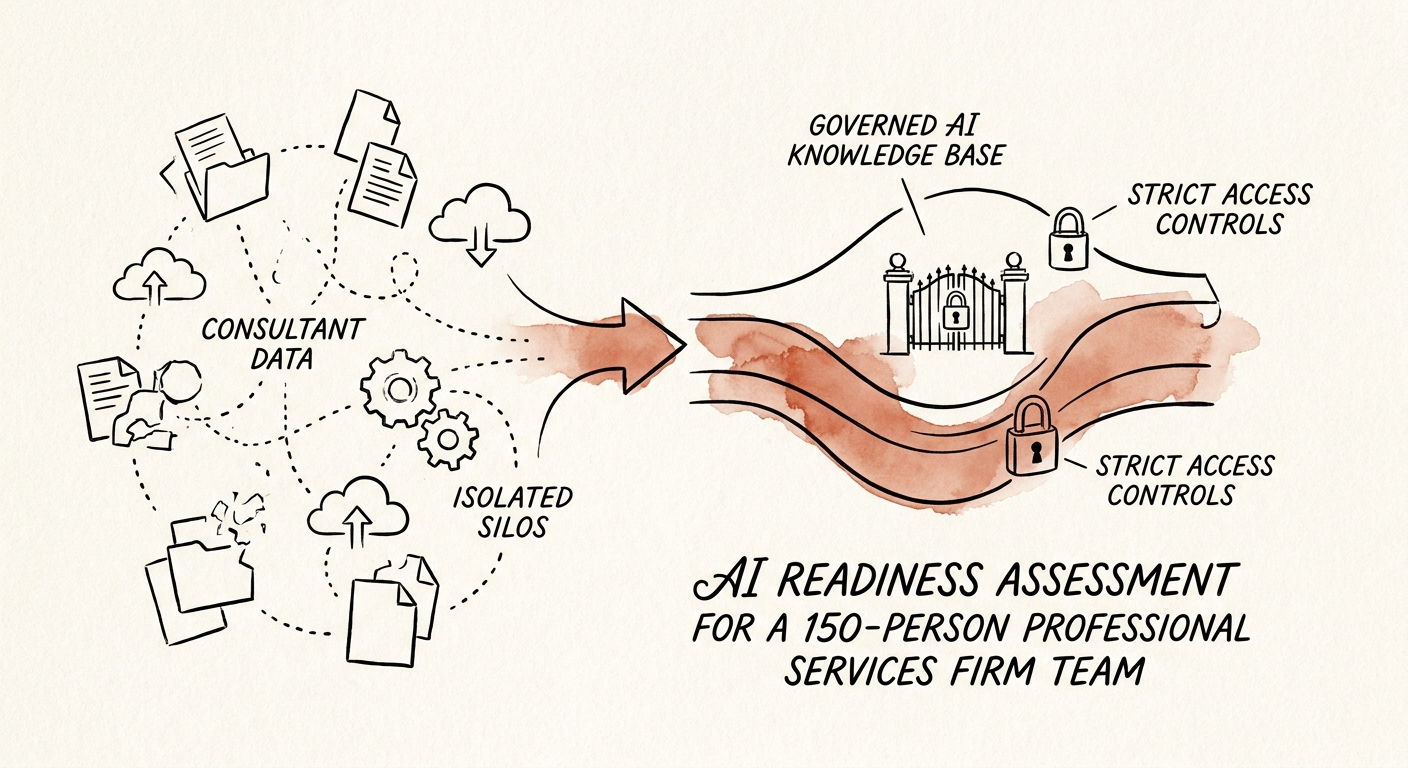
The greatest vulnerability for a 150-person firm is the illusion of structured data. You might have an expensive ERP or CRM implementation, but the actual work—the scoping documents, the project delivery nuances, the client feedback loops—lives in unstructured formats across Slack channels, fragmented SharePoint drives, and the minds of your top ten consultants. When you assess your readiness for an AI transformation, data architecture represents your absolute glass ceiling. McKinsey's 2024 State of AI Report reveals that 65% of mid-market service firms lack the foundational data architecture required to safely deploy generative models. If your CRM pipeline data is filled with outdated entries and your internal knowledge base is a graveyard of obsolete operational procedures, an AI agent will confidently ingest and regurgitate that exact operational decay.
The financial impact of this decay is devastating to your utilization metrics and gross margins. Bain & Company's 2024 Knowledge Worker Productivity Study found that consultants waste an average of 9.5 hours weekly—nearly a full billable business day—just searching for internal project documentation and historical deliverables. Before you invest a single dollar in custom AI workflows, you must systematically audit your data repositories. You have to index your proprietary methodologies, aggressively archive the obsolete templates, and enforce strict naming conventions across the organization. Your artificial intelligence is only as intelligent as the context you feed it, and right now, your context is highly fragmented. For a deeper dive into protecting your exit value against this specific margin compression, consult our strategic framework on AI for Consulting Firms: Protect Realization, Don't Just Chase Speed.
The Governance and Workflow Mandate
True readiness ultimately comes down to workflow governance and rigorous use-case selection. At 150 employees, you cannot launch an AI initiative across the entire company simultaneously without creating chaos. You must surgically target specific bottlenecks where the inputs are highly structured and the outputs are easily validated by human operators. In our last engagement with a mid-market consultancy, we completely quarantined their proposal generation workflow before applying any automation. We discovered they had 14 different custom templates floating around the sales team. We ripped those out, standardized on two rigidly defined formats, and mapped the exact approval gates. Only after that process hygiene was established did we deploy the AI automation, which subsequently cut drafting time by 60%. That victory was rooted in strict governance, not just advanced technology.
The security implications of unstructured AI rollouts at this scale are severe and often overlooked by eager leadership teams. Forrester's 2025 AI Governance Outlook notes that 82% of mid-market service firms are operating without a formalized AI data access policy, creating massive compliance liabilities when proprietary client data inevitably leaks across internal departmental walls. If your firm does not have Role-Based Access Control securely mapped to your document repositories, your newly deployed AI assistant will enthusiastically surface confidential HR compensation data or restricted client strategy to a junior analyst who simply prompts the system with the right question. True AI readiness requires building a secure, governed perimeter around your operational data. You must start small, prove the ROI on a single, well-documented process, and scale the governance framework alongside the technology. To identify which specific operational bottlenecks to target first, read our diagnostic on The Best First AI Use Cases for Professional Services Firms.