
The practical answer
- Short answer
- Discover why 100-person marketing agencies are bleeding margin at a 68.9% utilization rate and how an AI readiness assessment fixes operational gaps.
- Best fit
- Industry: Professional Services. Function: Operations
- Operating path
- AI Transformation Strategy → AI Transformation
- Key metric
- 50-80% Profit margin achieved by AI-native automation agencies, compared to 15-20% for traditional shops.
Your 100-person marketing agency's billable utilization rate just collapsed to 68.9%, and giving your copywriters ChatGPT licenses is only masking the margin bleed. If you are like most agency CEOs I speak with, your generative AI strategy is completely backwards. You purchased dozens of AI seats, handed them to your creative teams, declared your firm 'AI-enabled,' and waited for margins to magically expand. But when you look at your P&L today, you are likely still struggling to break a 15% net margin. The uncomfortable reality is that you have automated the wrong side of your business model.
In our last engagement with a mid-market agency, the CEO eagerly showed me their 'AI efficiency gains.' Yes, they were undeniably producing blog posts and ad copy faster. However, according to the TMetric 2025 Marketing Agency Benchmarks, average billable utilization across the industry has dropped to a dangerous 68.9%. The agency wasn't capturing efficiency gains as higher billable output. Instead, they simply filled the newly saved time with unbillable scaffolding: endless internal meetings, manual campaign reporting, and un-scoped client revisions.
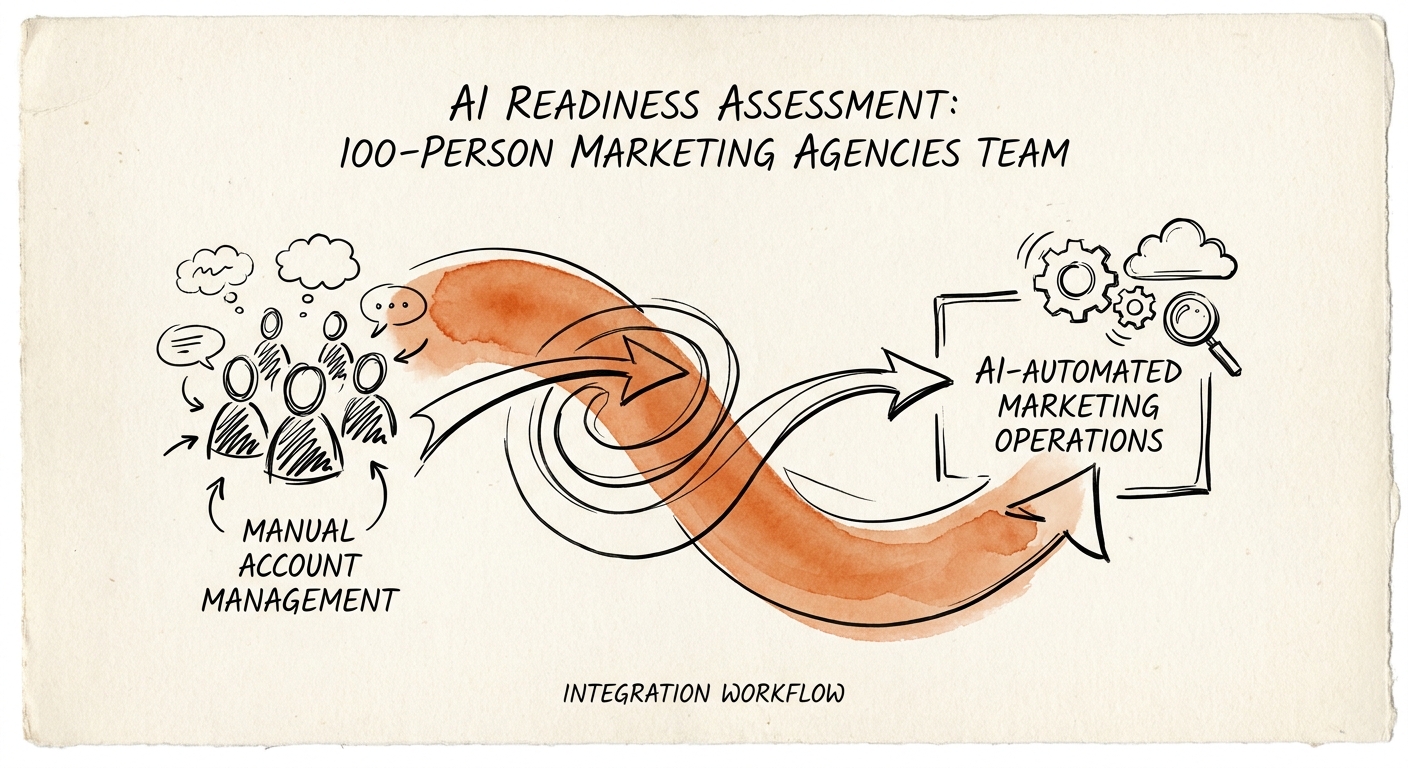
We are witnessing an aggressive bifurcation in the agency market. As highlighted by Forrester in their 2026 industry analysis, a new breed of 'AI automation agencies' operating on productized services are achieving 50% to 80% profit margins, while traditional shops remain stalled in the high teens. The structural difference is profound: traditional agencies are trying to use AI to automate the creative deliverable itself, while AI-native competitors use AI to eradicate the heavy operational workflows that surround the creative process.
Pushing generative AI onto your copywriters while your account managers spend 15 hours a week manually compiling campaign reports is like putting a spoiler on a tractor.
Assessing the Real Cost of Pilot Purgatory
An effective AI readiness assessment for a 100-person agency does not measure how well your creative directors write prompts. It strictly measures how much of your agency's capacity is bleeding out through operational friction. We consistently find that the most severe margin leak is not in the creative phase, but in the unbillable "administrative tax" of running the account. If your senior talent is spending a third of their week copy-pasting metrics into slide decks, your foundation is broken, and no language model can fix that inefficiency.
Consider the broader enterprise landscape to understand why so many digital transformations fail. A 2026 McKinsey report on the state of AI confirms this plainly: while an overwhelming 88% of organizations now use AI in at least one business function, only 39% attribute any measurable EBIT impact to AI at the enterprise level. Why the massive disconnect? Because deploying SaaS tools is easy, but redesigning complex workflows requires operational discipline. If you want to move the needle on valuation, you have to look at where expensive human capital is trapped doing repetitive work.
Before authorizing the purchase of another AI tool, you need to rigorously audit your marketing agency's first AI use cases based on their impact to your utilization rate. Are your account managers spending 12 hours a month manually extracting data from HubSpot, Google Ads, and Facebook just to build routine client reports? Are your strategists manually reading through hundreds of surveys to construct a single marketing brief? These are the high-volume, low-judgment tasks where AI workflows can actually reclaim billable capacity and push your utilization rate back toward the optimal 80% zone.
The Danger of the Autonomous AI Illusion
Do not fall into the dangerous trap of assuming that AI immediately equals cheaper labor or a permanent reduction in operating expenses. The unit economics of AI usage are changing rapidly as vendors transition to profitability. Gartner recently predicted that by 2030, the cost per resolution for generative AI will exceed $3—which is higher than the cost of many offshore human agents today. The computing power required to run enterprise-grade AI is massive, and those consumption costs are increasingly passed down to the agency layer in the form of API fees.
Furthermore, Gartner survey data reveals a sobering reality for executives focused solely on cost-cutting: while 80% of organizations deploying autonomous business capabilities have reduced their headcount, those workforce reductions do not automatically translate to a higher return on investment. If you treat AI strictly as a headcount replacement strategy, you will simply replace payroll with escalating cloud computing costs. We saw this exact pattern when conducting an AI readiness assessment for a 100-person professional services firm last quarter. They aggressively laid off junior staff, only to realize their expensive senior consultants were now forced to do administrative work because the AI workflows hadn't been properly integrated.
To survive the margin compression coming in 2026, marketing agencies must pivot from running isolated pilot projects to executing governed, programmatic AI deployments. You need a quantitative understanding of your data cleanliness, standard operating procedures, and your teams' willingness to adapt. Before you buy another software license or terminate another junior role, evaluate your true operational maturity. The agencies that thrive will use AI to amplify their operational leverage, not just their copywriting speed.