
The practical answer
- Short answer
- Avoid the $1.5M pilot trap. Learn how 250-person professional services firms evaluate AI readiness across data hygiene, process standardization, and governance.
- Best fit
- Industry: Professional Services. Function: Operations
- Operating path
- AI Transformation Strategy → AI Transformation
- Key metric
- 61% of business leaders scaling AI cite data architecture as their primary bottleneck.
Thirty percent of generative AI projects will be abandoned by the end of 2025 because firms try to automate broken processes over fragmented data, according to Gartner's 2024 AI implementation benchmark. For a 250-person professional services firm, this abandonment isn't just a bruised ego; it is a multi-million-dollar erosion of partner equity. At 250 employees, a professional services firm hits a very specific, dangerous complexity threshold. You are too large for everyone to know where the bodies are buried by simply walking down the hall, but you are generally too small to have a dedicated enterprise data architecture team cleaning up your digital exhaust. This creates a lethal environment for out-of-the-box AI deployments. We see this pattern constantly when called in to rescue failing initiatives. In our last engagement with a mid-market consulting firm, the executive team spent $400,000 on a custom Microsoft Copilot rollout across their delivery teams, only to discover their SharePoint permissions were so egregiously mismanaged that junior analysts were suddenly surfacing confidential M&A term sheets and partner compensation data.
The Foundational Trap of Unstructured Knowledge
The core problem is rarely the underlying language model; the problem is the readiness of the environment it operates within. Before you buy another enterprise license or hire a fractional prompt engineer, you must aggressively audit your firm's foundational readiness. According to Bain & Company's 2024 AI Survey, companies scaling AI past the pilot phase cite data architecture as their number one bottleneck, affecting 61% of respondents. In the professional services context, your data is your intellectual property: proposal decks, engagement letters, market research, and complex financial models. If these assets are scattered across personal OneDrive folders, siloed CRM instances, and localized hard drives, an AI assistant has nothing useful to index. You cannot automate the extraction of knowledge that has never been centralized. This is the core focus of AI transformation services for consulting firms—forcing operators to fix the basement before they try to build the penthouse.
You cannot automate a workflow that changes every time a different director is assigned to the account. Fix your foundational processes before buying enterprise AI licenses.
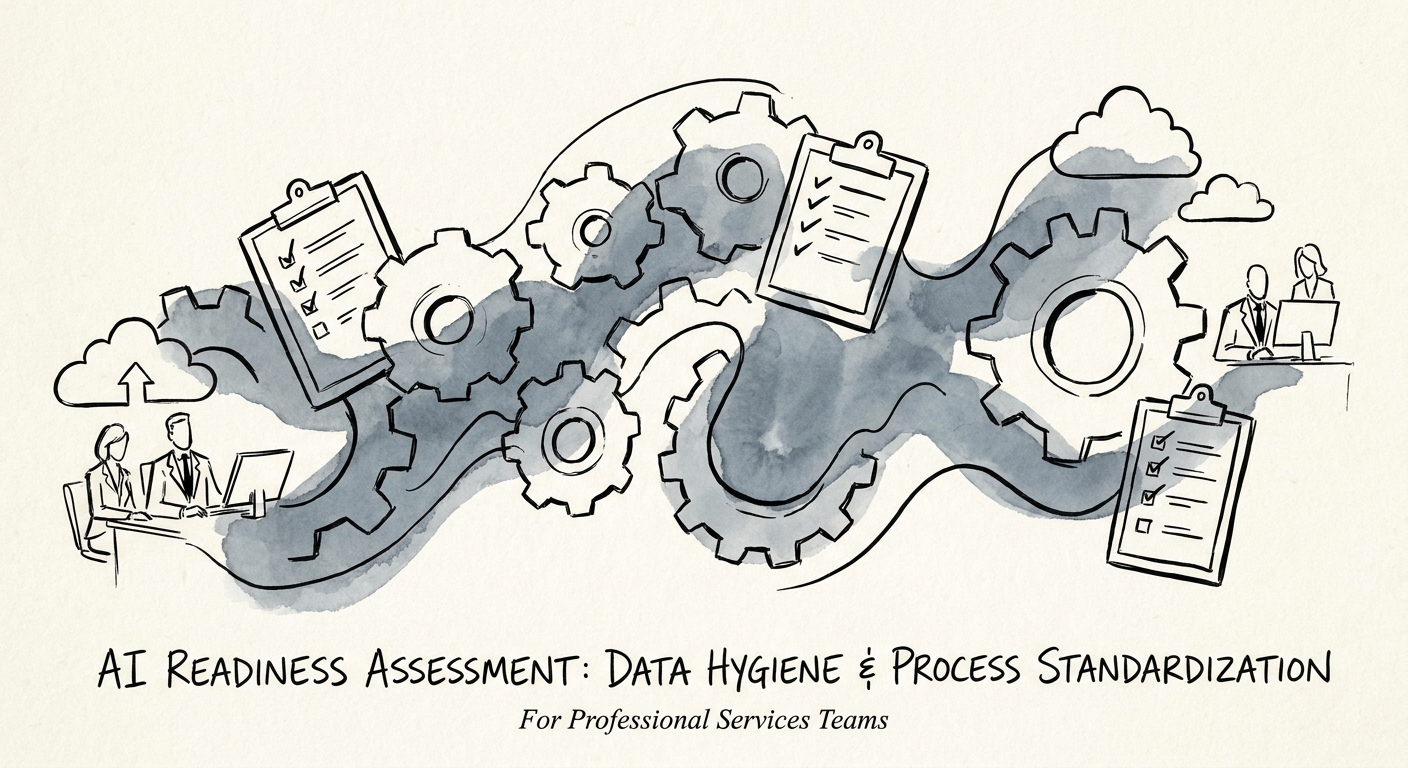
A legitimate AI readiness assessment for a mid-market services firm evaluates three distinct pillars: data hygiene, process standardization, and risk governance. Data hygiene is the most obvious but hardest to fix. If your firm's proposal generation process requires pulling from 14 different folder locations and relying on the tribal knowledge of one specific principal, deploying AI will just help you hallucinate faster. A recent analysis detailed in PwC's 2024 AI Business Predictions reveals that 44% of business leaders say their data isn't ready for AI implementation, which drastically limits their ability to achieve a positive return on investment. You must conduct a thorough data mapping exercise to identify where your most valuable, unstructured text actually lives, and more importantly, who has the rights to view it across the organization.
Taming the Partner Fiefdoms
Process standardization is the second, often fatal hurdle in professional services. Professional services firms bill for expertise, which historically means partners operate as autonomous fiefdoms with highly individualized delivery methods. I have rebuilt this team three times across different portfolios, and the mandate is always exactly the same: if a senior partner and a junior consultant do not agree on what a finished, baseline deliverable looks like, an AI agent certainly will not know. If Partner A demands a forty-page diagnostic deck and Partner B demands a five-page strategic memo for the exact same engagement type, your automation efforts will stall. You cannot automate a workflow that changes every time a different director is assigned to the account. Governance is the final pillar, addressing the very real risk of client data leakage. McKinsey's Global Survey on AI found that a staggering minority—only 23% of organizations—have enterprise-wide AI risk management protocols in place. For a 250-person firm handling sensitive client financials or competitive strategy, a lack of governance is an existential threat. Before scaling any use case, you must establish clear data loss prevention policies and zero-trust access controls, elements we rigorously detail when clients ask about AI Readiness Assessment: What Growing Businesses Should Expect.
When a 250-person firm passes the baseline readiness check, the strategic question immediately shifts to deployment sequencing. The cardinal rule of AI transformation in services is to automate the margin, not the advice. Do not let your pilot programs touch the core advisory work or direct client deliverables first. Instead, target the administrative scaffolding that surrounds the billable hour: contract review preparation, internal knowledge search, RFP response support, and CRM cleanup. By stripping away the non-billable drag, you increase realization rates without risking client trust. MIT Sloan's research on generative AI demonstrates a 40% performance improvement for highly skilled workers when the technology is deployed strictly within its capability boundary—meaning it acts as a synthesizer of known internal information rather than a creator of novel strategy.
The Mandate for 2026
Executing this successfully requires a fundamental shift from viewing AI as a software purchase to viewing it as a core organizational capability. The services firms that win in the next thirty-six months will be the ones that treat AI readiness as a continuous operational discipline rather than a one-time IT project. Deloitte's State of Generative AI in the Enterprise notes that while 79% of leaders expect generative AI to drive substantial transformation within three years, only 27% feel highly prepared to execute on that expectation. That preparation gap is exactly where market share will be won and lost. If you want to dive deeper into specific deployment sequencing to protect your margins, I strongly recommend reviewing The Best First AI Use Cases for Professional Services Firms. The technology is moving entirely too fast for a wait-and-see approach, but deploying without a readiness foundation is just an expensive way to accelerate your own operational chaos. Take the AI Opportunity Score assessment to measure exactly where your 250-person firm stands today, and prioritize the foundational fixes that will actually support enterprise-grade automation.