The practical answer
- Short answer
- Discover why 100-person law firms must automate administrative extraction, not legal advice. Learn how to conduct an AI readiness assessment to protect margins.
- Best fit
- Industry: Professional Services. Function: Operations
- Operating path
- AI Transformation Strategy → AI Transformation
- Key metric
- 63% Of an average attorney's workday is consumed by non-billable, administrative friction.
The average attorney in your 100-person firm bills just 2.9 hours out of an 8-hour workday, leaving a staggering 63% of your payroll consumed by an unbillable administrative tax. We are operating in an environment where partner profits are increasingly squeezed between rising associate compensation and aggressive client pushback on hourly rates. If you are trying to solve this margin collapse by simply demanding more billable hours from exhausted staff, you are playing a losing game. According to Clio's 2024 Legal Trends Report on unbillable hours, administrative friction—spanning intake, document triage, and time entry—is the primary bottleneck destroying law firm profitability across the mid-market.
When assessing AI readiness for mid-market law firms, we see a consistent and dangerous pattern. Managing partners attend a legal technology conference, see an impressive demo of an AI drafting a motion, and immediately try to deploy generative AI for complex legal reasoning. This fails every single time. In our last engagement with an 85-person regional firm, we found that junior associates were burning 14 hours a week just classifying discovery documents, renaming files, and assembling exhibits—not drafting novel legal arguments. When you try to automate advice rather than core operations, you trigger massive hallucination risks, immediate partner resistance, and insurmountable security bottlenecks.
The numbers completely back this up. As noted in Thomson Reuters' 2024 State of the US Legal Market productivity analysis, average billable output per lawyer has declined consistently despite massive financial investments in traditional legal tech. Firms are raising rates to mask this operational inefficiency, a strategy that will rapidly collapse as sophisticated corporate clients deploy their own AI billing algorithms to audit your invoices. Readiness is not about buying an off-the-shelf chatbot; it is about fundamentally restructuring how your firm processes unstructured data before a lawyer ever looks at it. To protect your margins and your practice, you must focus your AI strategy firmly on automating operations, not advice.
When you try to automate advice rather than operations, you trigger massive hallucination risks, immediate partner resistance, and insurmountable security bottlenecks. Fix the administrative tax first.
The Four Dimensions of Law Firm AI Readiness
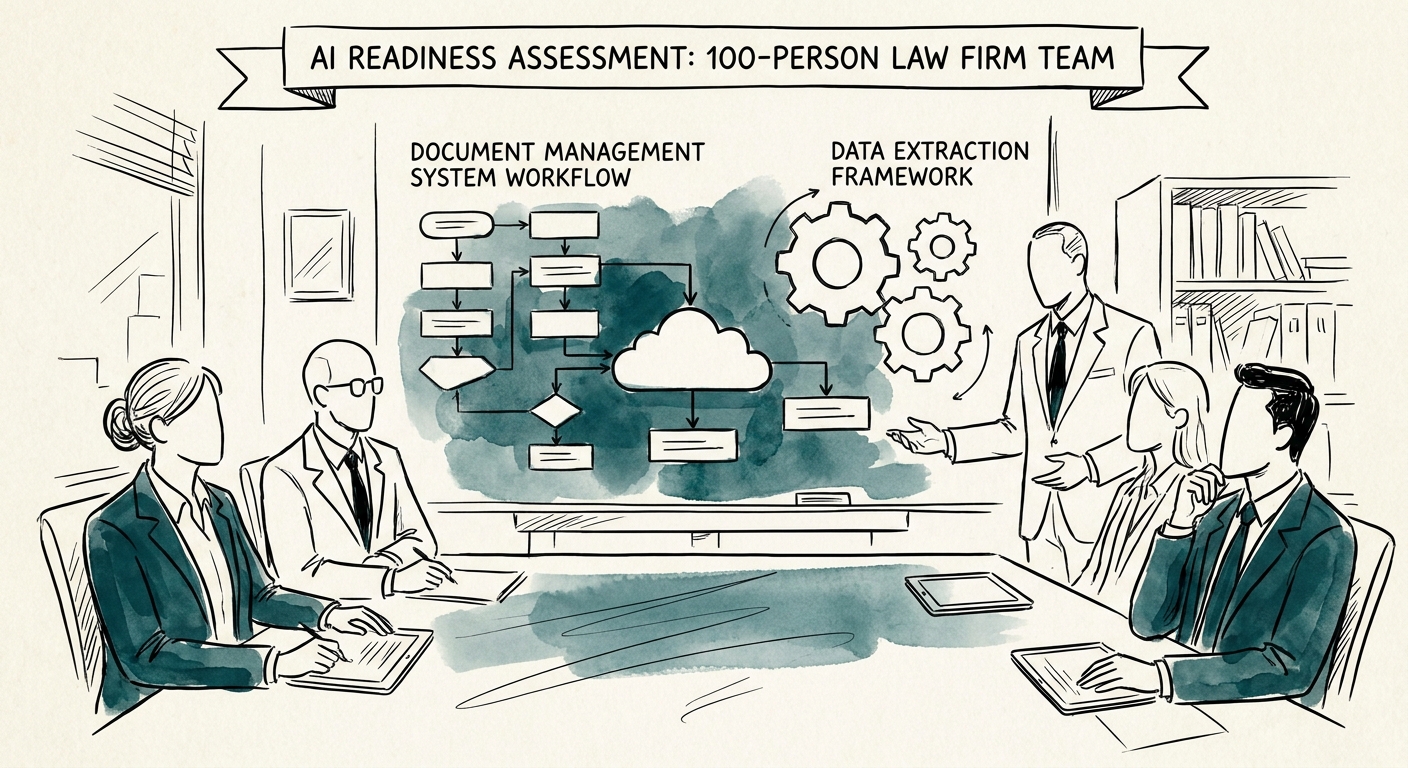
For a 100-person firm, deploying AI effectively requires crossing four specific readiness thresholds: data governance, workflow standardization, talent alignment, and security infrastructure. Most mid-market firms fail at step one. If your document management system (DMS)—whether it is iManage, NetDocuments, or a legacy on-premise server architecture—relies on lawyers manually tagging files into the correct client workspaces, your data is already too polluted to train an AI model. When you plug an enterprise large language model (LLM) into a poorly governed repository, it will inevitably surface privileged information across ethical walls, creating an immediate and devastating malpractice liability.
We mandate a strict data hygiene sprint before any AI implementation moves forward. PwC's 2024 Law Firms' Survey on productivity reveals that relentless pressure on utilization is driving severe lawyer burnout, but those same overwhelmed lawyers will actively subvert new AI tools if they do not explicitly trust the underlying data. We fix the data architecture first. Once governance is definitively established, we move to workflow standardization. You cannot automate a business process that exists only in a senior partner's head. You must meticulously map the exact steps taken during client intake, contract review, and discovery triage before you automate a single touchpoint.
Furthermore, Goldman Sachs' 2023 study on legal task automation predicted that 44% of legal tasks could be automated, but that percentage heavily skews toward administrative extraction rather than textual generation. Your readiness assessment must clearly and ruthlessly separate tasks that require fiduciary judgment from those that merely require basic pattern recognition. If your operations team is spending their days manually moving email attachments into case folders, your readiness score is low, but your operational ROI potential is massive.
Execution: Stop Drafting, Start Extracting
The absolute most successful AI transformations in the legal sector start deep in the back office. Instead of trying to build a robot lawyer to write briefs, you need to build an automated operational scaffold to support your fee earners. Gartner's 2025 benchmark on GenAI use cases in legal operations found that contract visibility and automated data extraction deliver the highest business value with the lowest feasibility risk. This aligns perfectly with our implementation playbook. By using AI to accurately extract key dates, liabilities, and party information from incoming documents, you eliminate the unbillable friction that drains your firm's revenue capacity daily.
This targeted approach requires tremendous operational discipline. We establish a dedicated AI steering committee led by a highly respected, high-billing partner—not just the IT director. When IT forces a new software tool onto the practice groups, adoption stalls entirely. When a high-performing partner proves that a simple extraction workflow saves them three hours of mundane reading per week, the rest of the firm immediately demands access to the same capability. To understand exactly which workflows to target first and why, I strongly recommend reading our detailed guide on the best first AI use cases for law firms.
Your 100-person firm is standing at a critical inflection point in the legal market. You can either continue paying expensive, frustrated attorneys to perform paralegal-level data sorting, or you can leverage a rigorous AI readiness assessment to identify exactly where your profit margin is leaking. Stop running disjointed, unmeasured pilots with generic chatbot tools. Define your rigid security parameters, clean your disparate document repositories, and target high-volume extraction tasks first. To determine exactly where your firm stands today and which specific use case will deliver immediate cash flow relief, take our AI Opportunity Score diagnostic. The firms that operationalize this correctly today will easily absorb the market share of those who refuse to adapt.