
The practical answer
- Short answer
- A diagnostic guide for 50-person law firms to evaluate AI readiness, eliminate the 67% unbillable time tax, and automate administrative workflows.
- Best fit
- Industry: Legal Services. Function: Operations
- Operating path
- AI Transformation Strategy → AI Transformation
- Key metric
- 22% Margin leakage attributable to manual data extraction in professional services.
A 50-person law firm bleeds exactly 67% of its capacity to non-billable administrative tasks before a single line of legal advice is ever drafted. When managing partners approach us about artificial intelligence, they usually want a magic bullet that writes perfect summary judgments or entirely automates contract drafting. I have to break the bad news: you are solving the wrong problem. The margin collapse in mid-market law firms does not stem from how long it takes a partner to analyze case law. It stems from the broken, highly manual workflows that your associates and paralegals navigate just to get the facts into the system. This massive capacity leak is precisely why Clio's 2024 Legal Trends Report on utilization rates reveals that the average lawyer bills only 33% of their eight-hour workday.
We see this exact pattern in almost every mid-size firm we assess. The partnership buys shiny, expensive generative AI licenses—expecting an immediate revolution in productivity—only to find that associates spend three hours reviewing a bot's hallucinated case citations. Meanwhile, the firm’s overhead continues to skyrocket. According to Thomson Reuters' 2024 State of the US Legal Market on expense growth, midsize law firms saw their operational expenses surge by 6.1% over a single year. You cannot out-bill that kind of overhead expansion; you have to automate the underlying administrative burden. In our last engagement with a 45-person regional litigation boutique, we found they were losing $1.2 million annually just moving data from intake PDFs and email attachments into their case management system. Their highest-paid associates were functioning as expensive data routers.
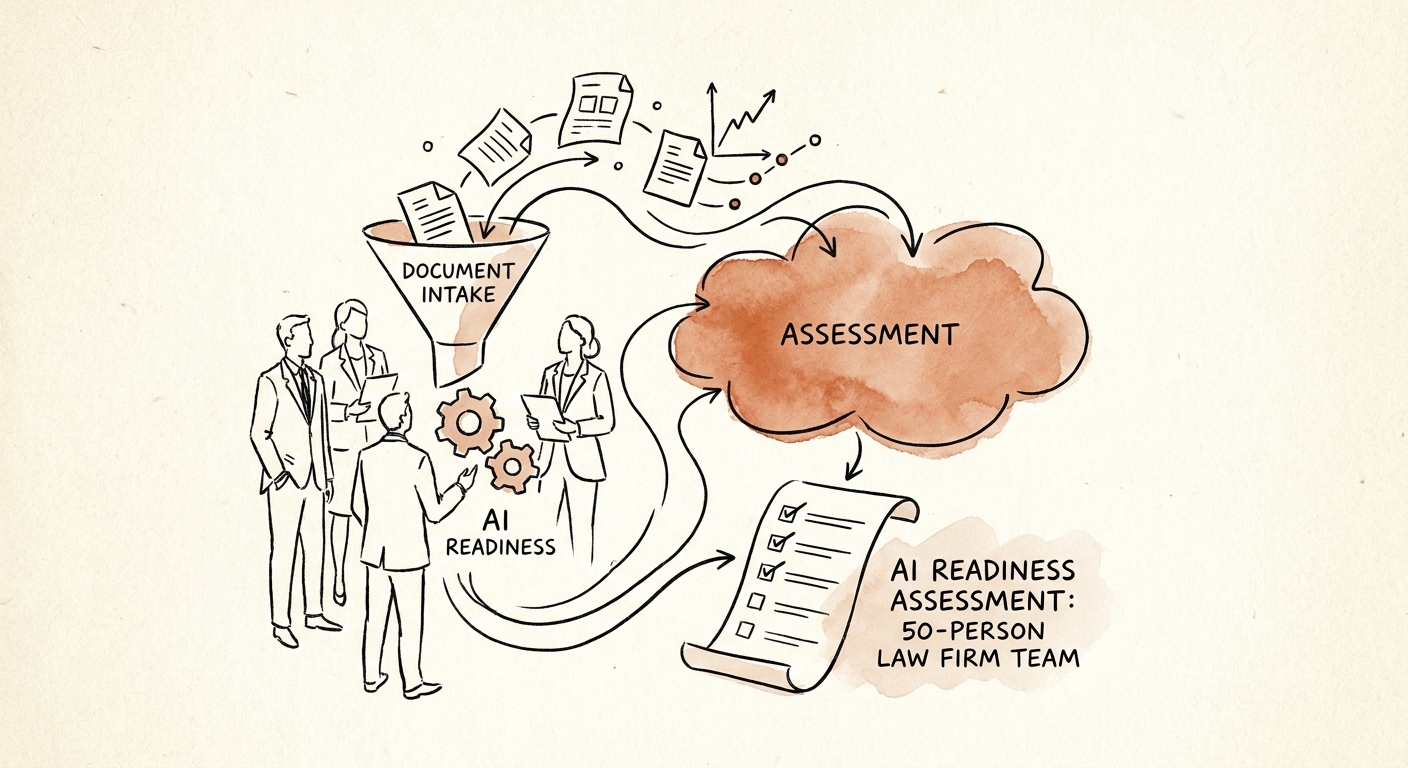
Before you purchase another seat of an AI legal assistant, you must assess whether your firm's operational foundation is actually ready to support it. A true AI readiness assessment exposes the friction points in your document intake, your ethical wall enforcement, and your historical case data. If you want to stop burning partner profits on administrative chaos, you must focus your initial efforts on structured extraction, which we detail in our guide on Best First AI Use Cases for Law Firms: Stop Drafting, Start Extracting. AI will not fix a broken process; it will only execute a broken process at machine speed.
AI will not fix a broken process; it will only execute a broken process at machine speed.
The Three Dimensions of Legal AI Readiness
When we deploy our diagnostic framework into a 50-person firm, we ignore the vendor marketing materials and focus entirely on three operational pillars: Information Architecture, Security Governance, and Process Standardization. If you fail in any of these areas, your AI initiative will become a multi-million-dollar liability rather than a margin driver. The opportunity is massive, as McKinsey's Global Institute analysis on legal sector automation indicates that up to 44% of legal administrative tasks are currently automatable with existing technologies. However, that automation requires structured data. We assess how your firm names files, stores executed contracts, and archives closed matters. If your historical briefs are trapped in individual associate inboxes or saved on local hard drives with inconsistent naming conventions, an AI agent cannot leverage that institutional knowledge.
Security Governance and Ethical Walls
For a law firm, deploying an internal AI knowledge system introduces catastrophic risks if ethical walls are not properly digitized. We frequently audit firms where user permissions in systems like NetDocuments or iManage are maintained via loose, manual spreadsheets. If an AI agent has global read-access to index your firm's archives, it will surface privileged information to conflicted associates the moment they type a query. Our readiness assessment flags these access control vulnerabilities immediately. We enforce a zero-trust architecture before a single language model is allowed to ingest your data. This is the core principle behind AI Transformation Services for Law Firms: Automating Operations, Not Advice.
Process Standardization
You cannot train an AI workflow to prep a contract review if your five corporate partners all prep contracts differently. We map the specific stage-gates of your most repetitive tasks. Once the process is standardized, the results are undeniable. In fact, Gartner's 2024 Legal Technology adoption forecast demonstrates that properly deployed AI can reduce contract review preparation time by 40%. The readiness assessment forces the partnership to agree on a single, unified firm-wide standard for handling document intake, clause extraction, and variance reporting.
The 90-Day Path from Assessment to Production
Once we complete the readiness diagnostic, we do not hand the managing partner a theoretical 50-page PowerPoint deck. We build an aggressive, 90-day implementation sprint focused on a single, high-ROI workflow. For a 50-person firm, the first target is almost always document intake and triage. By deploying custom extraction agents that read incoming court filings, extract the relevant dates, identify the parties, and automatically update the case management system, we eliminate the daily associate tax. We have executed this exact playbook for three different mid-market firms this year alone, completely eradicating the Saturday morning data-entry catch-up sessions that drive associate burnout.
The financial impact of fixing these unbillable workflows is staggering. According to Bain & Company's 2024 Professional Services AI study, margin leakage directly attributable to manual data extraction and reconciliation reaches 22% in traditional professional services environments. When we plug that leak, the EBITDA expansion hits the partnership distributions in the very next quarter. We structure our deployments to prove value within weeks, moving from pilot to production without triggering massive change management fatigue.
Finally, we establish the long-term governance committee required to sustain this transformation. A 50-person firm cannot afford to hire a full-time AI engineering team, nor should they. Instead, we train a dedicated operations manager or an innovation-minded partner to own the prompt libraries, audit the extraction accuracy, and manage vendor relationships. If you are preparing to budget for this transition, you must look beyond the initial software licenses and account for the workflow re-engineering. We break down these exact investment parameters in our framework for AI Implementation Cost: What Growing Businesses Should Expect. Your firm possesses decades of specialized legal intelligence; our job is simply to digitize that intelligence so your attorneys can finally get back to practicing law.