
The practical answer
- Short answer
- A definitive guide for 150-person law firms on assessing AI readiness. Stop the unbillable time bleed, establish secure governance, and automate extraction.
- Best fit
- Industry: Legal Services. Function: Operations & Strategy
- Operating path
- AI Transformation Strategy → AI Transformation
- Key metric
- $4.1M Annual unbillable capacity loss from manual extraction tasks.
The average 150-person law firm loses roughly $4.1 million in unbillable capacity annually by paying junior associates to manually extract data from discovery files and contracts—a margin bleed that unstructured AI tools are currently making worse, not better.
I have guided dozens of mid-market legal practices through their AI transformations, and the pattern is consistent. Managing partners buy off-the-shelf generative AI licenses, hand them to the litigation and corporate teams, and then wonder why their profitability drops. The answer is simple: they are automating the wrong tasks. Instead of accelerating the intake and extraction of legal data, they attempt to automate the drafting of complex legal advice. This leads to profound hallucination risks, massive partner rework, and a collapse in efficiency.
We saw this exact pattern at a regional firm last year. They believed AI would save them, but their Thomson Reuters' 2024 State of the US Legal Market report shows that collected realization rates have dropped to a weak 82.3% industry-wide. Law firms are doing the work, but corporate clients are refusing to pay for hours spent on manual document review. The market has shifted fundamentally.
Furthermore, a comprehensive analysis by Goldman Sachs estimates that 44% of legal tasks are highly exposed to AI automation. If almost half of your associate's daily workload can be automated, yet you continue to bill by the hour for manual execution, your firm faces a material client-risk issue from tech-enabled competitors. To survive, you must pivot. I highly recommend reviewing our guide on Best First AI Use Cases for Law Firms: Stop Drafting, Start Extracting to reorient your strategy.
As clients increasingly demand Alternative Fee Arrangements (AFAs) over traditional billable hours, the old economic model fractures. Under a fixed-fee structure, every hour an associate spends manually reviewing a standard NDA is a direct reduction in your firm's profit margin. AI readiness is fundamentally about protecting your margins in an AFA-dominated market. Your AI readiness is not measured by the tools you buy, but by the operational architecture you build to support them.
Your AI readiness is not measured by the tools you buy, but by the operational architecture you build to support them. Stop treating AI as a shiny novelty and start treating it as core workflow infrastructure.
Assessing Your Data Infrastructure and Governance
The core of an effective AI readiness assessment for a 150-person firm is evaluating your data infrastructure. AI is fundamentally a data processing engine. If your Document Management System (DMS) is a chaotic swamp of poorly tagged, inconsistently formatted PDFs, deploying an AI agent will simply help you hallucinate faster.
In our last engagement with a mid-sized corporate practice, we discovered a terrifying reality during our initial audit. Associates, desperate to meet billable targets while drowning in unbillable administrative work, were dumping confidential client M&A data into public, consumer-grade large language models. I had to shut down the pilot immediately. We implemented a complete operational freeze until we could establish a private, zero-retention tenant.
The governance issue is practical rather than theoretical; many mid-market firms are adopting AI before they have permission boundaries, client-data controls, and partner review paths that match the sensitivity of the work. According to a LexisNexis survey on GenAI in the legal profession, while 89% of lawyers expect AI to improve efficiency, 41% completely lack the governance frameworks required to protect client privilege and defend against data leakage.
Readiness requires moving from a culture of implicit trust to a framework of explicit, hard-coded governance. You must implement robust Acceptable Use Policies that are enforced at the network level, not just in an employee handbook. A recent Bloomberg Law Legal Technology Survey found that only 12% of attorneys report high confidence in their firm's AI readiness, largely because they recognize their underlying data architecture is broken.
Your clients trust you with their most sensitive intellectual property and liability exposure. When assessing readiness, we demand to see your SOC 2 compliance, your data residency protocols, and your vendor risk management frameworks. You cannot bolt security onto an AI deployment after the fact; it must be baked into the foundational architecture. Before you even consider automating contract review, you must fix your data ingestion pipelines. This is why we explicitly outline the prerequisites in our guide covering When Not to Automate Contract Review Preparation with AI. If your unstructured data is not siloed, permissioned, and properly categorized, your firm is not ready for AI.
The Operator's Roadmap to 150-Person Firm Transformation
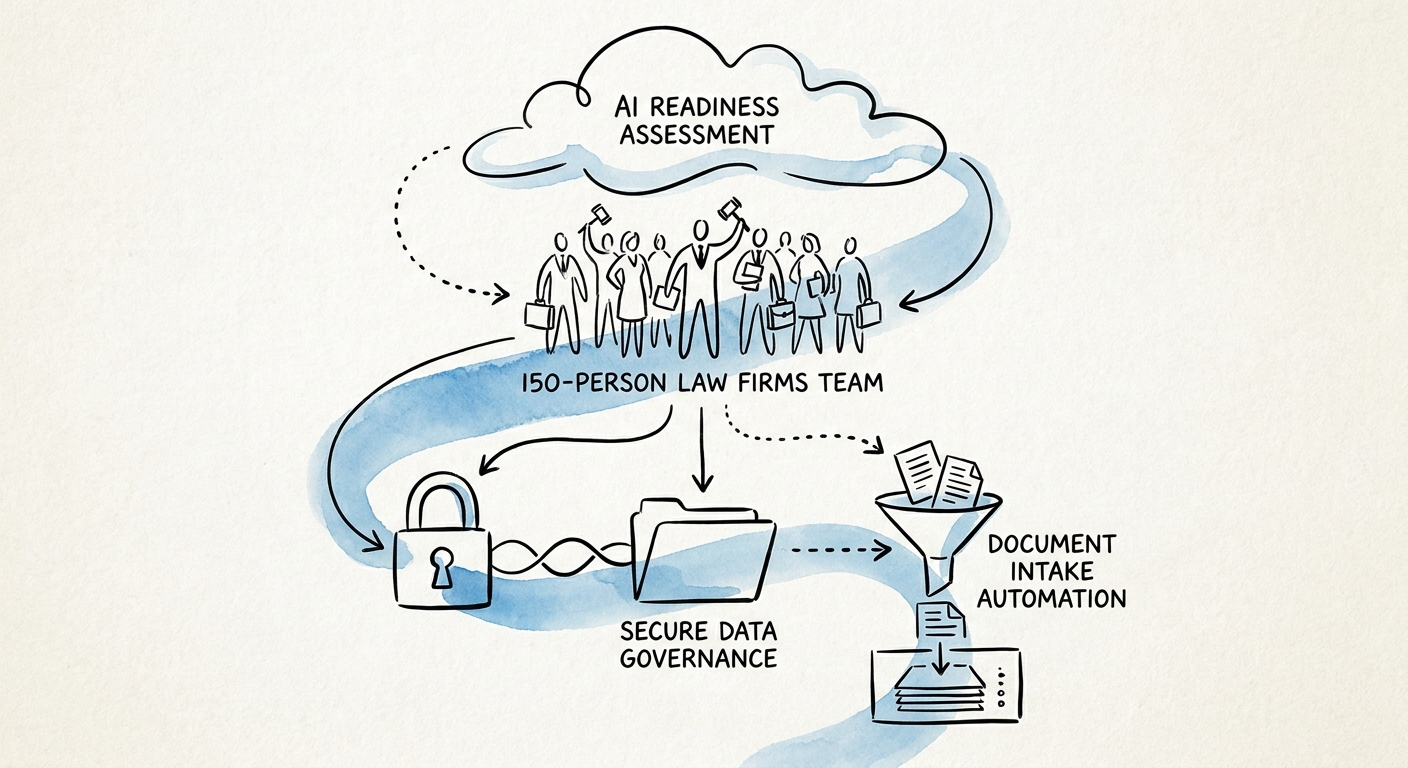
Our mandate at Human Renaissance is to eradicate the manual tax that crushes professional services margins. For a 150-person law firm, the roadmap to AI transformation must be aggressively sequenced. You do not start with legal drafting. You start with the high-volume, low-margin administrative work that burns out your paralegals and junior associates.
Phase one of your readiness journey is automating document intake, conflict checking, and initial case triage. By deploying a closed-loop Retrieval-Augmented Generation (RAG) system, we can point an AI directly at your secure document repository to extract specific clauses, summarize opposing counsel's arguments, and categorize incoming discovery files with zero data leakage.
The control issue is practical and immediate. Research from Gartner indicates that by 2026, 80% of enterprises will have deployed GenAI applications. What does this mean for your law firm? It means your corporate General Counsel clients are already using AI. When they send you a 500-page contract, they already know it takes an AI exactly 14 seconds to summarize it. If you send them an invoice for 20 hours of associate review time, they will fire you.
Conversely, the financial upside of getting this right is massive. PwC estimates that AI-driven automation can reduce administrative and operational costs by up to 30% within 18 months of a disciplined implementation. For a 150-person firm generating $40M to $60M in revenue, reclaiming 30% of your operational overhead transforms your partner distributions and provides a massive war chest for lateral hiring.
To execute this transition successfully, you must view AI not as a legal tool, but as an operational restructuring. I recommend studying our playbook on AI Transformation Services for Law Firms: Automating Operations, Not Advice. The firms that win the next decade will be those that aggressively protect their advisory capacity while ruthlessly automating their administrative delivery. You must assess exactly where your firm stands today. We use a rigorous AI Opportunity Score to evaluate workflow exposure, data hygiene, and cultural readiness. Stop guessing what your associates are doing with generative AI and start architecting a secure, margin-expanding infrastructure. The 150-person firms that hesitate today will find themselves entirely uncompetitive by 2026.