
The practical answer
- Short answer
- Learn how to conduct an AI readiness assessment for your 25-person law firm. Stop the 67% unbillable tax and start automating document extraction and operations.
- Best fit
- Industry: Legal Services. Function: Operations & Practice Management
- Operating path
- AI Transformation Strategy → AI Transformation
- Key metric
- 75% Of billable administrative tasks can be automated with AI
The 67% Unbillable Tax and the Cost of Delay
A 25-person law firm bleeds roughly 67% of its total working capacity into unbillable administrative tasks and manual document handling before a single AI tool is even evaluated. That is the brutal reality of the modern legal practice, hiding in plain sight behind prestigious letterheads and demanding partnership tracks. According to Clio's 2024 Legal Trends Report on billable capacity, the average lawyer bills just 2.6 hours of an 8-hour day. The rest of their time is consumed by client intake, drafting routine correspondence, aggressive context-switching, and manual research. When a firm relies on brute human force to parse through mountains of unstructured data, margins inevitably collapse under the weight of overhead.
In our last engagement with a mid-market litigation boutique, we found that senior associates were spending up to three hours a day just synthesizing deposition transcripts, extracting timelines, and cross-referencing exhibits. It was a massive drag on realization rates, yet the partners were hesitant to adopt automation due to deeply ingrained security fears. But the market isn't waiting for perfection or permission. Thomson Reuters' 2025 Generative AI in Professional Services Report reveals that 26% of legal professionals are already using GenAI at work, almost double the adoption rate from just one year prior.
If your 25-person firm is not aggressively preparing its data and operational workflows for this shift, you are actively choosing a structural cost disadvantage. The firms that survive the next five years will not be the ones that merely experiment with public chatbots; they will be the ones that systematically reconstruct their firm operations to separate bespoke legal strategy from commoditized data processing. To understand where to begin, leaders must look toward the Best First AI Use Cases for Law Firms: Stop Drafting, Start Extracting, focusing on low-risk administrative wins rather than attempting to replace attorney judgment.
Assessing your firm's AI readiness is not about buying enterprise software licenses; it is a rigorous evaluation of your data hygiene, governance frameworks, and workflow standardization.
The Three Pillars of Law Firm AI Readiness
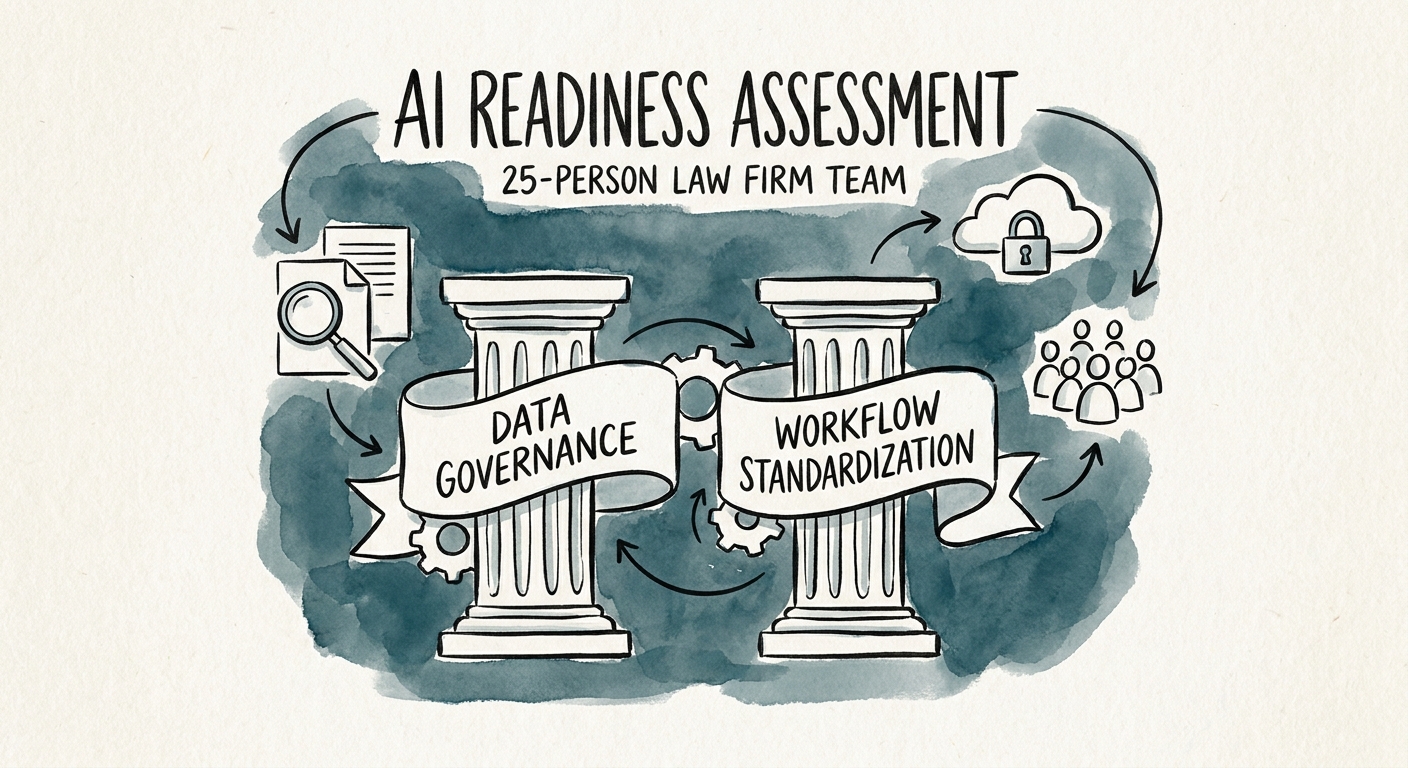
Assessing your firm's AI readiness is not about buying enterprise software licenses or testing a few prompts; it is a rigorous evaluation of your data hygiene, governance frameworks, and workflow standardization. You simply cannot automate a chaotic process. If your client case files are scattered across local hard drives, nested email attachments, and legacy practice management software without a strict, unified naming convention, an AI assistant will fail. Worse, it will hallucinate at scale, feeding your attorneys plausible but entirely fabricated information that could result in court sanctions.
First and foremost, we look at governance and ethical firewalls. Thomson Reuters' 2024 AI policy data found that a shocking 10% of law firms have a formalized policy guiding the use of AI at work. An AI readiness assessment must define strict boundaries for client confidentiality, expressly prohibiting the use of public, consumer-grade LLMs for substantive legal work. You need closed-loop enterprise systems that do not train public models on your proprietary case strategies, ongoing litigation, or sensitive client data.
Second, we assess workflow standardization. Are your paralegals using the exact same intake checklists every time? Are your associates using standardized templates for discovery responses, or is everyone recreating the wheel based on their personal preferences? We consistently see that AI can automate up to 75% of certain routine, repeatable legal tasks—but that efficiency is only unlocked if those tasks follow a predictable, documented pattern. Without process standardization, AI implementation becomes an exercise in automating chaos, resulting in expensive technology that no one trusts enough to actually use. This is why we heavily emphasize AI Transformation Services for Law Firms: Automating Operations, Not Advice, keeping the focus strictly on the operational scaffolding.
Executing the First Use Case: Extraction Over Creation
When a 25-person firm passes the initial readiness threshold, the next crucial step is scoping a high-impact, low-risk first use case. The biggest mistake we see managing partners make is attempting to deploy AI for high-stakes, nuanced legal reasoning right out of the gate. Do not start by asking an AI to draft complex appellate briefs or predict litigation outcomes. Instead, point the technology at your most tedious, repetitive extraction tasks. We build customized workflows that summarize thousands of pages of medical records for personal injury cases in seconds, extract key indemnification clauses from hundreds of vendor contracts during M&A due diligence, and draft initial deposition summaries overnight.
The economic impact of deploying secure AI against these specific operational bottlenecks is profound. Gartner's 2026 Legal AI Productivity Forecast estimates that generative AI will improve legal department productivity by 10% to 20% over the next two to five years by eliminating administrative overhead and duplicative manual effort. For a 25-person legal team, reclaiming even 15% of lost capacity translates to thousands of newly billable hours per year, dramatically reducing the need to hire additional contract attorneys just to handle document review and administrative bloat.
However, realizing this return on investment requires a ruthless focus on change management. Partners must model the new behaviors, and associates must be explicitly trained on prompt engineering specific to legal reasoning and factual extraction. You must incentivize the adoption of these tools by adjusting billable hour targets or rewarding fixed-fee efficiency, otherwise, attorneys will cling to the manual methods they know out of self-preservation. Before you sign a vendor contract for another expensive legal tech solution, take our AI Opportunity Score. It will objectively diagnose exactly which of your firm's workflows are bleeding the most margin, pinpoint your data governance gaps, and give you a clear roadmap for your first 90 days of AI transformation.